

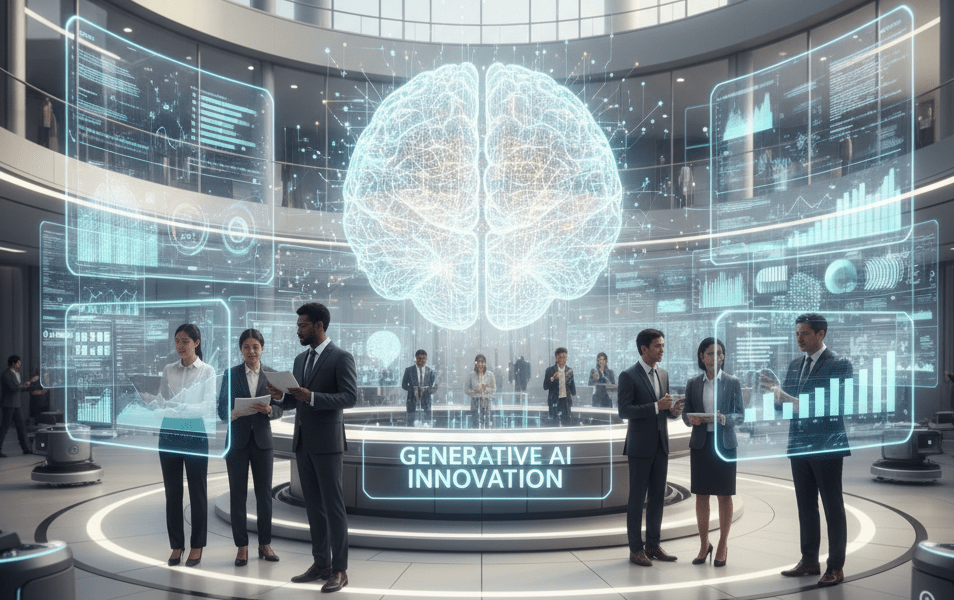
Generative AI has swiftly moved from an experimental technology into a powerful catalyst driving innovation, productivity, and decision-making across industries. While ChatGPT popularized the concept of AI-driven conversations, the underlying technology extends far beyond chatbots. Businesses today are discovering that generative AI is not just a tool for customer service—it’s a transformative force redefining how organizations create, operate, and compete. From automating design and marketing to reimagining supply chains and data analytics, the technology is becoming an indispensable pillar of modern digital transformation. Let’s explore seven transformative ways generative AI is reshaping business operations around the world.
1. Accelerating Content Creation and Marketing Efficiency
In today’s fast-paced digital economy, content is the fuel that powers marketing, branding, and customer engagement. Generative AI tools can now create high-quality blog posts, ad copies, social media visuals, video scripts, and even entire campaign strategies in minutes. This allows marketing teams to scale operations without increasing manpower or cost. Beyond speed, AI-driven personalization is revolutionizing how brands communicate with their audience. Instead of producing one-size-fits-all campaigns, AI models analyze behavioral data, preferences, and purchase patterns to craft personalized content that resonates with individual users. For example, companies like Coca-Cola and Nestlé are experimenting with generative design for hyper-personalized ad creatives, while smaller businesses use tools like Jasper and Copy.ai to maintain a constant flow of SEO-optimized blogs and email campaigns. The result is not only more engaging marketing but also improved conversion rates driven by data-backed insights.
2. Reinventing Product Design and Prototyping
Generative AI is revolutionizing product design by automating the creative process traditionally reserved for human designers. Tools like Autodesk’s Dreamcatcher and Adobe Firefly are helping engineers and artists explore hundreds of design variations in real-time, based on performance metrics, materials, and user requirements. Instead of manually iterating through ideas, designers can input objectives and constraints, and the AI generates optimized prototypes. This drastically shortens the development cycle, reduces design costs, and inspires innovation. In industries like automotive and architecture, generative design is producing lighter, stronger, and more sustainable components that were once impossible to conceive through conventional methods. Tesla, BMW, and Airbus have already integrated such AI-driven design workflows, giving them a clear edge in product performance and sustainability.
3. Transforming Customer Support and Experience Management
Chatbots like ChatGPT may have introduced the public to conversational AI, but the real transformation lies in how businesses integrate these models into end-to-end customer experience systems. Generative AI can now handle multilingual, contextual, and emotionally intelligent conversations, making customer service faster and more human-like. Advanced systems don’t just respond—they anticipate customer needs based on previous interactions, purchase history, and sentiment analysis. Moreover, generative AI enhances self-service experiences, creating dynamic FAQ pages, automated knowledge bases, and real-time support summaries for agents. For global organizations, this means consistent support 24/7 without the traditional constraints of staffing or language barriers. Companies such as Shopify and Zendesk have embedded generative AI into their support systems, leading to a significant drop in resolution time and improved customer satisfaction.
4. Revolutionizing Data Analysis and Decision Intelligence
In the past, decision-making relied on static dashboards and historical data. Today, generative AI introduces a new era of “decision intelligence”—where insights are generated dynamically through predictive modeling and natural language interfaces. Business leaders can now query their data conversationally, asking questions like “What will my sales look like next quarter?” and receive AI-generated visual reports with explanations. This democratizes data access, allowing non-technical teams to extract actionable insights without relying on analysts. Generative AI also simulates multiple business scenarios, helping leaders make data-driven choices with confidence. In finance, logistics, and retail, AI models are helping companies predict demand surges, optimize pricing, and reduce operational costs. Platforms like Power BI with Copilot and Tableau GPT exemplify how AI is turning raw data into strategic foresight.
5. Streamlining HR and Talent Management Processes
Recruitment and human resource management are among the most time-consuming functions in any organization. Generative AI is now automating candidate screening, job description writing, onboarding materials, and even employee performance analysis. Tools like SKYA AI and Paradox use natural language processing to match candidates with organizational culture and skill requirements, drastically cutting hiring times. Beyond recruitment, AI assists in generating personalized learning paths for employees, identifying skills gaps, and recommending relevant training programs. HR teams can use AI-generated summaries for annual reviews or policy updates, ensuring consistency and objectivity in evaluations. As hybrid and remote work environments expand, generative AI also aids in crafting adaptive workforce management strategies, improving engagement and retention.
6. Optimizing Supply Chain and Operations Management
Generative AI is enhancing operational resilience by helping businesses simulate and optimize supply chain processes. By generating “digital twins” of real-world systems, organizations can predict disruptions, evaluate supplier reliability, and simulate alternative logistics strategies before implementing them. AI models analyze millions of variables—from weather conditions and fuel prices to geopolitical risks—to recommend the most efficient routes and inventory levels. For instance, major retailers like Amazon and Walmart use generative AI for demand forecasting and inventory optimization, while manufacturers apply it to production scheduling and energy management. The outcome is reduced waste, faster delivery times, and a more sustainable footprint. The next generation of enterprise resource planning (ERP) systems will likely have built-in generative intelligence, enabling autonomous decision-making across operations.
7. Enhancing Innovation and Strategic Planning
Perhaps the most transformative aspect of generative AI is its ability to fuel innovation itself. Organizations are no longer confined to human brainstorming sessions or static market research reports. AI can generate new product ideas, marketing angles, or business models by analyzing global trends, customer feedback, and competitor data. In strategic planning, executives can use AI co-pilots to simulate market responses to pricing changes, mergers, or product launches. AI-driven scenario modeling allows companies to anticipate opportunities and threats in real-time, transforming long-term strategy into a living, adaptive process. For startups, this means leveling the playing field against larger competitors, while for corporations, it means faster innovation cycles with lower risk.
The Ethical and Governance Perspective
While the benefits of generative AI are vast, they come with critical ethical considerations. Data bias, privacy risks, and misinformation must be actively managed through governance frameworks and transparent AI policies. Companies must ensure compliance with standards like ISO 42001 and GDPR, implement human-in-the-loop validation, and maintain accountability in decision-making. Forward-thinking organizations are now establishing AI governance boards to oversee fairness, transparency, and security across their AI deployments. The goal is to balance innovation with responsibility—ensuring that generative AI amplifies human potential without replacing it.
Conclusion: The Future of Business is Generative
Generative AI represents more than just a technological evolution—it’s a paradigm shift in how businesses think, operate, and grow. It enables companies to move from reactive to proactive decision-making, from generic to personalized engagement, and from rigid workflows to adaptive intelligence. As we move beyond ChatGPT, the future of business will not be about replacing humans with machines, but about augmenting human creativity, speed, and strategy through AI collaboration. The organizations that embrace this partnership early will not only survive but thrive in the age of intelligent automation. The message is clear: the generative AI revolution is here, and it’s redefining the very DNA of business operations—one intelligent prompt at a time.