

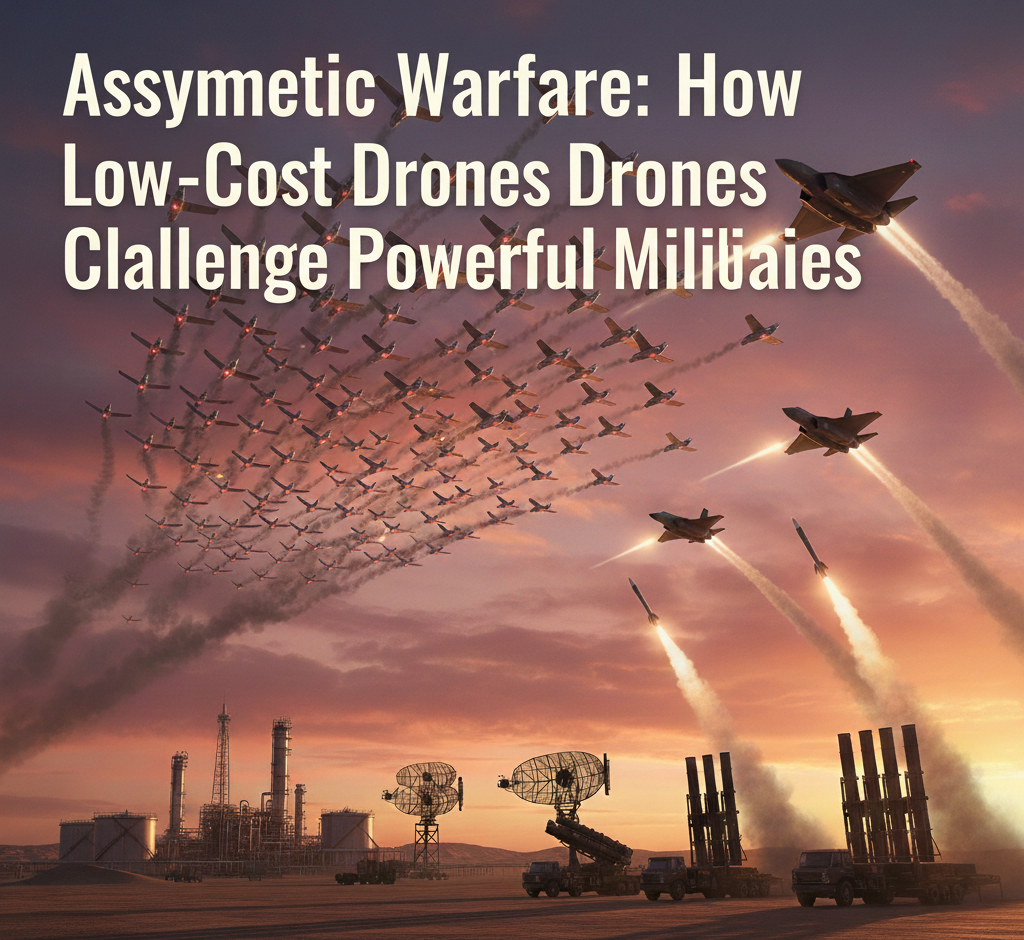
Modern conflicts are no longer fought only with massive armies, advanced fighter jets, and expensive missile systems. Increasingly, wars involve asymmetric strategies, where weaker countries challenge stronger military powers using unconventional and cost-effective tactics. The ongoing tensions between Iran on one side and powers like the United States and Israel illustrate this shift in modern warfare.
Understanding Asymmetric Warfare
In military strategy, asymmetric warfare refers to a conflict where two opposing sides have significantly different military capabilities or resources. Instead of trying to match the stronger power weapon-for-weapon, the weaker side uses alternative tactics, cheaper technologies, and unconventional strategies to offset the imbalance.
Countries with smaller defense budgets often rely on innovation, flexibility, and cost-efficient weapon systems to challenge technologically superior opponents. These strategies can make conflicts unpredictable and significantly more difficult for stronger nations to control.
Military Strength vs Strategic Adaptation
The United States and Israel possess some of the most advanced military technologies in the world. Their defense systems include:
Highly advanced fighter jets
Sophisticated intelligence networks
Long-range missile systems
Extensive defense infrastructure
However, these capabilities come with extremely high costs. A single modern fighter jet can cost tens or even hundreds of millions of dollars, while maintaining large military infrastructures requires billions in annual defense spending.
Iran, by comparison, does not match this level of military spending or technological sophistication. Instead of attempting to compete directly with such expensive systems, it has developed a strategy centered on lower-cost weapons that can still create strategic pressure.
The Role of Low-Cost Drones
One of the most prominent tools in Iran’s asymmetric strategy is the use of relatively inexpensive drones, particularly the Shahed drone family.
These drones can cost anywhere from around $30,000 to several hundred thousand dollars, depending on the model. Even at the higher end, they remain dramatically cheaper than advanced aircraft used by larger militaries.
This cost difference creates a strategic dilemma. When a low-cost drone threatens a high-value target, defending against it can require very expensive interception systems. Over time, repeatedly using expensive defenses against cheap threats can lead to a war of attrition, where the cost of defense outweighs the cost of attack.
Missile Capabilities and Limitations
Iran also deploys various missile systems, including weapons such as the Khorramshahr missile. While these missiles provide significant regional strike capabilities, they are generally not designed for intercontinental range.
Despite these limitations, such missile systems remain effective within regional conflicts. When combined with drones and other low-cost weapons, they contribute to a broader strategy focused on volume, affordability, and persistence.
The Strategy of Attrition
A central element of asymmetric warfare is the idea of attrition through economic imbalance. If a weaker country can attack expensive military systems using much cheaper tools, it can gradually strain the opponent’s defense budget and resources.
For example:
A $30,000 drone may require a multi-million-dollar defense missile to intercept.
Repeated attacks force the defending country to spend heavily just to maintain protection.
Over time, the cumulative cost can become strategically significant.
This economic pressure is one reason asymmetric warfare is considered extremely difficult to defend against.
Challenges for Modern Defense Systems
Many advanced military defense structures were originally designed to counter equally powerful adversaries. These systems anticipated threats such as:
Enemy fighter jets
Strategic bombers
Advanced intelligence operations
Large-scale conventional warfare
However, asymmetric tactics shift the battlefield. Instead of confronting powerful systems directly, weaker forces use smaller, decentralized, and cheaper technologies that are harder to predict and intercept.
This transformation forces militaries to rethink their defense strategies, particularly in the face of drone swarms and precision low-cost weapons.
Regional Impact of Drone Warfare
Iranian drone technology has reportedly been used in attacks across the Middle East. Targets have included locations in countries such as:
Kuwait
Bahrain
Qatar
United Arab Emirates
In some cases, attacks have targeted economic infrastructure or symbolic locations, including oil facilities and commercial sites. The goal is often to create maximum strategic or economic impact with minimal operational cost.
Economic Targets and Strategic Messaging
Another characteristic of asymmetric warfare is the selection of high-impact targets. Rather than focusing solely on military bases, attackers may strike economically critical locations. One frequently discussed example is the Ras Tanura oil terminal in Saudi Arabia, one of the world’s most important oil export facilities.
Strikes on such infrastructure can disrupt energy markets, attract international attention, and exert pressure far beyond the immediate military consequences.
The Future of Asymmetric Conflict
As technology becomes more accessible, asymmetric warfare is likely to become even more common. Drones, cyber capabilities, and precision weapons are increasingly affordable, allowing smaller actors to challenge larger powers in ways that were previously impossible.
For powerful militaries, the challenge lies in developing defense systems that are both technologically effective and economically sustainable. This may involve new strategies such as:
Lower-cost drone interception systems
Electronic warfare and signal disruption
Artificial intelligence for threat detection
Integrated multi-layered defense networks
Conclusion
The evolving dynamics between Iran, the United States, and Israel demonstrate how modern warfare is changing. Instead of relying solely on traditional military strength, conflicts increasingly involve strategic adaptation, cost efficiency, and technological creativity.
Asymmetric warfare highlights an important reality of modern conflict: military superiority does not always guarantee strategic dominance. In an era where relatively inexpensive tools can challenge powerful defense systems, nations must continuously adapt their strategies to keep pace with the changing nature of warfare.