

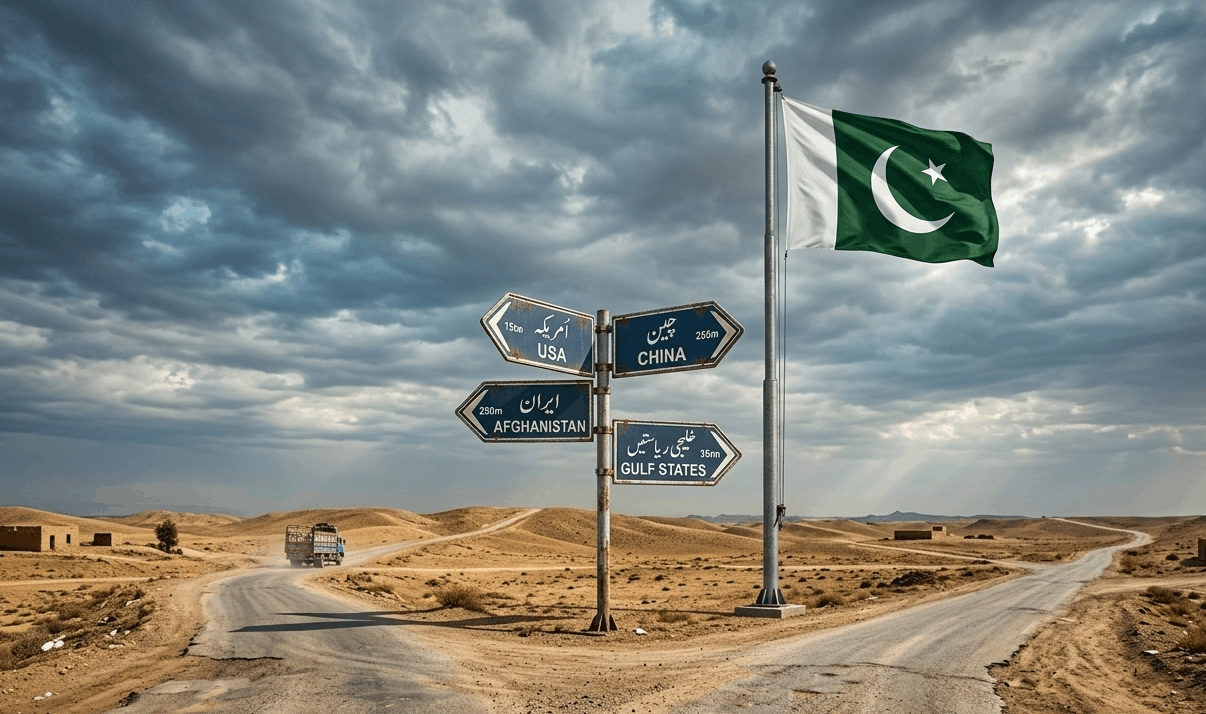
In international politics, when powerful states clash, it is rarely only those states that suffer the consequences. Smaller and mid-level countries often find themselves caught in the middle, forced to maneuver carefully to avoid being crushed. Pakistan today stands precisely in such a position. Surrounded by competing interests and escalating regional tensions, it must perform a delicate diplomatic balancing act.
The situation can be compared to a fight between two powerful bulls. While the world watches the spectacle of the confrontation, it is the grass beneath their feet that gets trampled. Countries like Pakistan represent that grass — not the main combatants, but still deeply affected by the conflict. The challenge becomes deciding where to absorb the blows and where to avoid them altogether.
Pakistan’s foreign policy at the moment resembles a difficult juggling act. It is as if several balls have been thrown into the air simultaneously, and none of them can be allowed to fall. Maintaining relationships with multiple actors, each with conflicting interests, is not a matter of preference but necessity. Any visible displeasure toward one partner could trigger diplomatic or economic consequences.
Meanwhile, frustrations that have accumulated over time often spill over in more manageable directions. Tensions with Afghanistan, for instance, sometimes become an outlet for internal pressure. Yet even this conflict receives limited global attention because far larger geopolitical confrontations are unfolding elsewhere, particularly in the Gulf region.
Another pressing concern for Pakistan is energy security. Oil remains the lifeblood of the global economy, and securing reliable supplies is critical for a country already dealing with economic challenges. Regardless of the difficulties, Pakistan cannot simply step away from this reality. It must continue navigating the complex energy landscape while avoiding diplomatic missteps.
In many ways, Pakistan’s foreign policy operates like a regional marketplace where every visitor expects satisfaction. No customer can be turned away unhappy. Each relationship — whether with global powers, regional neighbors, or economic partners — demands careful management. This task becomes even more difficult when the “marketplace” sits at a busy crossroads where multiple political and economic routes intersect.
At present, the regional environment resembles a severe traffic jam. None of the major players appear willing to yield ground. Global powers, regional rivals, and economic interests all compete for influence, leaving countries like Pakistan to carefully navigate the congestion.
One of the most complicated dimensions of this challenge involves the relationship between the United States and Iran. Washington considers Tehran an adversary, while Iran remains Pakistan’s immediate neighbor. At the same time, the United States continues to play a significant role in Pakistan’s economic and diplomatic calculations. This overlapping web of relationships makes it difficult for Pakistan to openly side with either camp.
Complicating matters further is the Gulf region, where tensions and missile exchanges have raised security concerns. Pakistan cannot ignore these developments because millions of its citizens live and work in Gulf countries such as Saudi Arabia, the United Arab Emirates, Qatar, Kuwait, Bahrain, and Oman. These overseas workers form a crucial pillar of Pakistan’s economy through the remittances they send home.
For this reason, Islamabad must speak carefully and act cautiously. A single miscalculation could affect not only diplomatic relations but also the livelihoods of millions of Pakistani families who depend on overseas employment.
Ultimately, Pakistan’s current foreign policy posture is less about bold declarations and more about careful navigation. In a region where rivalries intersect and crises overlap, the country must balance its relationships while safeguarding its economic interests and regional stability.
This approach may appear restrained, even silent at times. Yet in an increasingly volatile geopolitical environment, restraint itself becomes a strategy. For Pakistan, survival in this complicated neighborhood requires diplomacy that is flexible, calculated, and constantly aware of the shifting forces around it.