

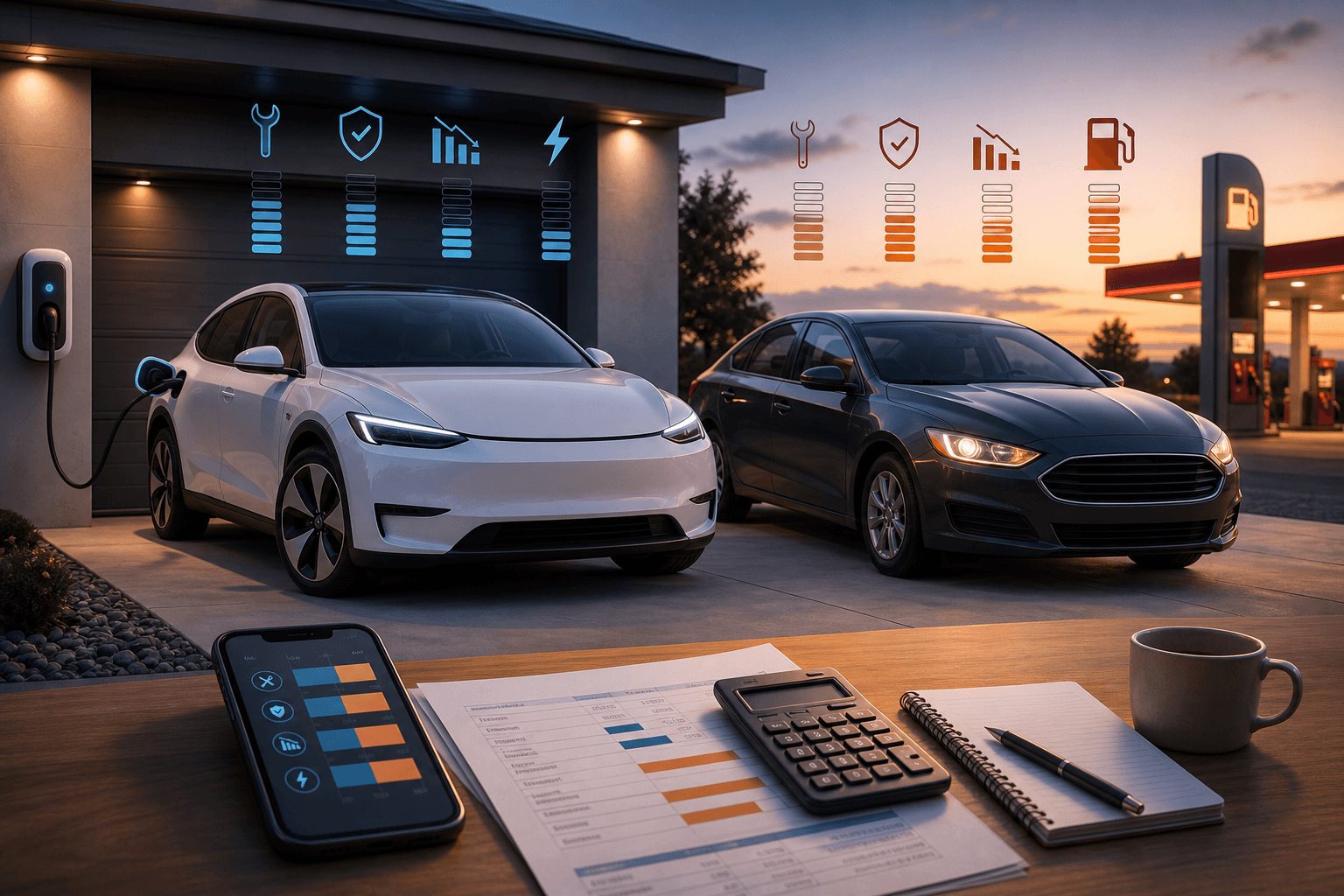
Electric vehicles are becoming a practical choice for drivers who want lower running costs, reduced fuel dependence, and a more efficient driving experience. However, the purchase price of an electric vehicle can still be higher than that of a comparable gasoline-powered car. This raises an important question: are electric cars genuinely cheaper to own?
To answer that question accurately, buyers must look beyond the initial price. The total cost of EV ownership includes the purchase price, financing, depreciation, electricity, maintenance, insurance, taxes, charging equipment, and potential repair expenses. A gasoline car may cost less at the dealership but require considerably more money for fuel and routine servicing over time.
The real financial difference depends on how much you drive, local gasoline prices, electricity rates, available incentives, vehicle efficiency, insurance costs, and how long you plan to keep the car. This guide examines the real numbers behind electric and gasoline vehicle ownership.
What Is the Total Cost of Vehicle Ownership?
The total cost of ownership, also known as TCO, is the complete amount of money spent on a vehicle throughout the ownership period. It provides a more accurate financial picture than the sticker price alone.
The main costs include:
- Vehicle purchase price
- Loan interest or financing charges
- Registration fees and taxes
- Depreciation
- Gasoline or electricity
- Insurance
- Maintenance and repairs
- Home-charger installation
- Resale value
For example, an electric vehicle may cost $5,000 more than a similar gasoline car at the time of purchase. However, the EV could save the owner hundreds of dollars each year in fuel and maintenance expenses. After several years, those savings may recover the higher initial cost.
This point is known as the break-even period. It is the point at which the accumulated operating savings of the EV equal its additional upfront cost.
Electric Vehicle Purchase Price vs. Gasoline Car Price
The initial purchase price is often the biggest disadvantage of an electric car. EV batteries are expensive to manufacture, which can increase the retail price of the vehicle.
Consider a simple example:
- Electric vehicle price: $42,000
- Comparable gasoline car price: $35,000
- Initial price difference: $7,000
At first, the gasoline car appears to be the cheaper option. However, government incentives, manufacturer discounts, tax credits, or local rebates may reduce the effective price of the electric vehicle.
Suppose the buyer receives a $4,000 EV incentive. The adjusted cost of the electric vehicle would be $38,000, reducing the difference to $3,000.
The financing cost must also be considered. A more expensive vehicle usually requires a larger loan, which can result in additional interest charges. Buyers should compare the total amount payable over the loan term instead of focusing only on the monthly installment.
A low monthly payment can sometimes be created by extending the loan period. Although this makes the vehicle appear more affordable, it can significantly increase the total interest paid.
Electricity Cost vs. Gasoline Cost
Energy expenses are where electric vehicles often deliver the greatest savings.
To calculate gasoline costs, divide the annual mileage by the vehicle’s fuel economy and multiply the result by the gasoline price.
Assume a driver covers 12,000 miles per year in a gasoline car that delivers 30 miles per gallon.
The vehicle would consume:
12,000 ÷ 30 = 400 gallons of gasoline per year
At $3.50 per gallon, the annual fuel cost would be:
400 × $3.50 = $1,400 per year
Over five years, the driver would spend approximately $7,000 on gasoline, assuming the fuel price remains unchanged.
Now consider an electric vehicle that consumes 30 kilowatt-hours of electricity per 100 miles.
For 12,000 miles, the vehicle would use:
12,000 ÷ 100 × 30 = 3,600 kilowatt-hours per year
At an electricity rate of $0.15 per kilowatt-hour, the annual charging cost would be:
3,600 × $0.15 = $540 per year
Over five years, the electricity cost would be approximately $2,700.
In this example, the electric vehicle would save around $860 per year and $4,300 over five years in energy costs.
These numbers are illustrative. Actual savings depend on local fuel prices, electricity tariffs, vehicle efficiency, driving conditions, and charging habits.
Home Charging and Public Charging Expenses
Most EV owners achieve the lowest charging costs by charging at home. However, home charging may involve an additional setup expense.
A standard household outlet can charge an electric vehicle, but charging is generally slow. Many owners install a Level 2 charging unit for faster and more convenient charging.
The total installation cost depends on several factors:
- Charger price
- Electrical panel capacity
- Distance between the panel and parking area
- Wiring requirements
- Installation labor
- Local permit requirements
A straightforward installation may be relatively affordable, while a property requiring electrical upgrades may involve a much higher cost.
Public charging can also affect the total cost of EV ownership. Fast-charging stations are convenient for long journeys, but they can cost more than home electricity. Drivers who depend mainly on public fast chargers may experience lower savings than drivers who charge mostly at home.
Before purchasing an EV, buyers should evaluate whether they have reliable access to overnight charging.
Maintenance Costs of EVs and Gasoline Cars
Electric vehicles usually require less routine maintenance because their powertrains contain fewer moving parts.
A gasoline-powered vehicle may require regular services such as:
- Engine oil changes
- Oil-filter replacements
- Spark-plug replacements
- Fuel-system maintenance
- Exhaust-system repairs
- Transmission servicing
- Engine cooling-system maintenance
Electric vehicles do not require engine oil, spark plugs, or exhaust-system repairs. Their electric motors are simpler than internal-combustion engines and generally require less scheduled servicing.
EVs still need maintenance, including:
- Tire replacement
- Tire rotation and alignment
- Brake inspection
- Suspension repairs
- Cabin air-filter replacement
- Battery cooling-system checks
- Windshield-wiper replacement
Electric vehicles can also reduce brake wear through regenerative braking. This system slows the vehicle by using the electric motor to recover energy and send it back to the battery. As a result, the physical brake pads may be used less frequently.
However, EV repairs are not always inexpensive. Damage involving the battery, electronic systems, sensors, or specialized body components can be costly. Repair expenses also depend on parts availability and the number of qualified technicians in the local market.
EV Battery Life and Replacement Costs
Battery replacement is one of the biggest concerns for potential EV buyers. A complete battery pack can be expensive, but buyers should not assume that every EV will need a replacement during normal ownership.
Electric vehicle batteries gradually lose capacity over time. This means the vehicle’s maximum driving range may decrease as it ages. The rate of degradation depends on battery design, climate, charging habits, mileage, and thermal-management systems.
Frequent use of high-speed charging, repeated charging to maximum capacity, exposure to extreme heat, and leaving the battery at very low charge levels for extended periods may influence long-term battery health.
Before buying an EV, review the manufacturer’s battery warranty. Buyers should understand:
- Warranty duration
- Mileage limit
- Minimum capacity guarantee
- Conditions covered
- Exclusions
- Transferability to a second owner
For most buyers, battery warranty coverage is more relevant than the theoretical cost of a complete replacement. However, used-EV buyers should carefully evaluate battery condition because battery health can affect both driving range and resale value.
Insurance and Registration Costs
Insurance costs can be higher for some electric vehicles. This is often related to the vehicle’s purchase price, repair complexity, battery value, and access to replacement parts.
However, insurance rates are highly specific to the individual driver and vehicle. Factors include:
- Driver age
- Driving history
- Location
- Annual mileage
- Vehicle model
- Repair costs
- Theft risk
- Coverage limits
- Deductible amount
The best approach is to obtain insurance quotations for both vehicles before making a purchase decision.
Registration fees and road taxes may also differ. Some regions offer lower registration fees for electric vehicles, while others charge additional EV fees to recover revenue that would normally be collected through gasoline taxes.
These local charges should be included in the total ownership calculation.
Depreciation and Resale Value
Depreciation is often the largest ownership expense, even though owners do not pay it as a monthly bill. It represents the difference between the vehicle’s purchase price and its resale value.
For example, if a vehicle is purchased for $40,000 and sold five years later for $22,000, the depreciation cost is $18,000.
EV depreciation can vary significantly by brand, model, battery range, charging capability, market demand, and technological development. A model with limited range or outdated charging technology may lose value faster than one with strong demand and modern features.
Gasoline vehicles also depreciate, particularly when they have high mileage, poor fuel economy, or expensive repair requirements.
Buyers should research the expected resale value of the specific vehicles being compared rather than relying on general assumptions about electric or gasoline cars.
Five-Year EV vs. Gasoline Car Cost Comparison
The following hypothetical comparison shows how the numbers may work over five years.
Electric Vehicle
- Purchase price after incentives: $38,000
- Five-year electricity cost: $2,700
- Five-year maintenance cost: $2,000
- Home-charger installation: $1,200
- Five-year insurance cost: $9,000
- Estimated resale value: $21,000
Estimated ownership cost:
$38,000 + $2,700 + $2,000 + $1,200 + $9,000 − $21,000 = $31,900
Gasoline Vehicle
- Purchase price: $35,000
- Five-year gasoline cost: $7,000
- Five-year maintenance cost: $4,000
- Five-year insurance cost: $8,000
- Estimated resale value: $19,000
Estimated ownership cost:
$35,000 + $7,000 + $4,000 + $8,000 − $19,000 = $35,000
In this example, the electric vehicle costs approximately $3,100 less to own over five years despite its higher initial price.
The result would change if electricity were more expensive, gasoline were cheaper, the EV had a lower resale value, or the owner relied heavily on public fast charging.
When Does an Electric Vehicle Make Financial Sense?
An electric vehicle is more likely to provide strong financial savings when:
- The driver covers a high annual mileage
- Gasoline prices are high
- Home electricity is affordable
- Home charging is available
- EV incentives reduce the purchase price
- The vehicle is kept for several years
- The EV has strong efficiency and resale value
- Maintenance costs for the alternative gasoline car are high
A gasoline car may still be more economical when:
- The driver covers very few miles
- The EV purchase-price difference is large
- Home charging is unavailable
- Public charging is expensive
- Insurance costs are considerably higher for the EV
- The vehicle will be sold before energy savings recover the upfront premium
The right decision depends on the buyer’s circumstances rather than a universal rule.
How to Calculate Your Own Total Cost of EV Ownership
Start by selecting one electric vehicle and one comparable gasoline model. Use the same ownership period and annual mileage for both.
Calculate the following for each vehicle:
- Purchase price after discounts and incentives
- Total loan interest
- Annual energy or fuel cost
- Expected maintenance and repair expenses
- Insurance premiums
- Registration fees and taxes
- Charging-equipment costs
- Estimated resale value
Subtract the resale value from the total expenses. The remaining amount is the estimated total cost of ownership.
For a more accurate comparison, calculate the cost per mile:
Total ownership cost ÷ total miles driven
This figure allows buyers to compare vehicles with different purchase prices, efficiencies, and resale values.
Final Verdict: Are Electric Cars Cheaper to Own?
Electric vehicles can be cheaper to own than gasoline cars, particularly for drivers who travel regularly, charge at home, qualify for incentives, and keep their vehicles long enough to recover the higher purchase price.
Their main financial advantages are lower energy costs and reduced routine maintenance. Their potential disadvantages include a higher upfront price, charger-installation expenses, insurance differences, uncertain depreciation, and expensive specialized repairs.
The most important lesson is that the purchase price does not determine which vehicle is cheaper. A proper comparison must include every major expense over the planned ownership period.
By calculating the complete total cost of EV ownership, buyers can move beyond marketing claims and make a decision based on realistic numbers, personal driving habits, and long-term financial value.
Frequently Asked Questions
Is charging an electric car cheaper than buying gasoline?
Home charging is often cheaper per mile than fueling a gasoline vehicle. However, the exact savings depend on electricity rates, gasoline prices, vehicle efficiency, and the use of public fast chargers.
Do electric vehicles cost less to maintain?
EVs generally have lower routine maintenance requirements because they do not need engine-oil changes, spark plugs, or exhaust-system repairs. They still require tires, brakes, suspension servicing, and other standard vehicle maintenance.
How long does it take for an EV to pay for itself?
The break-even period depends on the EV’s additional purchase cost and annual operating savings. Divide the upfront price difference by the estimated yearly fuel and maintenance savings to calculate an approximate break-even period.
Does an EV battery need to be replaced regularly?
An EV battery is not a routine replacement item. Batteries gradually lose capacity, but many remain usable for a long period. Buyers should review the battery warranty and assess battery health when purchasing a used EV.
Is an EV worth buying without home charging?
It can be, but the financial and practical benefits may be lower. Buyers who rely primarily on public charging should compare local charging prices, station availability, charging speed, and convenience before purchasing.