

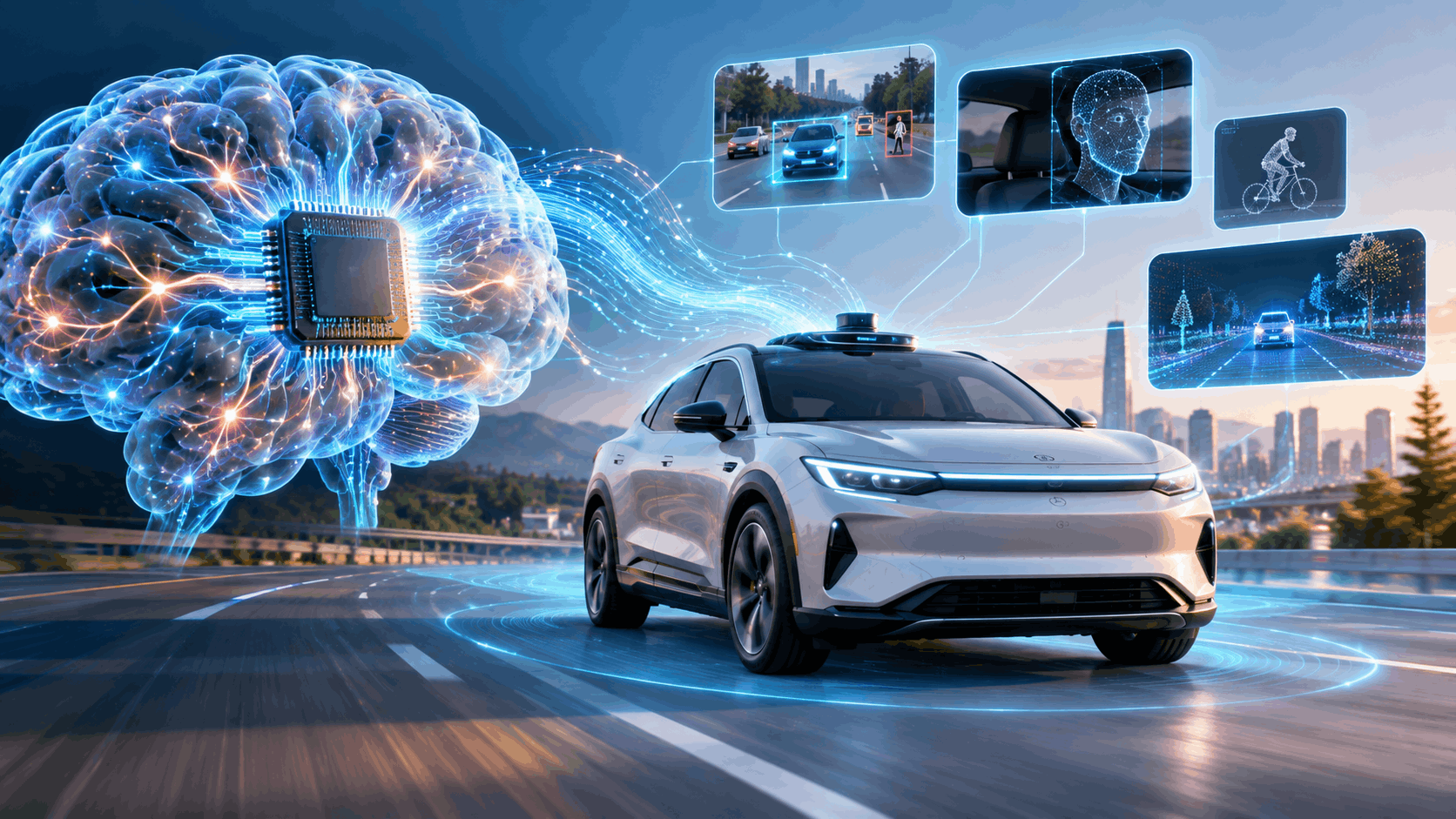
Artificial intelligence is moving out of data centers and into cars, robots, cameras, industrial machines, and other edge devices. This creates a difficult engineering problem: these systems need increasingly powerful AI while also operating within strict limits on electricity consumption, heat, hardware size, and response time.
Neuromorphic computing approaches this problem differently from conventional CPUs and GPUs. Instead of continuously processing large amounts of data using traditional computing architectures, neuromorphic chips take inspiration from biological nervous systems. They can use networks of artificial neurons, event-driven processing, local memory, and highly parallel computation to react when relevant information appears. For cars and edge AI systems that constantly process sensor data, this approach could eventually provide faster responses while consuming less energy.
What Is Neuromorphic Computing?
Neuromorphic computing is a type of computer architecture inspired by how biological neurons and synapses communicate. Traditional processors generally execute instructions and repeatedly transfer data between computing units and memory. Neuromorphic processors attempt to reduce some of this movement by placing computation and memory closer together and organizing processing around networks of artificial neurons.
Many neuromorphic systems use Spiking Neural Networks (SNNs). Instead of continuously transmitting numerical values through every part of a neural network, artificial neurons can communicate through discrete events called spikes. A neuron may remain inactive until relevant input causes it to respond.
This makes the architecture particularly interesting for workloads where information arrives irregularly, such as cameras, microphones, radar, motion sensors, and robotic systems.
How Is Neuromorphic Computing Different From Normal AI Chips?
GPUs and NPUs are designed to perform enormous numbers of mathematical operations efficiently. They are extremely effective for conventional deep learning, generative AI, computer vision, and large language models. However, these architectures still consume energy performing calculations and moving data between memory and processing hardware.
Neuromorphic computing focuses heavily on sparse and event-driven computation. Instead of processing every part of an input continuously, the system can concentrate computational activity on events that actually change.
Intel’s Loihi 2 research processor, for example, uses asynchronous event-based processing, integrated memory and computation, and programmable neural models. Intel says research with Loihi systems has demonstrated significant improvements in efficiency, speed, and adaptability for selected edge workloads. These results do not mean neuromorphic hardware is faster for every AI task, but they demonstrate why the architecture is attracting interest for energy-constrained applications.
For more technical details, see Intel’s official Neuromorphic Computing research.
Why Neuromorphic Computing Could Matter for Cars
Modern vehicles already contain many computers and sensors. Cameras monitor the road, radar detects objects, microphones support voice assistants, sensors monitor the driver, and electronic systems continuously analyze the battery, motors, tires, and surrounding environment.
More advanced vehicles may need to operate several AI systems at the same time. Running powerful processors continuously increases electricity consumption and generates additional heat. In an electric vehicle, every system ultimately draws energy from the battery.
Neuromorphic processors could potentially handle selected always-on tasks using less energy, especially when most incoming sensor information does not require a response. Rather than replacing CPUs, GPUs, and NPUs, neuromorphic chips could become another specialized processor inside future automotive computing platforms.
Event-Based Cameras and Neuromorphic Vision
One of the most promising areas is event-based vision. A traditional camera captures complete frames at fixed intervals, even when most of the image has barely changed. An event camera works differently. Individual pixels can report changes in brightness as they occur.
Imagine a vehicle driving along a relatively stable road scene when a cyclist suddenly moves into its path. Instead of repeatedly processing complete images containing mostly unchanged information, an event-based system can emphasize the rapidly changing parts of the scene.
This approach can provide very high temporal resolution while generating less redundant information. Combined with neuromorphic processing, it could be useful for high-speed object tracking, motion detection, robotics, and some autonomous-driving perception tasks.
Traditional cameras would still be important because they provide detailed visual information such as colors, signs, traffic lights, lane markings, and object appearance. Event cameras are therefore more likely to complement existing automotive cameras rather than replace them completely.
Lower-Power AI at the Edge
Energy efficiency is particularly important for edge AI. A data center can use large power supplies and sophisticated cooling systems, but a small embedded device has much tighter limits.
Consider a camera that monitors an environment continuously. Most of what it sees may remain unchanged for long periods. Processing every pixel of every frame through a large neural network can waste energy.
An event-driven system can potentially remain mostly inactive until meaningful changes occur. This ability to reduce unnecessary computation is one of the main reasons neuromorphic computing is being explored for intelligent sensors, robotics, autonomous systems, and other always-on devices.
The benefit depends heavily on the workload. Conventional processors can still be more appropriate when calculations are dense, predictable, and continuous.
Faster Local Processing Without the Cloud
Edge devices often need to respond immediately. A vehicle detecting an obstacle cannot depend on sending data to a remote cloud server and waiting for an answer.
Neuromorphic systems are designed for local processing, which could help reduce latency and network dependence for certain applications. Processing information directly inside a car also means raw sensor information does not always need to leave the vehicle.
This could be useful for driver monitoring, gesture recognition, audio detection, motion sensing, and other applications where fast local responses matter.
Cloud AI would still remain important for tasks such as large-scale data processing, complex searches, software updates, fleet analysis, and computationally intensive AI.
Driver Monitoring and Cabin AI
Driver-monitoring systems increasingly use cameras and sensors to detect distraction, head position, eye movement, and other signals. These systems may need to operate continuously while the vehicle is being driven.
That makes them suitable candidates for low-power event-driven processing. A small neuromorphic system could potentially monitor basic patterns and activate more computationally expensive AI when something unusual occurs.
Similar approaches could be used for passenger detection, gesture recognition, security monitoring, voice activity detection, and smart cabin systems.
Instead of keeping the most powerful processor fully active for every sensor input, vehicles could distribute workloads across different specialized processors.
Neuromorphic Computing and Autonomous Driving
Autonomous and advanced driver-assistance systems combine information from cameras, radar, positioning systems, ultrasonic sensors, and sometimes lidar. Processing all of these streams in real time requires substantial computing power.
Neuromorphic computing could potentially assist with specific perception and sensor-processing workloads because event-driven architectures naturally respond to information as it arrives.
However, neuromorphic technology should not be confused with a complete autonomous-driving computer. Driving systems also require conventional computer vision, mapping, planning, prediction, control software, and highly validated safety systems.
Neuromorphic hardware is therefore more likely to complement existing automotive processors than independently control an autonomous vehicle.
Could Neuromorphic Chips Run Generative AI?
Neuromorphic computing is not simply a more efficient way to run every existing AI model.
Large language models and generative AI systems rely heavily on large matrix operations, workloads that GPUs and modern AI accelerators handle extremely well. Neuromorphic architectures are currently more closely associated with sparse processing, sensory workloads, optimization, adaptive systems, and spiking neural networks.
Choosing between smaller AI models and large language models is another design consideration for cars and edge devices.
This could change as research advances, but the likely future is heterogeneous computing. A vehicle or edge device could contain a CPU for general software, a GPU or NPU for conventional neural networks, and a neuromorphic processor for specialized event-driven workloads.
The goal would not be choosing one type of chip for everything, but assigning each task to the architecture that can perform it most efficiently.
Continuous and Adaptive Learning
Another interesting area of neuromorphic research is continuous learning. Most deployed AI systems are trained beforehand and then use the resulting model for inference. Updating the model normally requires additional training.
Biological nervous systems continuously adapt as new information arrives. Neuromorphic researchers are investigating systems that can modify connections and learn locally from changing inputs.
For edge devices, this could eventually allow AI to adapt without repeatedly sending large datasets to cloud infrastructure.
Automotive use would require strict controls, particularly for safety-critical systems. Allowing driving software to modify itself without predictable validation would create serious safety challenges. Continuous learning would therefore likely appear first in lower-risk applications such as personalization, sensor calibration, or adaptive interfaces.
Challenges of Neuromorphic Computing
Neuromorphic computing remains an emerging technology. One major limitation is software maturity. Developers have decades of tools and experience working with conventional processors, while neuromorphic programming models and frameworks are still developing.
Spiking neural networks also have a smaller software ecosystem than conventional deep learning. Existing neural networks cannot always be moved directly onto neuromorphic hardware without redesigning or converting parts of the model.
Another challenge is proving that neuromorphic systems provide enough real-world benefit to justify additional automotive hardware. GPUs, NPUs, and other accelerators are also becoming more energy-efficient every generation.
Safety and reliability create another barrier. Automotive electronics must operate consistently under heat, vibration, cold, electrical interference, and other demanding conditions. Any neuromorphic processor used for important vehicle functions would need extensive validation.
The Future of Neuromorphic Computing in Cars and Edge AI
Neuromorphic computing represents a different philosophy of AI hardware. Instead of improving performance mainly by performing more operations, brain-inspired architectures attempt to reduce unnecessary computation and respond efficiently when meaningful events occur.
That approach fits many requirements of future automotive and edge AI systems: low power consumption, fast local response, continuous sensor processing, and reduced dependence on cloud infrastructure.
Neuromorphic chips could eventually support event-based vision, driver monitoring, intelligent sensors, robotics, anomaly detection, and other always-on functions inside vehicles. They are unlikely to completely replace CPUs, GPUs, or NPUs. Instead, future computing platforms may combine several processor types and automatically send each workload to the hardware best suited to handle it.
Neuromorphic computing is still developing, but as vehicles and edge devices process increasingly large amounts of sensor data, improving AI may require more than simply building larger processors. Brain-inspired chips offer another possibility: making computers more efficient by changing when, where, and how they process information.