

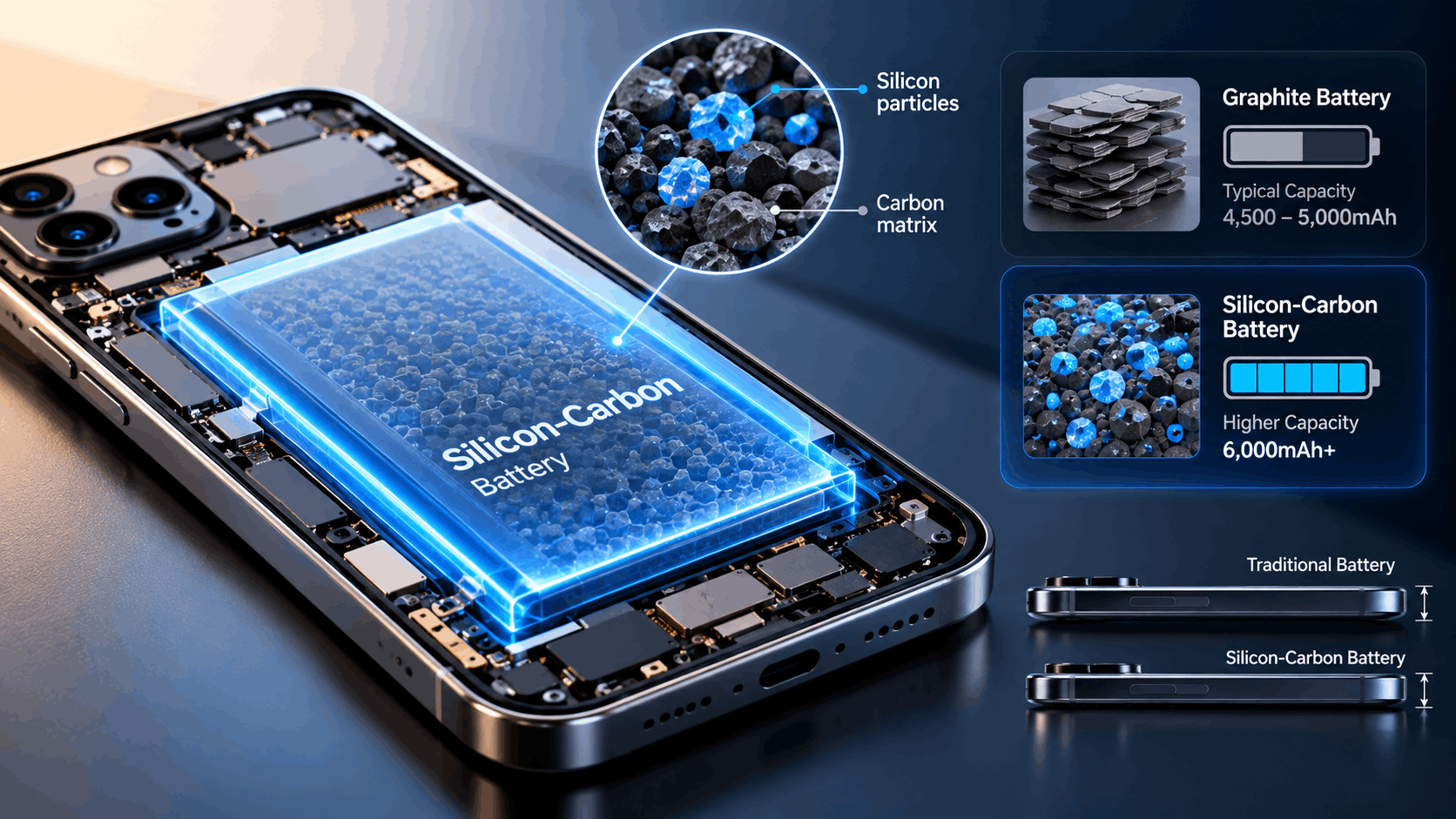
Smartphones have become more powerful without becoming dramatically thicker. Larger displays, brighter screens, high-performance processors, advanced cameras, 5G connectivity, and on-device AI all require more energy, yet manufacturers have limited physical space available for the battery. For years, this created a difficult trade-off between battery capacity and phone thickness.
Silicon-carbon phone batteries are helping change that equation. By incorporating silicon into the battery anode instead of relying almost entirely on graphite, manufacturers can store more energy within a similar physical volume. This is helping modern smartphones move beyond traditional battery capacities while maintaining relatively slim designs.
Silicon-carbon technology does not mean phones have abandoned lithium-ion batteries. These are still lithium-ion cells. The important change is happening in one of their key internal components: the anode.
What Is a Silicon-Carbon Phone Battery?
A lithium-ion battery contains several important components, including a cathode, anode, electrolyte, and separator. During charging, lithium ions move from the cathode toward the anode, where they are stored. During discharge, the ions move back while electrons flow through the device and provide electrical energy.
For decades, graphite has been the dominant material used in lithium-ion battery anodes. Graphite is stable, relatively inexpensive, well understood, and capable of surviving many charging cycles. Its disadvantage is that there is a limit to how much lithium it can store.
Silicon can store substantially more lithium per unit of material than graphite. A silicon-carbon anode therefore combines silicon with carbon-based materials to increase capacity while attempting to control some of silicon’s weaknesses.
In smartphones, the goal is straightforward: fit more battery capacity into the limited internal space available.
Why Silicon Can Increase Battery Capacity
The advantage of silicon comes from how it interacts with lithium during charging. Silicon can accommodate substantially more lithium than graphite, giving it a much higher theoretical specific capacity.
That does not mean replacing graphite with silicon instantly creates a battery several times better. Battery performance depends on the entire cell, including the cathode, electrolyte, separator, packaging, and safety systems. However, increasing the capacity of the anode can still contribute to higher overall cell energy density.
This can allow smartphone manufacturers to pursue two different strategies. They can fit more milliamp-hours into approximately the same battery volume, or they can achieve a familiar battery capacity using a thinner battery.
Both approaches are valuable in smartphones, where every millimeter of internal space matters.
Why Isn’t Every Battery Made From Pure Silicon?
Silicon has a major problem: expansion.
When silicon absorbs lithium during charging, its volume can increase dramatically. It then contracts again when lithium leaves during discharge. Repeating this expansion and contraction can damage the material, break electrical connections, and destabilize interfaces inside the battery.
This is one of the main reasons commercial batteries generally use silicon in combination with carbon rather than replacing the entire graphite-based anode with pure silicon.
A detailed review published in Nature Energy explains that although silicon offers high capacity, practical silicon-containing batteries must overcome challenges including electrode swelling, cycle life, safety, cost, and maintaining stable performance over time.
For a deeper technical explanation, see Nature Energy’s review of silicon-containing lithium-ion batteries.
What Does the Carbon Do?
Carbon helps make silicon more practical.
In a silicon-carbon composite, carbon materials can provide electrical conductivity and help create a structure capable of accommodating some of the expansion caused by silicon. Different manufacturers use different structures, particle sizes, coatings, binders, and silicon concentrations.
Instead of treating the anode as one solid block of silicon, engineers attempt to create structures that allow silicon to expand while maintaining electrical contact with the rest of the electrode.
This engineering is one of the reasons the term silicon-carbon battery can describe several different implementations rather than one standardized chemistry.
The percentage of silicon used can also vary significantly between battery generations.
How Silicon-Carbon Batteries Allow Bigger Smartphone Batteries
Consider two smartphones with almost identical internal dimensions. If one battery can store more energy per unit of volume, the manufacturer can potentially increase battery capacity without needing a much larger battery compartment.
This is particularly important because the battery competes for space with cameras, speakers, cooling systems, wireless charging coils, vibration motors, antennas, and increasingly powerful processors.
Higher volumetric energy density can therefore make capacities above 6,000mAh or 7,000mAh more practical in designs that previously might have required much thicker bodies.
The important improvement is not the number printed on the battery specification by itself. It is the ability to increase capacity without increasing physical size at the same rate.
Does More mAh Always Mean Better Battery Life?
No. Battery capacity is only one part of smartphone battery life.
A 7,000mAh smartphone does not automatically last exactly 40% longer than a 5,000mAh phone. Power consumption varies depending on the processor, display size, refresh rate, modem, signal strength, operating system optimization, cameras, background applications, and how the phone is used.
Battery capacity is measured in milliamp-hours (mAh), but comparing only mAh can also become misleading when battery voltage differs. Watt-hours provide a more complete measurement of stored energy.
Still, when two similar phones have comparable hardware and efficiency, additional battery capacity generally gives manufacturers more energy to work with and can improve practical endurance.
Silicon-Carbon Batteries and Thin Phones
Higher energy density is particularly useful for thin smartphones and foldable devices.
A manufacturer developing a very thin phone faces a difficult choice. Reducing battery thickness can lower capacity, but leaving a thick battery inside defeats the goal of making the device slim.
A higher-density silicon-carbon battery can reduce this trade-off by storing more energy within a thinner cell.
This does not remove all design limitations. Foldable phones, for example, still require hinges, multiple displays, structural reinforcement, and complex internal layouts. But improved battery density gives engineers more flexibility when distributing space inside the device.
What About Charging Speed?
Silicon-carbon chemistry does not automatically determine smartphone charging speed.
Fast charging depends on many factors, including cell design, charging voltage, battery temperature, current limits, charger technology, thermal management, battery-management software, and how aggressively the manufacturer wants to protect battery longevity.
Silicon-based anodes also introduce additional engineering challenges because charging behavior influences expansion and degradation.
A phone can therefore have a silicon-carbon battery without offering unusually high charging power, while another phone may combine silicon-carbon technology with very fast charging.
Battery capacity and charging speed should be evaluated separately.
Do Silicon-Carbon Batteries Last Longer?
Not necessarily.
Higher energy density and longer battery lifespan are different goals. Silicon’s expansion problem can actually make maintaining long cycle life more difficult if the anode is poorly designed.
Modern silicon-carbon batteries use material engineering intended to control this degradation, but longevity still depends on the specific battery rather than simply whether silicon is present.
Temperature remains especially important. High temperatures can accelerate chemical degradation in lithium-ion batteries regardless of whether the anode contains additional silicon.
Charging frequently at extreme temperatures, leaving a battery hot for long periods, or repeatedly operating it under stressful conditions can influence long-term capacity retention.
Are Silicon-Carbon Batteries Safer?
Silicon-carbon should not automatically be described as safer or less safe than conventional graphite-based smartphone batteries.
Battery safety depends on the complete cell design, including cathode chemistry, electrolyte, separator, manufacturing quality, charging controls, thermal monitoring, enclosure design, and battery-management system.
Silicon-carbon describes primarily an anode innovation, not an entirely separate battery chemistry.
A well-engineered silicon-carbon battery can meet smartphone safety requirements, but the presence of silicon alone does not determine the safety of the finished device.
Silicon-Carbon vs. Traditional Graphite Batteries
The easiest way to understand the difference is that traditional lithium-ion batteries generally rely heavily on graphite to store lithium on the anode side, while silicon-carbon designs introduce more silicon to increase the anode’s storage capability.
Graphite has the advantage of excellent maturity, predictable behavior, and long-established manufacturing. Silicon-carbon offers the opportunity for higher energy density but requires additional engineering to control expansion and degradation.
For smartphones, that trade-off can be worthwhile because physical space is extremely valuable. Even a moderate increase in energy density can allow manufacturers to increase battery capacity while keeping the device comfortable to hold.
Will Silicon Completely Replace Graphite?
Probably not in the near term.
The more realistic direction is gradually increasing the amount of silicon while improving the materials surrounding it. Battery manufacturers are developing new carbon structures, binders, coatings, electrolytes, and particle designs that allow higher silicon content without sacrificing too much cycle life.
Future batteries may therefore contain progressively more silicon rather than suddenly switching from graphite to a pure silicon anode.
This gradual approach allows manufacturers to improve energy density while using production techniques that can still meet smartphone requirements for lifespan, cost, charging performance, and reliability.
The Future of Silicon-Carbon Phone Batteries
Smartphone battery development is increasingly about energy density rather than simply making batteries physically larger. Consumers want longer battery life, but they also want thinner phones, larger cameras, brighter displays, faster processors, and more advanced features.
Silicon-carbon technology provides manufacturers with another way to balance those competing requirements.
As silicon content and material engineering improve, smartphones could continue moving toward larger battery capacities without equivalent increases in thickness and weight. Foldable devices and compact flagship phones could benefit even more because they operate under particularly strict space constraints.
The biggest achievement of the silicon-carbon phone battery may therefore not be reaching one specific capacity such as 7,000mAh. It is removing some of the physical limitations that kept smartphone batteries within roughly the same capacity range for years.
Future phones may continue increasing battery capacity, but the more important story is what happens inside those batteries: storing more energy in less space.