

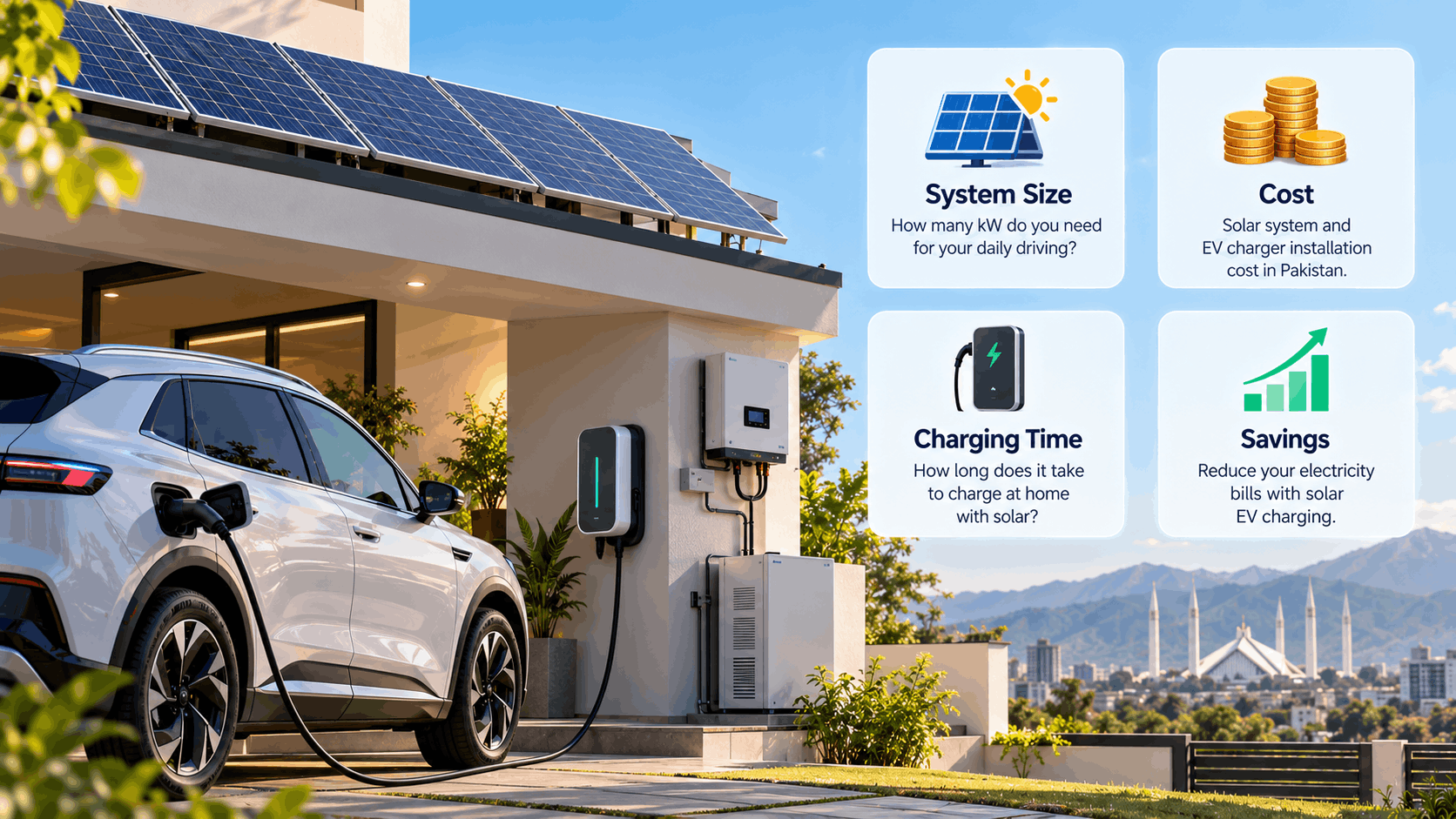
As electric vehicles become more common in Pakistan, solar-powered home charging is becoming an attractive option for EV owners. Pakistan receives strong sunlight across much of the country, while many homeowners are already installing rooftop solar systems to reduce their electricity bills. Combining the two can allow an EV to use locally generated electricity instead of relying entirely on the grid or public charging stations.
However, solar EV charging in Pakistan is not as simple as installing a few panels and connecting the car directly to them. The correct setup depends on how far you drive each day, your EV’s battery size and efficiency, the charger’s power, your household electricity consumption, available roof space, and whether you want battery backup.
This guide explains how to size a solar system for an EV, approximate costs, charging times, potential savings, and what Pakistani homeowners should consider before installation.
How Does Home EV Charging With Solar Work?
In a typical home solar installation, solar panels generate DC electricity. A solar inverter converts that electricity into AC power that can be used by household appliances and an AC EV charger.
The basic flow is:
Solar panels → Solar inverter → Home electrical system → EV charger → Electric vehicle
The car does not normally connect directly to the solar panels. Instead, the solar installation supplies electricity to the home’s electrical system, and the EV charger draws power from that system.
If your panels are producing 5 kW while your house is consuming 1 kW, approximately 4 kW remains available for other loads such as EV charging. If the charger requires more power than the solar system is producing, the additional electricity can normally come from the grid in a grid-connected setup.
How Much Electricity Does an EV Need?
Battery capacity is measured in kilowatt-hours (kWh), but you usually do not need to recharge the entire battery every day.
Suppose an EV consumes approximately 16 kWh per 100 km.
If you drive 50 km per day:
50 km × 16 kWh ÷ 100 = 8 kWh
The vehicle would therefore require roughly 8 kWh to replace the energy used for driving, before allowing for charging losses.
At 30 km per day, the requirement could be around 5 kWh, while 100 km of daily driving might require roughly 16 kWh.
Actual consumption can be higher or lower depending on the vehicle, speed, air-conditioning, temperature, traffic, terrain and driving style.
This is why daily kilometres are often more useful than total battery size when sizing solar specifically for EV charging.
What Size Solar System Do You Need for an EV?
A common mistake is assuming that a 60 kWh battery requires a huge 60 kW solar installation. It does not.
You need enough solar generation to replace the electricity you normally consume each day.
For example, consider an owner who drives about 50 km daily and needs roughly 8–9 kWh of electricity after accounting for charging losses. A relatively small amount of additional solar capacity could generate that energy across a sunny day.
But your EV is not the only load in your house.
Air conditioners, refrigerators, fans, water pumps, lights, computers and other appliances also consume solar generation. Therefore, a practical residential installation might look more like this:
| Daily EV Driving | Approx. EV Energy | Solar Capacity to Consider* |
|---|---|---|
| 20–30 km | 3–5 kWh | 1–2 kW additional solar |
| 40–60 km | 6–10 kWh | 2–3 kW additional solar |
| 80–100 km | 13–18 kWh | 3–5 kW additional solar |
*These are planning estimates for the EV portion only, not the entire household. Actual solar output changes with location, season, panel orientation, weather, shading and system losses.
If your household already requires a 5 kW system before buying an EV, for example, you might eventually find that a 7–10 kW installation better matches the combined load.
Is a 5 kW Solar System Enough for an EV?
For many households, 5 kW can contribute significantly to EV charging, particularly when daily driving is moderate.
The important distinction is between solar-system capacity and EV-charger capacity.
You can have a 7 kW EV charger connected to a home with 5 kW of solar. The charger does not necessarily need to receive all 7 kW from solar continuously. If the solar installation is producing 4 kW and the charger is drawing 7 kW, a grid-connected system can potentially supply the remaining demand.
Alternatively, a smart charger can be configured in some installations to reduce charging power according to available solar production.
5 kW vs. 10 kW Solar for EV Charging
A 5 kW system can make sense for a smaller household with moderate electricity use and relatively low daily EV mileage. A 10 kW system provides considerably more generation capacity and can be more suitable for larger homes with air conditioning, multiple heavy loads and an EV that travels substantial distances.
Do not choose the system based only on the car. Look at your household’s annual electricity consumption plus the expected electricity required by the EV.
Oversizing purely to export large amounts of electricity should also be considered carefully because Pakistan’s rules and economics for exported rooftop solar electricity can change.
How Much Does a Solar EV Charging Setup Cost in Pakistan?
There is no single price because the EV charger is only one component. Costs depend on solar capacity, inverter type, panel brand, electrical protection, installation quality and whether batteries are included.
As of 2026, Pakistani market prices can vary significantly between installers. Current market surveys place complete residential systems across broad ranges depending on configuration; for example, a 5 kW on-grid installation can cost several lakh rupees, while hybrid systems with lithium storage cost substantially more. You can compare current panel, inverter and installed-system prices through this Pakistan solar market price tracker.
For EV owners, the total project can include solar panels, an on-grid or hybrid inverter, mounting structure, DC/AC protection, wiring, earthing, EV wall charger and installation work.
If you already have adequate rooftop solar, adding EV charging can be considerably cheaper because you may only need the charger, electrical protection and installation.
Do You Need a Solar Battery to Charge an EV?
Not necessarily.
This is one of the biggest potential cost savings when designing the system.
If your EV is parked at home during daylight hours, solar electricity can be used while it is being generated. A large stationary lithium battery is therefore not required solely to charge the car.
If your vehicle is away during the day and only returns at night, the situation changes. Solar panels are no longer generating electricity when you plug in.
A hybrid system with battery storage can store daytime solar energy for later use, but installing enough stationary battery capacity to charge a large EV battery can become expensive.
For many households, it may make more financial sense to use solar for daytime household consumption and charge the EV from the grid at night rather than installing a very large battery purely for the vehicle.
How Long Does Home EV Charging Take?
Charging time depends primarily on the car’s battery, how much energy needs replacing, the onboard AC charger and the wallbox.
Consider a 60 kWh EV charging from 20% to 80%. That means approximately 36 kWh must be added.
A rough comparison is:
| Home Charger | Approx. Time for 36 kWh* |
|---|---|
| 3.3 kW | 11–12+ hours |
| 7 kW | 5–6 hours |
| 11 kW | 3.5–4 hours |
*Approximate figures before variations caused by charging losses and vehicle limitations.
A 7 kW wallbox is therefore powerful enough for overnight charging for many EV owners. An 11 kW charger can be faster, but the vehicle must support 11 kW AC charging and the property needs a suitable electrical connection.
Can You Charge an EV Directly During Peak Solar Hours?
Yes, and this can be one of the most effective ways to maximize self-consumption.
Suppose your rooftop system is producing 6 kW around midday and your house is consuming 1.5 kW. Approximately 4.5 kW is available for other loads.
A smart EV charger could potentially adjust charging according to this surplus instead of pulling substantial additional electricity from the grid.
At the grid level, AI for smart grids can help balance EV charging and renewable energy.
This approach is particularly useful for people who work from home, have a second vehicle, operate a business from their property, or leave their EV parked during daytime hours.
How Much Money Can Solar EV Charging Save?
The simplest calculation is:
EV electricity used per month × grid electricity cost per kWh = potential electricity cost being offset
Suppose your EV consumes 240 kWh per month. If your effective electricity cost were Rs. 50 per kWh, charging that energy entirely from the grid would represent:
240 × Rs. 50 = Rs. 12,000 per month
If a significant portion can instead come from surplus rooftop solar, that grid purchase can be reduced.
This does not mean the electricity is literally free. The solar installation has an upfront cost, maintenance requirements and eventual equipment replacement. But once the system exists, using your own solar generation can have a much lower marginal cost than purchasing the same amount of electricity from the grid.
Use your actual electricity tariff rather than Rs. 50 when calculating your own savings because tariffs, taxes and billing structures vary.
Solar EV Charging vs. Public Fast Charging
Home solar charging and public DC fast charging serve different purposes.
Public fast chargers are useful during motorway trips or when you need energy quickly. Home charging is generally designed around convenience: plug the car in while it is parked and allow several hours for charging.
EV battery preconditioning matters for fast charging because battery temperature affects how quickly an EV can accept energy.
Solar makes this model even more attractive because the vehicle can consume electricity generated on the same property.
For someone driving 30–60 km each day, there may be little reason to repeatedly charge from 10% to 100%. Replacing the electricity used during normal daily driving is usually enough.
Is Solar EV Charging Worth It in Pakistan?
The economics are particularly attractive when the house already has solar or when the owner was planning to install solar regardless of the EV.
A homeowner starting from zero needs to calculate the complete system cost rather than treating solar electricity as free. Roof space, daytime parking, household consumption, driving distance and grid electricity prices all influence the result.
For many Pakistani households, the most practical setup may be rooftop solar + grid connection + a properly installed AC wallbox, without installing an enormous stationary battery solely for the EV.
As electric vehicles and rooftop solar continue to grow in Pakistan, the two technologies complement each other naturally. An EV increases household electricity consumption, while solar provides a way to generate a significant portion of that energy at home.
The key is proper sizing. Calculate how many kilometres you drive, estimate the EV’s daily kWh requirement, add existing household consumption, and then design the solar installation around actual energy use rather than simply buying the largest system available.