

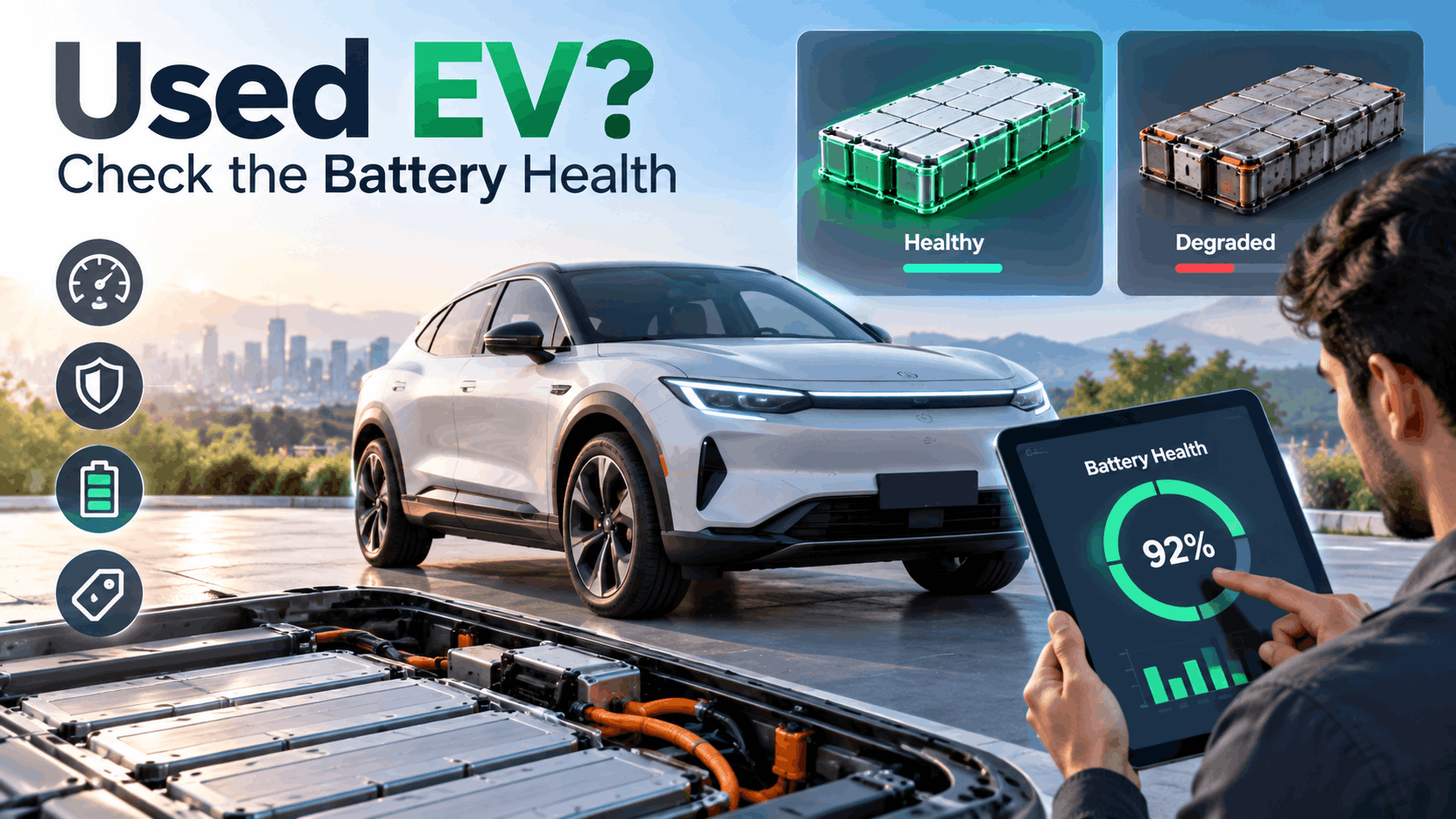
Buying a used electric vehicle is different from buying a used petrol or diesel car. Mileage, service history, accident records, tires, suspension, and overall condition still matter, but an EV adds another major factor: the condition of its high-voltage battery.
The EV battery State of Health, usually shortened to SOH, gives buyers an indication of how much usable battery capacity remains compared with when the battery was new. A used EV can look perfect and have relatively low mileage, yet its battery condition may differ from another car of the same age. Understanding battery health can therefore help you estimate real-world range, identify possible problems, and make a more informed decision before buying a used electric car.
What Is EV Battery State of Health?
Battery State of Health is a measurement used to describe how an EV battery has aged relative to its original condition. It is commonly expressed as a percentage. A new battery would normally start near 100% SOH, while that percentage gradually declines as the battery ages and loses usable capacity.
A simplified way to understand it is:
Battery SOH = Current usable battery capacity ÷ Original usable battery capacity × 100
For example, if an EV originally had 60 kWh of usable capacity and can now store approximately 54 kWh under comparable conditions, its capacity-based State of Health would be around 90%.
Geotab similarly defines battery SOH using current usable battery capacity compared with original usable capacity, although manufacturers and diagnostic systems may use different methods to calculate or estimate the figure.
For a technical explanation of the calculation, see Geotab’s EV battery State of Health documentation.
Why Battery Health Matters When Buying a Used EV
The battery is directly connected to one of the most important characteristics of an electric car: how far it can travel between charges. As usable capacity decreases, the vehicle generally has less energy available for driving.
Suppose two identical EVs originally offered similar battery capacity. One battery has retained significantly more usable capacity than the other. Even if both vehicles have similar mileage, the healthier battery may provide better real-world range and potentially greater long-term usefulness.
Battery condition can also influence the value of a used EV. Buyers should therefore evaluate battery health alongside the vehicle’s age, mileage, condition, charging capabilities, remaining battery warranty, and asking price rather than relying on odometer readings alone.
Battery Degradation Is Normal
All lithium-ion EV batteries degrade gradually. This does not automatically mean something is wrong with the car.
Battery cells experience chemical changes as they age and go through charging cycles. Over time, these changes reduce the amount of energy the battery can store. Temperature, battery chemistry, calendar age, charging behavior, operating conditions, and thermal management can all influence degradation.
Importantly, degradation is not always linear. Some batteries may lose a small amount of capacity relatively early and then degrade more slowly. Different EV models and battery chemistries can also age differently.
This means a five-year-old EV should not automatically be rejected because its battery is no longer at 100% health. The more useful question is whether its remaining capacity, range, condition, and warranty are appropriate for its age and price.
Don’t Rely Only on the Dashboard Range
One common mistake when inspecting a used EV is looking at the estimated range shown on the dashboard after a full charge and treating that number as a direct battery-health measurement.
It isn’t.
The estimated range displayed by an EV is influenced by recent driving efficiency, speed, weather, cabin heating or air conditioning, terrain, wheel and tire configuration, and software calculations. A car that was recently driven aggressively may show a lower estimated range even when its battery is healthy.
Similarly, a vehicle driven efficiently in mild weather could display an impressive range estimate despite having experienced some battery degradation.
Dashboard range can provide useful information, but it should be considered alongside other battery-health checks rather than used as the only test.
Check Whether the EV Shows Battery SOH
Some electric vehicles provide battery-health information through the vehicle’s diagnostic system, dashboard, service menu, manufacturer application, or dealership diagnostic software.
If a State of Health percentage is available, ask the seller for it. Ideally, obtain a battery report from an authorized service center or a diagnostic system capable of reading the battery-management system.
Be careful when comparing SOH values between different brands. Manufacturers may calculate battery health differently, and some systems expose more detailed battery information than others.
A reported 90% SOH should therefore be interpreted within the context of that specific model rather than assumed to be directly comparable with every other EV.
Use Diagnostic Data Where Possible
The vehicle’s Battery Management System, or BMS, continuously monitors battery voltage, temperature, charging, energy usage, and many other parameters. Diagnostic tools can sometimes access useful information from this system.
AI for EV battery health uses machine learning to predict range, aging, and potential battery failures.
Depending on the vehicle, an EV-specific diagnostic scan may reveal estimated SOH, usable capacity, cell-voltage differences, battery temperatures, fault codes, charging history, or other indicators.
Generic OBD scanners may not provide all of this information. Some vehicles require brand-specific software or specialized EV diagnostic tools.
For an expensive used EV purchase, paying for a professional inspection from someone experienced with that particular model can be worthwhile, especially if the vehicle does not provide a clear battery-health report itself.
Check for Battery Cell Imbalance
Overall capacity is not the only thing worth examining. Battery packs contain many individual cells or groups of cells, and ideally they should behave relatively consistently.
A diagnostic scan may identify unusually large differences between cell voltages. Significant imbalance can potentially indicate a weak cell, damaged module, calibration issue, or another battery problem.
Small voltage differences are normal, and interpreting cell data requires technical knowledge. Buyers should therefore avoid diagnosing a battery from one isolated measurement and instead have suspicious readings evaluated by an EV technician.
The presence of battery-related warning lights, charging errors, repeated power limitations, or stored high-voltage system faults deserves further investigation before purchase.
Test the Car’s Real-World Energy Consumption
A test drive can provide additional information, especially when combined with the vehicle’s energy-consumption display.
Start with a known battery percentage, drive the vehicle for a meaningful distance under normal conditions, and observe how much battery percentage is consumed and how much energy the vehicle reports using.
This will not provide a laboratory-quality State of Health measurement because temperature, traffic, speed, terrain, and driving style affect consumption. However, unusually rapid battery depletion can give you a reason to investigate further.
For a more accurate capacity assessment, specialist battery tests can estimate how many usable kilowatt-hours the battery currently stores rather than relying only on the percentage displayed by the vehicle.
Check DC Fast-Charging Performance
A DC fast-charging session can reveal useful information about the vehicle’s charging system and battery behavior.
If possible, arrive at a compatible charger with the battery at a relatively low state of charge and at an appropriate temperature. Check whether the vehicle charges normally and whether its charging performance is broadly consistent with expectations for that model.
Remember that charging speed alone is not a State of Health test. A battery can charge slowly because it is cold, hot, already at a high state of charge, connected to a limited charger, or following the vehicle’s normal charging curve.
However, repeated charging errors or abnormally low performance under suitable conditions may justify a more detailed inspection.
Check the Battery Warranty
Before buying any used EV, verify the remaining high-voltage battery warranty.
Battery warranties commonly have separate limits based on vehicle age and mileage, and some manufacturers also guarantee a minimum amount of battery-capacity retention. The exact terms differ significantly by manufacturer, model, country, and model year.
Do not assume that every EV battery is covered for the same number of years or that every warranty guarantees the same SOH level.
Check the vehicle identification number and warranty documentation directly with the manufacturer or authorized dealer. Also confirm whether the warranty transfers to subsequent owners and whether any exclusions apply.
Ask Whether the Battery Has Been Repaired or Replaced
A battery replacement is not necessarily a negative. In some cases, a used EV may have received a newer battery under warranty, which could significantly improve its value.
Ask the seller whether the battery pack, individual modules, battery-management components, charging hardware, or thermal-management system have ever been repaired or replaced.
Request service records where possible. If a battery was replaced, find out when it happened and whether the replacement was a new, refurbished, or remanufactured unit.
You should also check for outstanding recalls or manufacturer service campaigns related to the battery.
What Is a Good Battery State of Health?
There is no universal percentage that defines whether every used EV battery is “good” or “bad.”
A relatively new vehicle would normally be expected to retain more capacity than a much older EV. Battery chemistry, mileage, climate, vehicle design, and intended use all matter.
An SOH of 90%, for example, broadly means a capacity-based measurement estimates that around 90% of the original usable battery capacity remains. That does not mean the battery has only 90% of its life remaining.
Likewise, a battery below a particular percentage is not automatically unusable. What matters is whether the remaining capacity provides sufficient range for the buyer and whether degradation appears normal for that vehicle.
Used EV Battery Checklist
Before paying for a used electric car, check the battery SOH or usable capacity, remaining battery warranty, diagnostic fault codes, cell balance where available, real-world range, DC fast-charging operation, battery repair history, recall status, and high-voltage system warning lights. Combine those findings with the normal used-car checks for accident damage, suspension, tires, brakes, service history, electronics, and ownership records.
No single measurement should determine the purchase.
The Bottom Line
Checking EV battery State of Health should be one of the most important steps when buying a used electric car. Mileage alone cannot tell you how much usable battery capacity remains, and the dashboard’s range estimate is not a substitute for a proper battery assessment.
The strongest approach is to combine a reliable SOH or usable-capacity measurement with diagnostic data, warranty information, service history, charging performance, and a real-world test drive.
A used EV does not need a perfect 100% battery to be a good purchase. What matters is understanding exactly what condition the battery is in, how much practical range remains, and whether that condition is reasonable for the vehicle’s age and price.