

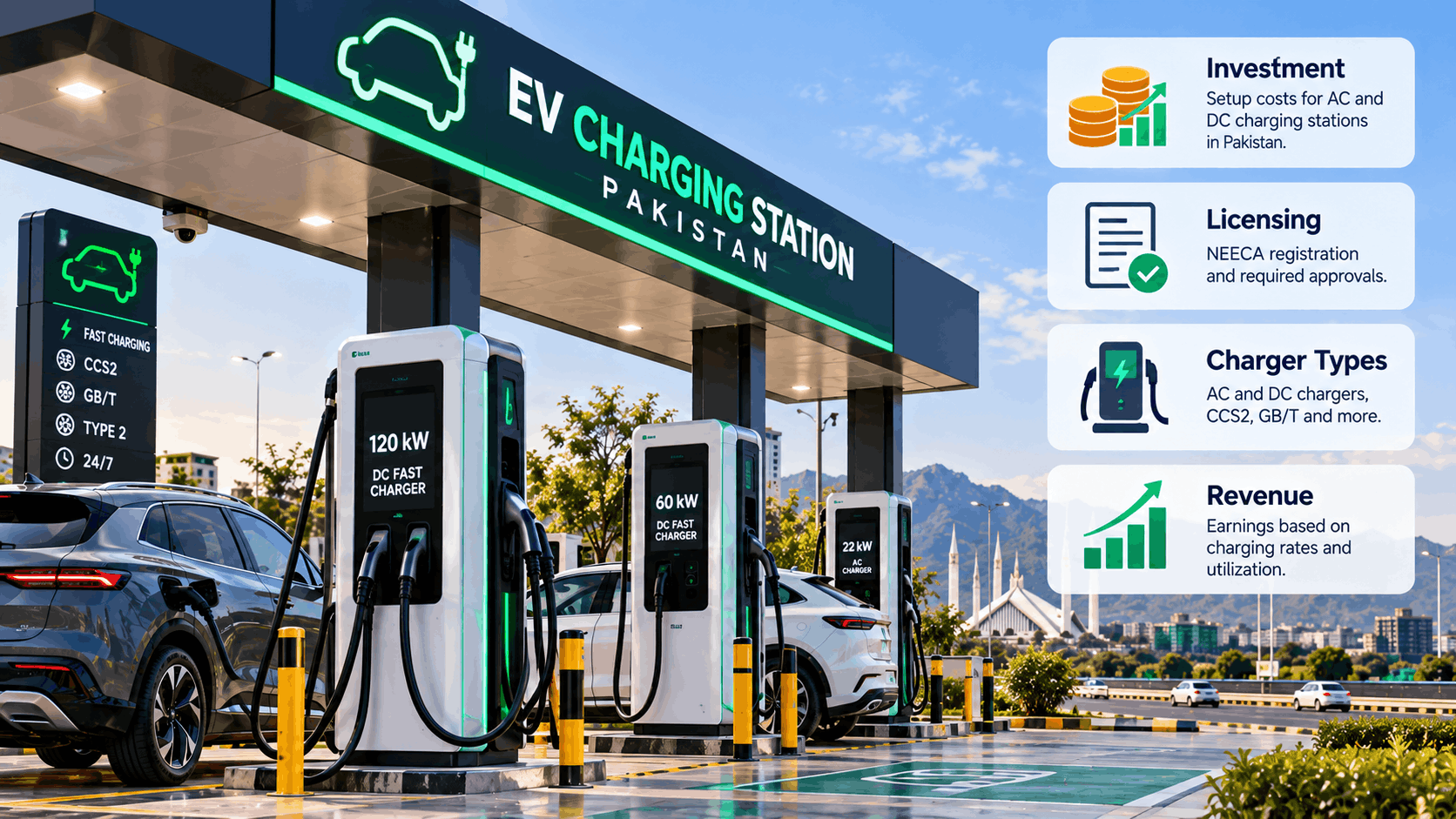
Pakistan’s electric vehicle market is expanding as more battery-electric and plug-in hybrid vehicles enter the country. BYD, Deepal, Kia, Hyundai, MG, OMODA/JAECOO and several Chinese EV brands are increasing the number of vehicles that need charging away from home. This creates a new infrastructure opportunity: the EV charging station business in Pakistan.
Opening a charging station, however, is more complicated than purchasing a DC charger and installing it beside a road. Investors need to consider location, grid capacity, charger power, registration and NOCs, connector compatibility, electricity costs, utilization and maintenance. Most importantly, profitability depends on how many kilowatt-hours the station actually sells each day.
This guide explains the investment, regulatory requirements, approximate setup costs, revenue model and major risks involved in starting an EV charging business in Pakistan in 2026.
How Does an EV Charging Station Make Money?
The basic business model is straightforward. The operator purchases electricity and sells EV charging as a service at a higher price per kilowatt-hour.
For example, if a customer receives 40 kWh and the station charges Rs. 110 per kWh, the charging session generates:
40 kWh × Rs. 110 = Rs. 4,400
But Rs. 4,400 is revenue, not profit. The operator still has to pay for electricity, rent or revenue sharing, staff, maintenance, internet connectivity, payment processing, software, taxes and the original charging equipment.
This makes charger utilization one of the most important numbers in the entire business.
What Type of Charging Station Should You Install?
Commercial stations generally fall into two categories: AC destination charging and DC fast charging.
A 7–22 kW AC charger works well where vehicles remain parked for several hours, such as hotels, offices, restaurants, apartment buildings and shopping centres. The equipment is relatively affordable, but each customer occupies the charging bay for longer.
A 60–120 kW DC charger is more appropriate for public charging stations, fuel stations and intercity routes. It can add substantial energy in a relatively short stop and therefore serve more vehicles each day.
Higher-power 150–350+ kW DC chargers can provide much faster charging to compatible vehicles, but their electrical infrastructure and equipment costs are considerably higher.
EV voltage architecture also affects charging power, electrical current and heat generation.
Installing a 350 kW charger does not automatically create a better business. If most vehicles visiting the site accept only 60–150 kW or customer traffic is low, the additional investment may produce little additional revenue.
Battery temperature also affects fast-charging speed, making battery preconditioning relevant to actual charging performance.
How Much Does an EV Charging Station Cost in Pakistan?
There is no standard 2026 price because chargers are available from different manufacturers and installation requirements vary significantly. Imported hardware, exchange rates, customs costs and site electrical work can also change the final amount.
For early feasibility planning, an investor might budget approximately:
| Setup | Indicative Investment |
|---|---|
| 7–22 kW commercial AC charger | Rs. 2–6 lakh |
| 30–60 kW DC charger installation | Rs. 20–45 lakh |
| 120 kW DC charging setup | Rs. 35–70 lakh |
| Complete 60 kW public station | Rs. 30–70 lakh+ |
| Complete 120 kW public station | Rs. 50 lakh–1.2 crore+ |
| Multi-charger/high-power hub | Rs. 1 crore to several crores |
These are planning ranges rather than supplier quotations. A site requiring a new transformer, substantial DISCO connection work, underground cabling, civil construction or multiple chargers can cost considerably more.
The charger itself may therefore represent only part of the investment.
What Other Costs Should You Include?
A realistic feasibility study should include the charger, transformer or grid upgrade if required, electrical panels, breakers, protection systems, cabling, earthing, civil works, parking bays, signage, lighting and internet connectivity.
Commercial operators may also need charging-management software, OCPP connectivity, RFID or app authentication, payment integration, CCTV and remote monitoring.
Then there are recurring costs: electricity, property rent, salaries, maintenance, software subscriptions, insurance, payment fees and regulatory inspection expenses.
Ignoring these costs can make an apparently profitable charging station perform very differently once it begins operating.
EV Charging Station Registration and Licensing in Pakistan
Commercial EV charging infrastructure is regulated in Pakistan. The important requirement is NEECA registration, together with applicable approvals and NOCs rather than simply treating the site as an ordinary electrical installation.
NEECA’s current framework states that individuals, companies and associations can establish charging infrastructure. The registration fee is Rs. 50,000 per station, while annual inspection fees are Rs. 35,000 for Level 2, Rs. 50,000 for Level 3, Rs. 65,000 for Level 4 and Rs. 80,000 for Level 5 infrastructure. Applicants may need approvals covering municipal requirements, land ownership/use, the relevant DISCO, EPA and NHA or another applicable authority depending on the location. NEECA says a complete application is reviewed within 15 working days.
This regulatory cost is relatively small compared with DC charging hardware, but investors should investigate site approvals before purchasing expensive equipment.
Choosing the Right Location
Location can matter more than charger power.
A 120 kW charger receiving only two customers per day may generate less revenue than a 60 kW charger positioned on a busy EV travel route.
Promising locations include motorway and highway stops, existing fuel stations, major intercity roads, restaurants, shopping centres, commercial districts and areas with growing EV ownership.
The ideal site also gives drivers something to do while charging. Restaurants, coffee shops, washrooms, supermarkets and shopping facilities can make a charging location more attractive.
For highway sites, 24-hour accessibility and reliability become particularly important.
CCS2, GB/T and Connector Selection
Pakistan has a mixed EV market, so connector compatibility deserves careful attention.
Many officially marketed newer EVs use CCS2 for DC charging and Type 2 for AC charging. However, Chinese domestic-market imports can use GB/T, while some older Japanese EVs use CHAdeMO.
An operator therefore needs to study the vehicles likely to visit the specific location.
For many new public charging projects, CCS2 is an important connector, but a station targeting a significant population of imported Chinese EVs may also benefit from GB/T support.
A multi-standard charger can expand the potential customer base but usually increases equipment cost.
How Much Revenue Can an EV Charging Station Generate?
Revenue depends primarily on electricity sold rather than the charger’s maximum rated power.
Consider an illustrative station charging customers Rs. 110 per kWh. The following examples show how utilization changes the business:
| Electricity Sold | Daily Revenue | Approx. Monthly Revenue |
|---|---|---|
| 100 kWh/day | Rs. 11,000 | Rs. 330,000 |
| 200 kWh/day | Rs. 22,000 | Rs. 660,000 |
| 300 kWh/day | Rs. 33,000 | Rs. 990,000 |
| 500 kWh/day | Rs. 55,000 | Rs. 1,650,000 |
These figures represent gross revenue only, assuming 30 operating days. They are not profit forecasts.
Suppose a station sells 300 kWh per day. At Rs. 110/kWh, monthly sales would be approximately Rs. 990,000. Electricity costs, taxes, rent, salaries, maintenance and other operating expenses must then be deducted.
Changing either the selling price or electricity cost by only Rs. 10–20 per kWh can significantly change profitability.
Utilization Is More Important Than Maximum Charging Speed
Consider a 120 kW charger capable of delivering enormous amounts of electricity throughout a day. That theoretical capacity means little if the charger remains unused for most of the time.
A successful charging business therefore needs cars, not just kilowatts.
Early EV charging stations can face a difficult utilization problem. Operators need enough stations to make EV ownership practical, but there may initially be too few EVs to keep every charger busy.
This makes sites that already generate revenue from another business particularly interesting.
A fuel station, restaurant, hotel or shopping centre can use EV charging as an additional service instead of relying entirely on charging revenue to pay for the property.
Can Solar Reduce EV Charging Station Costs?
Solar can complement a commercial EV charging station, particularly where the site has sufficient roof or ground space.
During sunny hours, locally generated solar electricity can contribute toward station and building consumption. However, a small rooftop system cannot continuously power multiple 120 kW chargers at full output.
For example, even a 50 kW solar installation produces variable power depending on sunlight, while a fast charger may demand considerably more power.
Battery storage can reduce grid demand or shift energy between different times, but commercial-scale battery storage substantially increases the initial investment.
Solar should therefore be designed around the site’s actual energy profile rather than marketed as if fast chargers operate directly from a few solar panels.
How Long Could It Take to Recover the Investment?
There is no reliable universal payback period for an EV charging station in Pakistan.
Imagine two investors each spending Rs. 50 lakh. One installs at a busy motorway location and sells hundreds of kWh every day. The other chooses a low-traffic location and receives only a handful of customers each week.
Their investment cost may be identical while their payback periods are completely different.
Before investing, calculate expected daily kWh sales under low, medium and high-utilization scenarios. Then subtract the full electricity cost, rent, salaries, maintenance, taxes and other operating expenses.
A project should still make financial sense under conservative utilization assumptions rather than depending on the charger operating near capacity from its first month.
Is an EV Charging Station Business Worth Considering in Pakistan?
The long-term opportunity comes from a simple relationship: more EVs require more places to charge. Pakistan’s public charging network therefore needs to expand alongside EV adoption.
But being early does not automatically guarantee profitability.
A commercially successful station needs the right location, sufficient grid capacity, compatible connectors, reliable equipment, competitive pricing and enough daily utilization. Investors who already control suitable land at fuel stations, malls, restaurants, hotels or highway locations may have an advantage because they can share property and staffing costs with an existing business.
For a new investor in 2026, the strongest approach is to perform a site-specific feasibility study first, obtain the required approvals, estimate realistic daily charging demand and only then select the charger capacity.
The biggest mistake would be buying an expensive fast charger first and searching for customers afterward.