

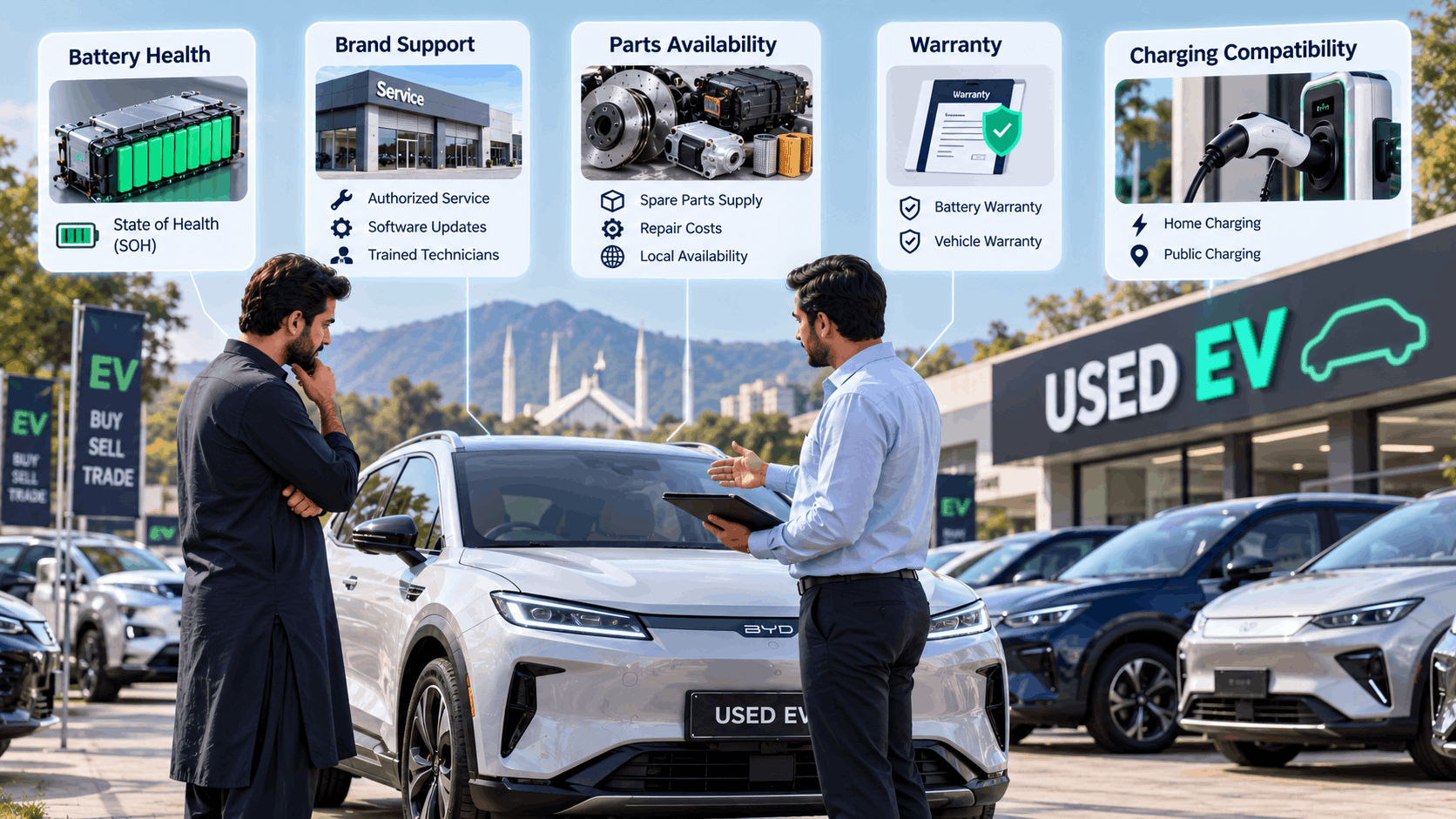
Electric vehicles are becoming more common in Pakistan, but buying or selling a used EV still works differently from the traditional petrol-car market. A Toyota or Suzuki buyer can usually estimate resale value from model year, mileage, condition, and market demand. With an EV, buyers also want answers about battery health, warranty coverage, charging compatibility, software support, and whether replacement parts can actually be sourced locally.
These factors make EV resale value in Pakistan more complicated than simply comparing mileage and model year. Two identical electric cars can command different used prices if one has documented battery health, an active warranty, and strong local dealer support while the other is an unsupported import with uncertain parts availability.
Why EV Resale Value Is Different in Pakistan
Pakistan’s used-car market has traditionally favored vehicles with established dealerships, easily available spare parts, affordable repairs, and a large pool of mechanics. EVs change that equation because much of their drivetrain is electronic and high-voltage.
Electric motors themselves require relatively little routine maintenance, but components such as battery packs, inverters, onboard chargers, cooling systems, control modules, and charging ports require specialized knowledge when something goes wrong.
As a result, buyers may value an EV not only according to how reliable the vehicle has been, but also according to how confidently they believe it can be maintained several years from now.
That confidence can have a direct effect on resale demand.
Battery Health May Be the Most Important Resale Factor
The high-voltage battery is one of the most expensive components in an electric vehicle. For a used buyer, its condition can therefore be more important than the odometer alone.
Battery condition is commonly described using State of Health (SOH), which estimates how much usable capacity remains compared with when the battery was new. If an EV originally provided 60 kWh of usable energy and has lost some capacity over time, its practical driving range will normally decrease as well.
This means two cars with the same mileage may not necessarily have identical battery condition. Temperature exposure, battery chemistry, charging behavior, thermal management, age, and usage patterns can all influence degradation.
A used EV with a documented battery-health report is therefore easier for a buyer to evaluate than one where the seller simply says the battery is “perfect.”
A Battery Report Could Become Important for Used EV Sales
As Pakistan’s used EV market develops, battery-health reports could become similar to engine inspection reports for conventional vehicles.
A proper inspection may include estimated State of Health, battery error codes, cell-voltage differences, charging performance, thermal-system faults, and other information available through the battery-management system.
Sellers who can provide documented battery condition may have an advantage because they reduce uncertainty for the buyer.
This is particularly important when an EV is no longer covered by its original battery warranty. A buyer taking responsibility for an expensive battery system will naturally want stronger evidence about its condition.
Battery Warranty Can Support Resale Value
Remaining manufacturer warranty can also influence a used EV’s attractiveness.
If a vehicle still has several years of battery coverage left, the next owner may face less financial risk than someone buying a similar EV with no warranty. However, buyers should check whether the warranty transfers to the next owner and exactly what conditions apply.
Warranty length also varies between brands and models.
In Pakistan, for example, BYD Mega’s current ATTO 3 documentation lists an 8-year or 160,000 km Blade Battery warranty and a 6-year or 150,000 km vehicle warranty, whichever limit is reached first. This illustrates why buyers should compare actual written warranty terms instead of assuming every EV receives similar coverage. BYD Automotive Pakistan
You can verify the current local specification and warranty information through BYD Mega’s official ATTO 3 specification sheet.
Brand Support Matters More With EVs
Brand reputation has always affected car resale in Pakistan, but local support can become even more important with electric vehicles.
A buyer considering a used EV may ask whether the manufacturer has authorized workshops, technicians trained for high-voltage systems, diagnostic equipment, software access, and replacement components.
An EV from a company actively operating in Pakistan may therefore feel less risky than a grey-market vehicle that was imported privately and has no official support.
Even an excellent EV can become difficult to sell if potential buyers are unsure where they would take it after a warning light appears.
Parts Availability Can Directly Affect Used Prices
Spare-parts availability is closely connected with resale.
An EV still needs conventional components such as suspension parts, body panels, lights, air-conditioning components, wheel bearings, interior electronics, and brake hardware. It also contains EV-specific parts including charging equipment, battery cooling components, inverters, DC/DC converters, and electronic modules.
If common parts require long international orders or expensive imports, buyers may factor that risk into the price they are willing to pay.
This does not mean every part needs to be sitting on a dealership shelf. What matters is whether there is a reliable supply chain and a clear process for obtaining components when needed.
A strong service and parts network can therefore become a major long-term advantage for EV brands in Pakistan.
Officially Sold EVs vs. Grey-Market Imports
Privately imported EVs can sometimes offer features, range, or pricing that officially distributed models do not. However, they may also carry additional resale risks.
A grey-market vehicle may have limited local warranty coverage, unfamiliar charging standards, region-specific software, unavailable body parts, or diagnostic systems that local workshops cannot easily access.
Software can be especially important in modern EVs. Some vehicles depend heavily on mobile applications, connected services, over-the-air updates, and manufacturer servers. A feature designed for another region may not work correctly in Pakistan.
For this reason, a cheaper imported EV may not always retain value as well as an officially supported vehicle, even if the imported model looks better on paper.
Charging Compatibility Also Affects Buyer Confidence
Resale value can also be influenced by how easily an EV fits into Pakistan’s charging environment.
Most owners will do a large percentage of their charging at home, but buyers who regularly travel between cities may care about public fast-charging compatibility.
An EV using a widely supported charging standard is generally easier to own than one requiring uncommon connectors or adapters.
Charging speed matters too. Older EVs with relatively slow DC charging may become less attractive as newer models enter the market with longer ranges and faster charging systems.
That creates another difference between EV and petrol-car depreciation: battery and charging technology can improve quickly between model generations.
New EV Price Cuts Can Hurt Used EV Resale
Used EV values are also affected by the price of new vehicles.
If an automaker reduces the price of a new EV significantly, existing owners may see the market value of their used cars fall because buyers can obtain a brand-new vehicle with a full warranty for slightly more money.
The same can happen when a newer model offers significantly better range, battery technology, or charging speed without a major price increase.
This technology-driven depreciation is something EV owners need to consider, particularly while Pakistan’s electric-car market is still developing and new brands are entering relatively quickly.
Accident History Can Matter More Around the Battery
Accident history is important for every used vehicle, but underbody damage deserves particular attention when inspecting an EV.
Most modern EV battery packs are installed underneath the passenger compartment. A serious impact to the underside of the vehicle could potentially damage the pack enclosure, cooling system, connectors, or structural protection.
A repaired bumper or door is very different from damage involving the battery enclosure.
Used EV buyers should therefore consider professional inspection particularly important after an accident, even when the car drives normally and has no obvious warning lights.
How EV Owners Can Protect Resale Value
EV owners can improve buyer confidence by keeping complete service records, maintaining warranty documentation, repairing the vehicle through qualified workshops, and keeping records of battery inspections.
When eventually selling the vehicle, providing a recent battery-health report can be more persuasive than simply claiming that the battery still provides good range.
Keeping original charging equipment and documenting any battery, charger, inverter, or software repairs can also help.
As the used market becomes more mature, buyers are likely to become increasingly knowledgeable about these details.
Are EVs Bad for Resale in Pakistan?
It is too broad to say that EVs automatically have poor resale value.
The Pakistani EV market contains very different vehicles: officially supported models, privately imported cars, established international brands, newer entrants, small city EVs, premium vehicles, and different battery technologies.
Resale performance will therefore vary considerably between models.
An EV with healthy battery capacity, remaining warranty, strong local support, readily available parts, good charging compatibility, and strong market demand may retain value much better than a technically impressive model with limited after-sales support.
For buyers, this means the cheapest used EV is not always the best financial choice.
The Future of EV Resale Value in Pakistan
Pakistan’s EV resale market will likely become easier to understand as more vehicles remain on the road for several years. Buyers will gain better information about real-world battery degradation, repair costs, parts availability, charging reliability, and which brands maintain long-term support.
Battery-health testing could also become a normal part of used EV transactions, reducing uncertainty around one of the biggest concerns buyers currently have.
Ultimately, EV resale value in Pakistan will depend on much more than how many kilometers a vehicle has travelled. Battery condition, warranty coverage, authorized service, spare-parts availability, charging compatibility, software support, accident history, and new-car pricing can all influence what a used buyer is willing to pay.
For anyone choosing a new EV today, these factors are worth considering before purchase—not only when it is time to sell.