

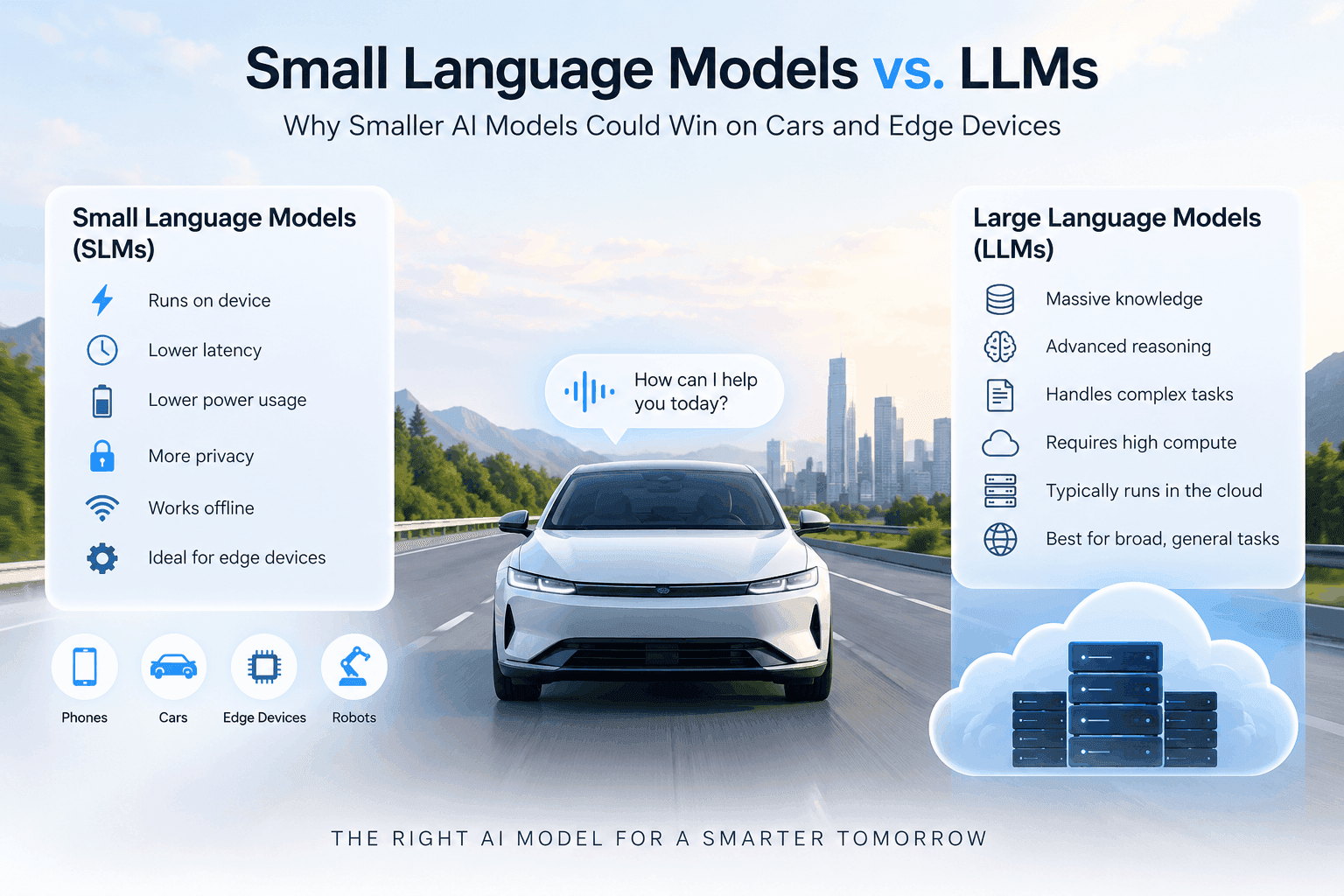
Artificial intelligence is moving beyond cloud data centers and into cars, smartphones, robots, industrial machines, and other edge devices. This shift is creating an important question for developers and manufacturers: should every AI application use a large language model, or are smaller models sometimes a better choice? The comparison between small language models vs. LLMs is becoming especially important in automotive and edge AI. Large language models can provide powerful reasoning, broad knowledge, and complex conversational capabilities, but they also require significant memory, processing power, and energy. Small language models, often called SLMs, are designed to deliver useful AI capabilities with fewer computational resources.
For cars and other edge devices, where latency, power consumption, privacy, and offline operation matter, smaller AI models could become increasingly valuable. Rather than replacing large language models completely, SLMs may become the preferred choice for many local and specialized AI tasks.
What Are Small Language Models?
Small language models are compact AI models designed to perform language understanding and generation tasks while using fewer parameters and computing resources than very large AI models. There is no single parameter count that officially defines an SLM, but the term is generally used for models that are small enough to run efficiently on devices such as smartphones, embedded systems, automotive processors, laptops, and edge AI hardware.
These models can perform tasks such as question answering, summarization, voice assistant interactions, classification, information extraction, and basic reasoning. Their smaller size can make them easier to deploy where memory, power, connectivity, and processing capacity are limited. Qualcomm, for example, lists the PLaMo-1B model as a small language model designed for edge applications including mobile devices, automotive systems, and robots.
What Are Large Language Models?
Large language models, or LLMs, are AI models trained on very large datasets and usually built with billions or even hundreds of billions of parameters. They are designed to understand and generate natural language across a wide range of tasks, including AI chatbots, coding assistance, research, content generation, reasoning, and AI agents.
The main challenge is that powerful LLMs often require substantial computing resources. Running them may require large amounts of memory, high-performance GPUs or AI accelerators, and significant power. This is manageable in cloud data centers, but much harder inside a vehicle or other embedded device where hardware and energy are limited.
Small Language Models vs. LLMs
The biggest difference between SLMs and LLMs is not simply the number of parameters. The practical difference is how much hardware, memory, power, and processing capacity are required to run them. Small language models are generally better suited to lightweight and specialized tasks, while large language models are often stronger for broad knowledge, complicated reasoning, and complex multi-step conversations.
A smaller model can usually start faster, consume less memory, and require less energy, which makes it useful for applications that need to run directly on a device. LLMs, on the other hand, can often handle more complicated queries, larger context windows, and broader tasks. For this reason, the future may not be about choosing only SLMs or only LLMs. Many automotive and edge AI systems are likely to use both.
Why Small Language Models Make Sense for Cars
Modern vehicles already contain powerful processors, cameras, sensors, microphones, displays, and software platforms. As cars become more intelligent, manufacturers are exploring ways to run generative AI directly inside the vehicle. However, vehicles have much stricter computing limits than cloud data centers. An AI model running inside a car needs to operate within limited memory, power, cooling, and processing capacity, while also responding quickly even when internet connectivity is poor or unavailable.
This is where small language models can provide a major advantage. An SLM running locally could support voice commands, navigation queries, vehicle controls, maintenance information, driver personalization, and basic conversational assistance without continuously sending information to the cloud. On-device processing can also reduce network dependency and help keep certain user data inside the vehicle.
Lower Latency for In-Car AI
Latency is especially important in automotive applications. Imagine asking an in-car assistant to adjust the cabin temperature, find the nearest charger, explain a dashboard warning, or provide navigation information. Waiting several seconds for every request to travel to a cloud server and return could make the experience frustrating.
A smaller AI model running locally can process many requests without requiring a network round trip. This does not mean every task should be handled locally. Complex searches, large-scale reasoning, or access to frequently changing information may still require cloud AI. A practical automotive AI system could therefore use an SLM for fast local interactions while sending more difficult tasks to a larger cloud model.
Better Privacy Through On-Device AI
Privacy is another important advantage of small language models. Vehicle AI systems may process sensitive information such as voice conversations, locations, driving habits, contacts, and personal preferences. If a model runs directly inside the vehicle, some requests can be processed locally instead of sending data to external servers.
This does not automatically guarantee privacy, but it can reduce the amount of information that needs to leave the vehicle. For manufacturers developing personalized automotive assistants, local AI could therefore become an important part of their privacy strategy.
Small Models Can Work Offline
Cars cannot always rely on stable internet connectivity. Drivers may travel through tunnels, rural areas, underground parking, or locations with weak mobile coverage. A cloud-only AI assistant may become much less useful in these situations.
An on-device small language model can continue handling certain functions even when the vehicle is offline. These could include explaining vehicle features, accessing stored manuals, controlling infotainment functions, or answering questions using locally stored information. This makes SLMs particularly attractive for systems that need to remain useful regardless of network conditions.
NVIDIA has also highlighted automotive edge AI architectures where local models can handle real-time in-vehicle tasks while cloud systems support more complex planning and information processing. You can read more in NVIDIA’s guide to building in-vehicle AI agents.
Lower Power and Memory Requirements
One of the biggest limitations of running AI models at the edge is hardware. Larger models need more memory and computation, which can increase power consumption and heat generation. These factors are especially important inside embedded automotive systems, where space and energy are limited.
Small language models can reduce these requirements significantly. Techniques such as quantization can further reduce memory usage by representing model weights with lower numerical precision. Modern neural processing units, GPUs, and specialized AI accelerators are also making it easier to run compact language models efficiently on edge devices.
Are Small Language Models Powerful Enough?
The main tradeoff is capability. Smaller models usually cannot match the broad reasoning ability and knowledge of the largest cloud-based AI systems. A small model may perform extremely well on a focused set of tasks but struggle with complicated questions outside its training or specialization.
However, many automotive applications do not require a model that knows everything. An in-car assistant may mainly need strong knowledge about vehicle functions, navigation, charging, maintenance, climate controls, infotainment, and driver preferences. A smaller model trained or optimized for these specific tasks could perform them effectively while consuming far fewer resources.
Retrieval-Augmented Generation, or RAG, can also help smaller models access relevant information from vehicle manuals, maintenance records, and other local documents instead of relying entirely on knowledge stored inside the model.
Hybrid AI Could Be the Best Approach
The strongest architecture may be a combination of small local models and larger cloud models. A vehicle could use an SLM for everyday requests such as adjusting controls, answering questions about the car, checking locally stored maintenance information, and processing basic voice commands. When a request requires deeper reasoning, live internet data, or large-scale knowledge, the system could pass the task to a more capable cloud-based LLM.
For example, asking the car to lower the temperature could be handled locally, while asking it to compare hotels at a destination or research a complex travel plan might require a cloud model. This hybrid approach can combine the low latency, privacy, and offline benefits of edge AI with the more advanced capabilities of large cloud-based models.
SLMs and AI Agents in Vehicles
Small language models could also play an important role in agentic AI in automotive. Instead of one massive model controlling every vehicle function, future cars could use multiple specialized AI agents. One agent might manage navigation, another could monitor battery health, while another handles maintenance, infotainment, or charging.
Each agent may not need a massive general-purpose LLM. Smaller specialized models could handle specific responsibilities efficiently while communicating with larger models only when advanced reasoning is required. This could make automotive AI systems more modular, efficient, and easier to optimize for specific hardware.
Will Small Language Models Replace LLMs?
Small language models are unlikely to completely replace large language models. Instead, they will probably complement them. LLMs will remain valuable for difficult reasoning, broad knowledge tasks, complex research, and applications where powerful computing infrastructure is available.
Small models will be more attractive where speed, privacy, power efficiency, offline operation, and local processing are more important. In automotive and edge computing, these advantages can be significant. The future AI stack may therefore look less like a single massive model and more like a combination of specialized local models connected to more powerful cloud systems.
The Future of Small Language Models in Automotive and Edge AI
As AI becomes embedded into more physical products, efficiency will become increasingly important. Cars, robots, industrial systems, and smart devices cannot always rely on enormous cloud models for every interaction. Small language models offer a practical alternative because they can run closer to the user, respond faster, work with limited connectivity, consume less power, and help keep sensitive information on the device.
Improvements in quantization, model architectures, AI accelerators, and edge hardware are also making smaller models more capable. Large language models will continue to provide the highest levels of general-purpose intelligence, but bigger does not automatically mean better for every application.
For cars and edge devices, the most effective AI model may simply be the smallest model capable of completing the required task reliably. As edge AI hardware continues to improve, the discussion around small language models vs. LLMs may become less about which technology wins overall and more about choosing the right model for the right workload.