

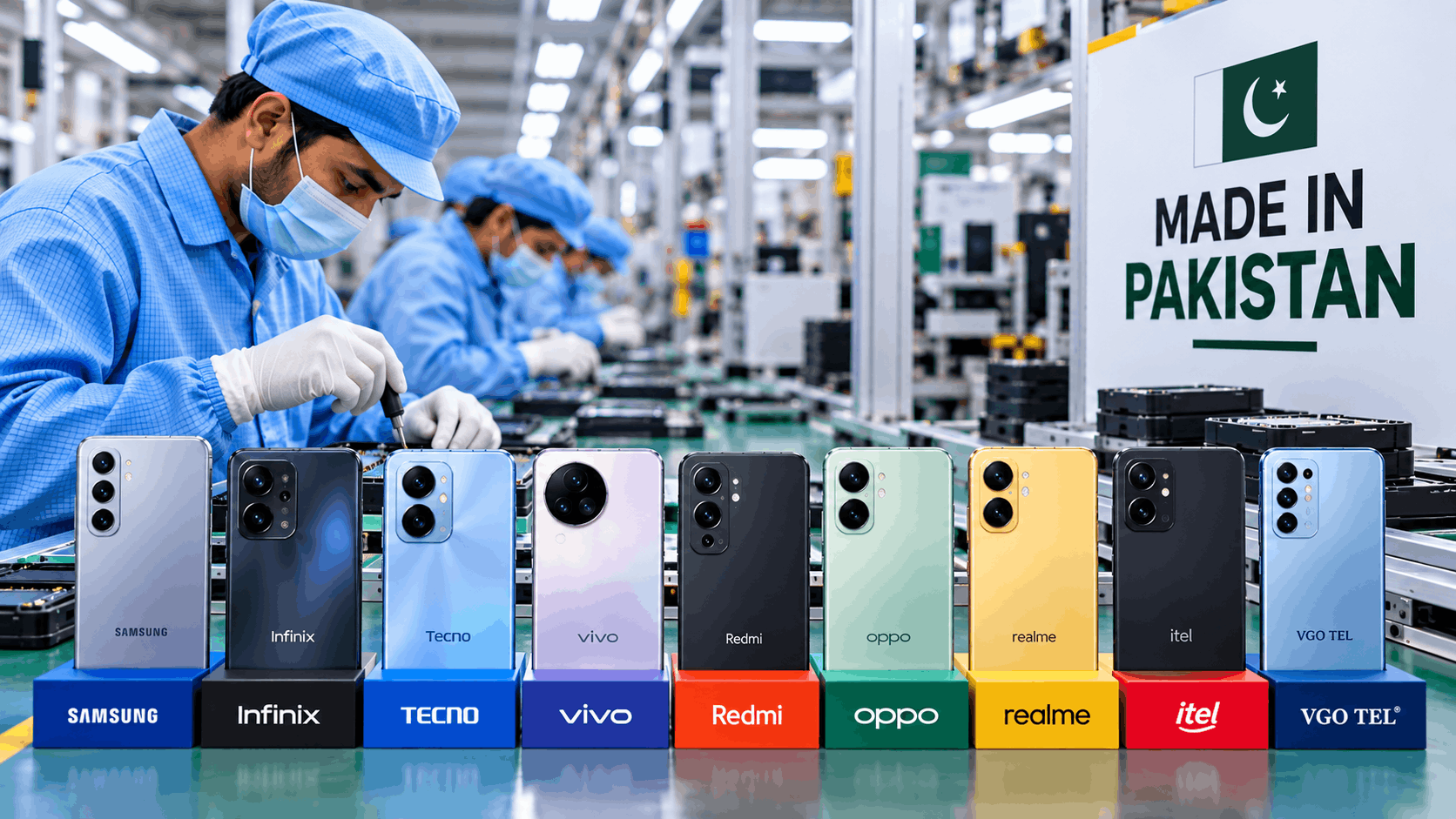
Pakistan has already moved a significant part of its mobile-phone market from importing completely built devices toward local assembly. The next challenge is more difficult: increasing the amount of actual manufacturing that takes place inside the country.
The proposed Pakistan Mobile & Electronics Manufacturing Policy 2026–33 is intended to push the industry further in that direction. Instead of focusing only on assembling imported smartphone kits, the broader goal is to encourage local component production, attract technology investment, develop skilled jobs and eventually make Pakistan more competitive as an electronics manufacturing and export base.
For consumers, however, the biggest questions are more practical. Could locally manufactured phones become cheaper? Will more international brands manufacture in Pakistan? And what kinds of jobs could a larger electronics industry create?
For phone buyers, 5G compatibility also depends on support for Pakistani networks.
What Is the Mobile & Electronics Manufacturing Policy 2026–33?
The new framework is intended as the next stage of Pakistan’s mobile manufacturing strategy. The country’s earlier policy helped encourage local phone assembly, while the proposed 2026–33 framework places greater emphasis on deeper localization and electronics manufacturing.
According to the MoIP February 17, 2026 announcement, the Engineering Development Board (EDB) had finalized the framework and it was ready to be presented to the Prime Minister for approval. The government said the plan would focus on exports, employment, technology transfer and foreign investment, and that companies including Apple and Samsung would be invited to establish manufacturing operations in Pakistan. Importantly, an invitation is not confirmation that those companies have agreed to manufacture locally.
That approval status matters. Until final rules are officially notified, proposed measures should not be treated as already implemented regulations.
Pakistan Already Makes Phones — So What Is Different?
When people hear that smartphones are “manufactured in Pakistan,” they may imagine that most of the phone is produced locally. In reality, manufacturing has different levels.
At the simplest level, major components can be imported and assembled inside Pakistan. Workers perform assembly, testing, packaging and quality-control operations locally, but many of the expensive components still come from overseas.
Those components can include processors, memory chips, displays, camera sensors and other electronic parts.
Silicon-carbon phone batteries are one approach to increasing smartphone battery capacity.
Deeper localization means gradually producing more of the components, subassemblies and manufacturing processes inside Pakistan rather than importing almost everything as kits.
That distinction is important because assembly creates jobs, but deeper manufacturing can create a much larger industrial ecosystem.
What Does Smartphone Localization Mean?
Localization measures how much of a product’s manufacturing value comes from within the country.
Pakistan does not need to manufacture every smartphone component immediately for localization to increase. A realistic progression could start with relatively achievable products and processes such as packaging, plastic components, chargers, cables, enclosures, PCB assembly and other electronic subassemblies.
More technically complex manufacturing could develop later if production volumes, skills and investment justify it.
Producing advanced smartphone processors locally, for example, would be an entirely different challenge. Semiconductor fabrication plants require enormous investment, sophisticated equipment and highly specialized supply chains.
The practical goal is therefore not to make every component in Pakistan overnight. It is to gradually increase local value addition.
Could Smartphones Become Cheaper in Pakistan?
Local manufacturing could reduce some costs, but it does not guarantee cheaper phones.
Importing fewer finished devices can potentially reduce some shipping costs and exposure to certain import-related expenses. Producing more components locally could also reduce dependence on foreign suppliers over time.
However, the retail price of a smartphone depends on many other factors, including the rupee exchange rate, taxes and duties, component prices, energy costs, manufacturer margins and competition.
Many critical smartphone components would also continue to be imported even under a stronger localization program.
A locally manufactured phone can therefore still become more expensive if the rupee weakens or imported component prices increase.
Consumers should view localization as a way to strengthen the domestic supply chain rather than as a guarantee that smartphone prices will immediately fall.
What Could Happen to Imported Phones?
A manufacturing policy designed to encourage localization generally needs to make domestic production commercially attractive compared with importing completely built devices.
That could result in manufacturers with substantial sales in Pakistan having stronger reasons to assemble or manufacture their products locally.
However, imported phones are unlikely to disappear.
Premium smartphones, niche devices and models sold in relatively small quantities may still be imported because establishing a local production line for a small market can be economically difficult.
Pakistan could therefore develop a mixed market where popular mass-market models are increasingly produced locally while some premium and specialized devices continue to arrive as imports.
The exact price difference will depend on whatever tariff and tax structure is ultimately approved.
Could Apple Manufacture iPhones in Pakistan?
The possibility of Apple manufacturing in Pakistan would naturally attract attention, but it is important to separate a government objective from an announced investment.
Pakistan has expressed an intention to invite major international electronics companies to establish manufacturing operations. That does not mean an iPhone factory in Pakistan has been confirmed.
Apple’s manufacturing supply chain is highly sophisticated. A country competing for that production needs more than relatively inexpensive labour. Manufacturers and their suppliers also consider logistics, electricity reliability, skilled workers, component suppliers, export infrastructure, regulations and production scale.
Pakistan could potentially make itself more attractive to global electronics manufacturers, but any individual investment should only be considered confirmed when the company involved formally announces it.
Why Electronics Exports Matter
Pakistan’s domestic smartphone market can support assembly operations, but exports become increasingly important if the country wants a much larger electronics manufacturing industry.
A factory producing only for Pakistani consumers is limited by the size of the local market. A factory capable of supplying several international markets can operate at much greater scale.
That scale matters because component suppliers are more likely to establish local operations when manufacturers can guarantee large production volumes.
Exports could therefore help create a cycle in which larger factories attract suppliers, local suppliers reduce dependence on imported components, and a stronger supply chain makes Pakistan more competitive for additional manufacturing investment.
What Could the Policy Mean for Local Jobs?
The type of employment created depends heavily on how far localization progresses.
Basic assembly creates jobs for production workers, quality-control teams, warehouse staff, supervisors and technicians. Deeper electronics manufacturing requires a broader range of skills.
It can create demand for electronics engineers, PCB designers, automation engineers, equipment technicians, embedded-software developers, supply-chain specialists, product-testing professionals and manufacturing managers.
Industrial AI combines artificial intelligence with machines, sensors and industrial software.
This is where the long-term opportunity becomes larger than smartphone assembly.
If Pakistan develops companies capable of manufacturing electronic components and subassemblies, those businesses could potentially supply industries beyond mobile phones.
The Opportunity Goes Beyond Smartphones
Modern products increasingly share similar electronic components and manufacturing processes.
PCB assembly, battery systems, power electronics, sensors, plastic moulding, electronic testing and embedded software are relevant to smartphones but also to laptops, smart-home products, IoT devices, telecommunications equipment, appliances and automotive electronics.
A supplier ecosystem initially built around mobile-phone manufacturing could therefore support a much broader electronics industry.
That would make the policy’s success more important than simply counting how many phones are assembled locally.
The Biggest Challenge: Real Local Value Addition
The real test will be whether Pakistan moves beyond final assembly.
Importing almost every high-value component and assembling the device domestically can increase local production numbers without creating a deep electronics supply chain.
Meaningful localization requires suppliers, manufacturing machinery, skilled workers, testing facilities, reliable energy, quality standards, efficient customs processes and long-term regulatory predictability.
Manufacturers also need sufficient production volumes to justify investing in local component factories.
This means progress should eventually be measured not only by the number of locally assembled smartphones but also by how much of their value is actually produced inside Pakistan.
What Could Consumers Notice First?
Consumers are unlikely to wake up one morning and suddenly find dramatically cheaper locally manufactured smartphones.
The changes would probably happen gradually.
More smartphone models could be assembled locally, manufacturers could increase local sourcing, new electronics suppliers could enter the market, and brands could invest in larger production facilities.
If local manufacturing becomes efficient enough, consumers could eventually benefit from stronger competition, improved product availability and reduced exposure to some costs associated with importing complete devices.
But taxes, currency movements and global component prices would continue to influence retail prices.
What the Policy Could Mean for Pakistan
The Pakistan Mobile & Electronics Manufacturing Policy 2026–33 has the potential to represent a shift from simply assembling smartphones toward building a wider electronics manufacturing ecosystem.
Its impact will depend on implementation.
If Pakistan can increase genuine local value addition, develop skilled workers, attract component suppliers and create export-oriented production, the benefits could extend well beyond smartphones.
If localization remains concentrated mainly on final assembly, the economic impact would be more limited.
For consumers, the most visible outcome may eventually be more locally produced devices and potentially more competitive pricing. For the economy, however, the bigger opportunity is developing the engineering skills, suppliers and manufacturing infrastructure required to participate in the global electronics supply chain.