

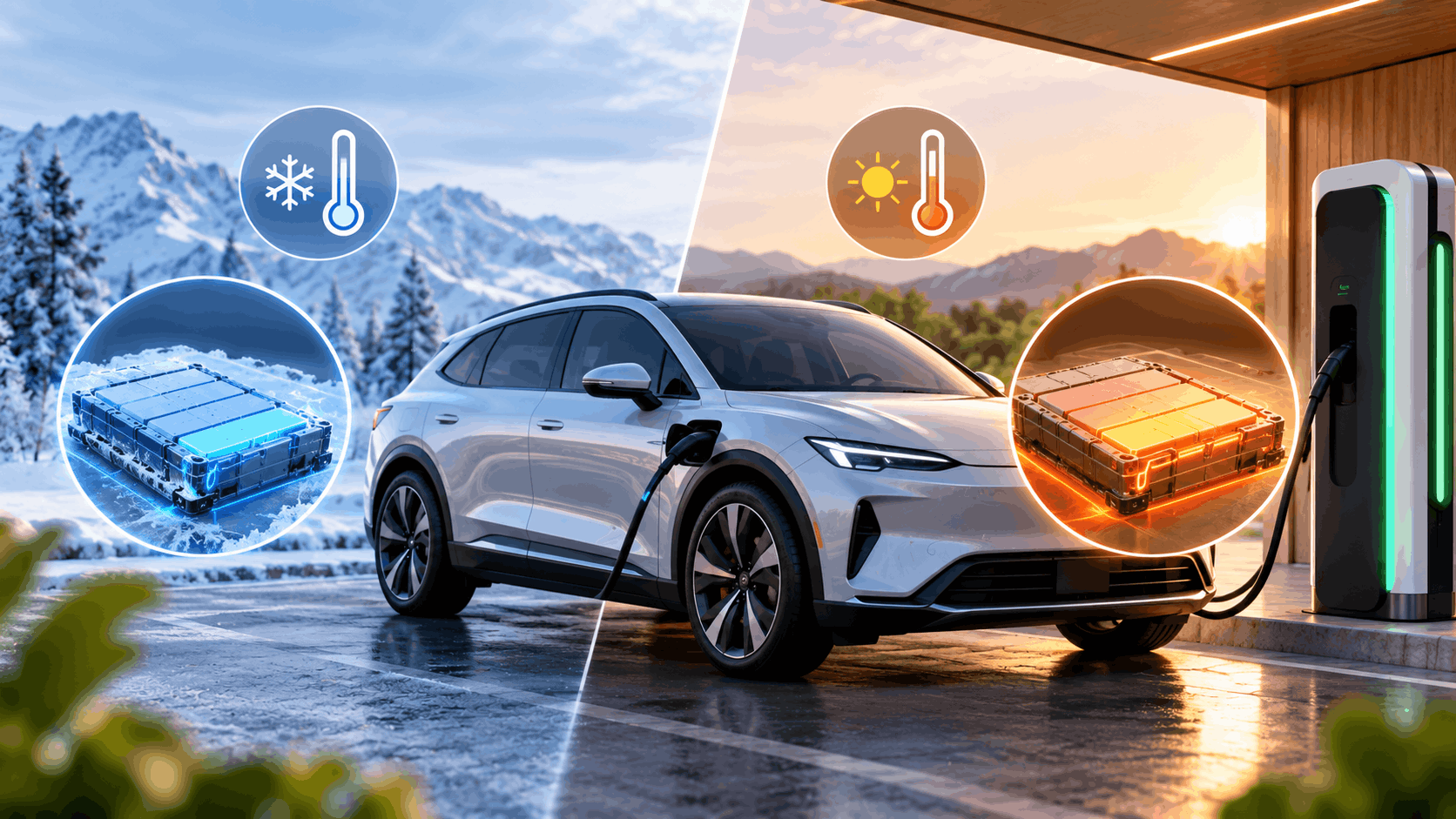
Fast charging an electric vehicle is not only about finding a powerful charger. The temperature of the battery can have a major effect on how quickly an EV can accept energy. A vehicle connected to a high-power DC charger may charge much slower than expected if its battery is too cold or too hot. This is where EV battery preconditioning becomes important.
Battery preconditioning prepares the high-voltage battery before charging by heating or cooling it toward a suitable operating temperature. In many modern EVs, this can happen automatically when a fast charger is selected in the built-in navigation system. By arriving at the charger with the battery already prepared, the vehicle may reach higher charging speeds sooner and spend less time connected to the charger. Hyundai and Kia both describe battery conditioning as a way to maintain DC fast-charging performance when battery temperature is too high or too low.
What Is EV Battery Preconditioning?
EV battery preconditioning is the process of actively heating or cooling an electric vehicle’s traction battery before it needs to perform a demanding task, particularly DC fast charging. Lithium-ion batteries work through chemical reactions, and those reactions are strongly influenced by temperature.
When a battery is cold, the vehicle’s battery management system may restrict charging current to protect the cells. When the battery becomes excessively hot, the system may also limit charging power to control temperature. Preconditioning attempts to bring the battery into a temperature range where it can safely accept higher charging power.
This process should not be confused with cabin preconditioning. Cabin preconditioning heats or cools the interior before the driver enters the vehicle, while battery preconditioning manages the temperature of the high-voltage battery. Some EVs can perform both functions simultaneously.
Why Battery Temperature Matters for Fast Charging
DC fast charging pushes considerably more power into a battery than normal AC home charging. The battery must therefore be able to accept that energy without creating excessive heat or conditions that could accelerate degradation.
AI for EV battery health uses machine learning to predict range, aging, and battery failure.
A cold battery generally cannot accept maximum charging power immediately. The vehicle may initially limit the charging rate and gradually increase it as the battery warms. This is one reason an EV capable of very high peak charging speeds can sometimes charge slowly during a cold winter journey.
Extremely high battery temperatures can create the opposite problem. The thermal-management system may need to cool the battery, and charging power can be reduced until temperatures return to an appropriate range. Battery temperature is therefore one of several reasons real-world charging speed can differ significantly from the maximum number advertised by the vehicle or charger.
How EV Battery Preconditioning Works
Modern EV battery packs commonly use liquid thermal-management systems containing coolant that circulates around battery cells or modules. The vehicle can use battery heaters, heat pumps, electric heaters, chillers, or air-conditioning components to adjust battery temperature.
When preconditioning begins, the battery management system monitors temperature sensors throughout the pack and determines how much heating or cooling is needed. The system continues adjusting the temperature while the vehicle travels toward the charger.
On supported Hyundai vehicles, for example, selecting a DC charging station as a navigation destination or waypoint can automatically activate battery conditioning so the battery approaches an appropriate fast-charging temperature before arrival.
Automatic vs. Manual Battery Preconditioning
How preconditioning is activated depends on the EV. Some vehicles automatically start the process when the driver selects a compatible DC fast charger through the built-in navigation system. This allows the car to calculate how much time is available before arrival and condition the battery accordingly.
Other vehicles provide a manual battery-conditioning option through the infotainment system or smartphone app. Some models support both methods. Kia, for example, documents vehicles where battery conditioning can be activated manually, automatically through navigation, or remotely while the vehicle is parked.
For owners, this means it is worth checking the vehicle manual rather than assuming preconditioning always happens automatically. Using a third-party navigation application instead of the vehicle’s built-in navigation may also prevent automatic charger-triggered preconditioning on some models.
Why Preconditioning Can Improve Fast-Charging Speed
EV manufacturers normally advertise a maximum or peak DC charging rate, such as 150 kW, 250 kW, or higher. That figure represents what the vehicle can accept under suitable conditions, not what it will receive throughout every charging session.
When the battery arrives at a fast charger cold, the battery management system may initially request far less power. Part of the charging session may then be spent warming the battery before higher charging rates become possible.
Preconditioning performs much of that thermal preparation before the vehicle reaches the charger. As a result, the battery may be able to enter the stronger part of its charging curve much sooner.
Kia specifically states that conditioning the battery while travelling toward a DC charger can reduce charging time compared with arriving with a battery that is too hot or too cold.
For a manufacturer explanation of the process, see Kia’s guide to EV battery preconditioning.
Battery Preconditioning in Cold Weather
Cold weather is where many EV drivers notice battery preconditioning most clearly. Low temperatures slow the electrochemical processes inside lithium-ion batteries and increase internal resistance. To protect the battery, an EV may significantly reduce charging power when the pack is cold.
Imagine an EV has been parked outside overnight during winter and is then driven only a short distance to a fast charger. The battery may still be very cold when charging begins, even if the vehicle itself feels warm inside.
If preconditioning starts while driving to the charger, the vehicle can use its battery heating system to raise the pack temperature before arrival. Kia’s owner documentation specifically recommends battery conditioning for improving DC charging performance when the high-voltage battery is cold.
Does Battery Preconditioning Help in Hot Weather?
Preconditioning is not only about heating the battery. In very hot conditions, the battery may need cooling before or during rapid charging.
Fast charging itself creates heat, so beginning a charging session with an already overheated battery can force the vehicle to reduce charging power earlier. An active thermal-management system can cool the pack toward a more suitable temperature before charging begins.
Modern battery-conditioning systems may therefore heat or cool the battery depending on environmental conditions. Hyundai describes its system as adjusting battery temperature when it becomes either too high or too low for ideal fast charging.
Does Preconditioning Use Battery Energy?
Yes. Heating or cooling a large EV battery requires energy. If the vehicle is driving toward a charger, that energy can come from the traction battery, which may slightly reduce the remaining driving range.
However, the purpose is to trade a relatively small amount of energy for better battery temperature and potentially faster charging after arrival. Kia’s documentation notes that battery conditioning consumes energy and may reduce driving range, particularly when the system has significant heating or cooling work to perform.
When some vehicles are plugged into an external power source, they can use grid electricity for conditioning instead of relying entirely on stored battery energy.
When Should You Precondition an EV Battery?
Preconditioning is most useful before a DC fast-charging session when the battery is significantly colder or hotter than its preferred charging temperature. It is particularly useful during winter, after the car has been parked outside for a long period, or before charging during extreme weather.
It is usually much less important for normal overnight AC charging because home charging operates at substantially lower power. The battery does not need to accept hundreds of kilowatts within a short period, so precise thermal preparation is less critical.
Drivers also do not usually need to precondition before every fast-charge stop. If the battery is already at a suitable temperature after a long drive, the vehicle may decide that additional conditioning is unnecessary.
Why Preconditioning Does Not Guarantee Maximum Charging Speed
Even with perfect battery temperature, an EV will not necessarily remain at its peak charging rate throughout the session. Battery preconditioning only addresses one part of the charging equation.
Charging power also depends on battery state of charge, the vehicle’s charging curve, battery chemistry, charger output, battery voltage, thermal limits, charger sharing, and the battery management system.
An EV might briefly achieve its maximum advertised charging rate at a relatively low state of charge before gradually reducing power as the battery fills. At high states of charge, particularly near full, charging normally becomes much slower to protect the battery.
This is why arriving at a fast charger with a warm battery and a relatively low state of charge can often produce much better charging performance than arriving with a cold battery that is already mostly full.
Does Every EV Have Battery Preconditioning?
No. Battery thermal-management capabilities vary significantly between manufacturers, models, years, and trim levels. Some modern EVs have sophisticated automatic battery conditioning, while others offer only basic thermal management or no user-controlled preconditioning function.
Software updates can also change how some vehicles manage battery temperature. Owners should therefore check their specific vehicle’s documentation to understand whether battery preconditioning is available and how it is activated.
The presence of battery preconditioning is becoming increasingly important as EV charging speeds increase because maintaining the battery within an appropriate temperature range becomes more important at higher charging power.
The Future of EV Battery Preconditioning
As electric vehicles move toward 800V and even higher-voltage architectures with increasingly powerful fast-charging systems, battery thermal management will become even more important. Faster charging means moving enormous amounts of energy into the battery within a short period, and temperature must be carefully controlled throughout that process.
Future EVs are likely to make preconditioning increasingly automatic. Navigation systems, battery management software, charger availability, weather information, driving behavior, and route planning can work together to determine exactly when the battery should begin heating or cooling.
For drivers, EV battery preconditioning is ultimately about arriving at a fast charger with the battery ready to charge. It cannot overcome every charging limitation, but when temperature is the problem, proper preconditioning can make the difference between a slow charging stop and one much closer to the vehicle’s expected fast-charging performance.