

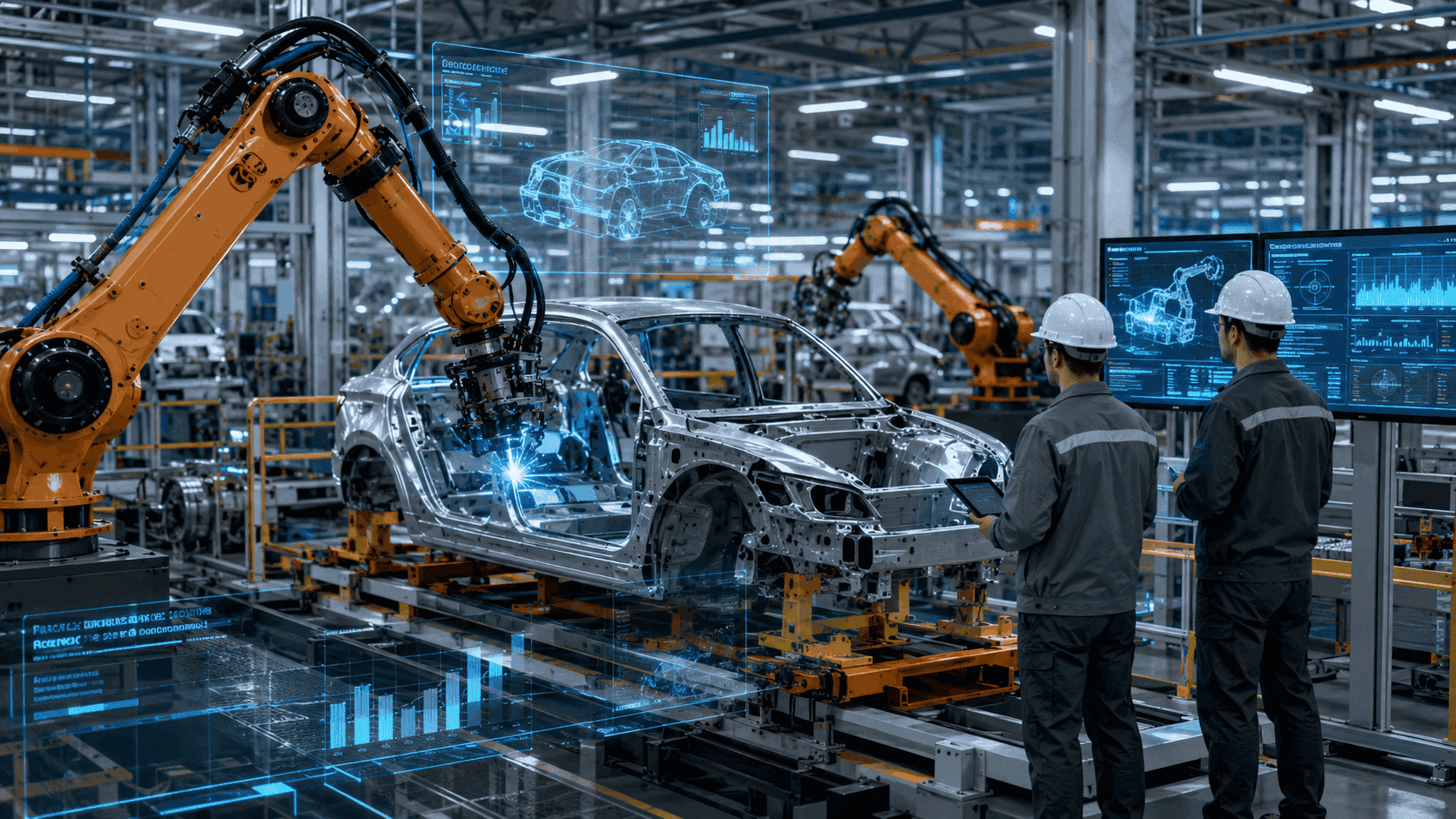
Artificial intelligence is rapidly moving beyond chatbots, search engines, and consumer applications. Today, AI is being integrated into factories, vehicles, power systems, engineering workflows, and other complex industrial environments.
This growing field is known as industrial AI.
Industrial AI combines artificial intelligence with machines, sensors, engineering systems, operational data, and industrial software. Its purpose is not simply to generate content or answer questions. Instead, industrial AI is designed to help organizations improve productivity, predict equipment failures, automate inspections, optimize energy use, improve product quality, and make better operational decisions.
From automotive manufacturing and smart factories to renewable energy and engineering design, industrial AI is becoming an important part of modern industry.
According to the U.S. National Institute of Standards and Technology (NIST), AI and machine learning are already supporting areas such as industrial data analytics, advanced sensing, autonomous systems, digital twins, robotics, supply-chain optimization, and sustainable manufacturing.
In this guide, we explore what industrial AI is, how it works, its major applications, benefits, challenges, and how it is transforming cars, energy, factories, and engineering.
What Is Industrial AI?
Industrial AI is the use of artificial intelligence technologies in manufacturing, engineering, automotive, energy, logistics, and other industrial environments.
It involves technologies such as machine learning, computer vision, predictive analytics, digital twins, robotics, generative AI, and intelligent automation.
Industrial companies produce enormous amounts of data.
Factory machines generate temperature and vibration readings. Cars collect information from sensors, batteries, cameras, and control systems. Power grids continuously monitor electricity demand and generation. Engineers use simulations, CAD systems, and testing data to develop products.
Industrial AI systems analyze this information to detect patterns, predict outcomes, identify problems, and recommend actions.
For example, an AI-powered system can monitor the vibration of a factory motor. If the vibration pattern begins to resemble patterns associated with previous equipment failures, the system can alert maintenance teams before the machine breaks down.
This application is commonly known as predictive maintenance.
How Does Industrial AI Work?
Industrial AI typically starts with data.
Industrial equipment may contain sensors that continuously measure variables such as:
- Temperature
- Pressure
- Vibration
- Speed
- Energy consumption
- Machine performance
- Product dimensions
- Equipment health
This information can be processed by AI and machine learning models.
The models analyze historical and real-time data to recognize patterns. Once trained, they can identify anomalies, predict failures, recommend operational changes, or automate specific tasks.
Industrial AI often works together with other technologies, including the Industrial Internet of Things (IIoT), cloud computing, edge computing, robotics, digital twins, enterprise software, and industrial automation systems.
The combination of these technologies makes it possible to create intelligent industrial environments that continuously monitor and improve their own performance.
Industrial AI in Manufacturing and Smart Factories
Manufacturing is one of the most important applications of industrial AI.
Modern factories contain machines, robots, production lines, cameras, sensors, and software systems that generate large volumes of operational data. AI can help manufacturers turn that data into useful information.
NIST describes AI in manufacturing as the use of intelligent algorithms and machine learning to analyze data, optimize operations, and support decision-making across factory environments. It highlights applications including predictive maintenance, quality control, demand forecasting, robotics, and generative design.
Predictive Maintenance
Unexpected equipment failure can be extremely costly. When a critical machine stops operating, production may slow down or stop completely. Industrial AI can analyze sensor data to detect warning signs before a failure occurs.
For example, an AI system may monitor:
- Motor vibration
- Machine temperature
- Hydraulic pressure
- Energy consumption
- Operating speed
- Acoustic signals
If unusual patterns appear, maintenance teams can investigate the problem before a major breakdown happens.
NIST specifically identifies predictive maintenance as an important AI manufacturing use case, where machine learning analyzes sensor data to predict equipment failure and reduce downtime.
AI-Powered Quality Control
Industrial AI is also transforming quality inspection.
Traditionally, workers may visually inspect products for defects. However, computer vision systems can now automatically examine products moving through production lines.
Cameras capture high-resolution images while AI models look for defects such as:
- Cracks
- Scratches
- Incorrect dimensions
- Missing components
- Assembly problems
- Packaging defects
Automated inspection can help manufacturers identify problems earlier and improve consistency.
Production Optimization
AI systems can analyze production data to identify inefficiencies.
For example, manufacturers can use industrial AI to determine why one machine is slowing down an entire production line or why certain materials are being wasted.
The system can then recommend adjustments to production schedules, machine settings, or workflows.
Industrial AI in the Automotive Industry
The automotive industry is becoming increasingly dependent on software, sensors, connectivity, and artificial intelligence. This shift is also driving the rise of the software-defined vehicle, where software increasingly controls vehicle features, performance, updates, and digital services.
For a deeper look at this transformation, read our guide on why software-defined vehicles are reshaping the automotive industry.
Industrial AI is now involved in multiple stages of the vehicle lifecycle, from design and manufacturing to driving assistance and electric vehicle management.
Automotive Manufacturing
Automotive factories use robotic systems for tasks such as welding, painting, assembly, and material handling.
AI can improve these processes by analyzing production performance and identifying defects.
Computer vision can also inspect vehicle components, body panels, electronics, and assemblies before vehicles leave the factory.
This is particularly valuable because modern vehicles contain thousands of individual parts that must meet strict manufacturing standards.
Advanced Driver-Assistance Systems
AI is also a key technology behind many advanced driver-assistance systems.
Modern vehicles can use cameras, radar, lidar, ultrasonic sensors, and other technologies to collect information about their surroundings.
AI models interpret this information to support functions such as:
- Lane detection
- Traffic-sign recognition
- Object detection
- Collision warnings
- Driver monitoring
- Automated parking
- Adaptive driving functions
These capabilities demonstrate how industrial AI extends beyond the factory floor and into complex physical products.
Industrial AI and Electric Vehicles
Electric vehicles create another important industrial AI opportunity.
EVs generate large amounts of data related to battery temperature, charging behavior, energy consumption, driving conditions, and battery health.
AI systems can analyze this information to improve battery management.
For example, machine learning models may help manufacturers estimate battery degradation or predict charging requirements.
AI can also assist with thermal management by determining how batteries should be cooled or heated under different driving conditions.
Improved battery management can contribute to better efficiency, vehicle performance, and battery lifespan.
Industrial AI in the Energy Sector
Energy systems are extremely complex.
Electricity networks must continuously balance supply and demand while integrating conventional power plants, renewable energy, energy storage, electric vehicles, and distributed energy resources.
Industrial AI can help energy companies manage this complexity.
The International Energy Agency (IEA) reports that AI is already being applied across the energy sector to optimize complex systems, improve production, reduce costs, increase efficiency, improve uptime, reduce emissions, and enhance safety.
Smart Grid Optimization
Electricity demand changes throughout the day. Utilities must constantly determine how much electricity needs to be generated and distributed.
AI models can analyze factors such as:
- Historical electricity usage
- Weather forecasts
- Industrial demand
- Time of day
- Renewable energy production
- Grid conditions
These models can help energy providers improve demand forecasting and grid planning.
Renewable Energy Forecasting
Solar and wind power depend heavily on weather conditions. AI can combine weather forecasts with historical generation data to estimate future renewable electricity production. For example, an AI model can predict how much electricity a solar farm may generate based on expected cloud cover and temperature.
Similarly, wind energy operators can use machine learning to analyze wind patterns and predict turbine output. The IEA notes that AI has significant potential to help optimize energy systems as they become more electrified, digitalized, connected, and decentralized.
Energy Equipment Monitoring
Power plants, wind turbines, transformers, compressors, pumps, and generators can be expensive to repair. Industrial AI can continuously monitor these systems and identify signs of deterioration. Predictive maintenance allows operators to schedule repairs before equipment fails unexpectedly.
Industrial AI in Engineering
Industrial AI is also changing how engineers design, test, and improve products. Engineering organizations frequently work with large amounts of technical data and highly complex systems. AI can help engineers evaluate more possibilities while reducing repetitive work.
Generative Design
Generative design uses computational algorithms to create multiple possible designs based on specific engineering requirements.
An engineer might define:
- Weight requirements
- Strength
- Material
- Manufacturing method
- Cost
- Size
- Performance targets
The software can then generate many potential design options. Engineers can evaluate the most promising designs and refine them.
Digital Twins
Digital twins are another major industrial AI technology. A digital twin is a virtual representation of a physical machine, product, factory, or system. Sensor data from the real-world system can update the digital version. AI can then analyze the digital twin to understand current performance, simulate future scenarios, and identify potential problems.
NIST identifies digital twins as one of the important areas where AI and machine learning are advancing smart manufacturing.
Engineering Simulation
Traditional engineering simulations can require substantial computing power and processing time. AI models can sometimes help accelerate these workflows by learning patterns from previous simulations. This enables engineers to evaluate more design possibilities during product development.
What Are the Benefits of Industrial AI?
The growing interest in industrial AI is driven by its potential to improve operational performance.
Reduced Downtime
Predictive maintenance can detect equipment problems before they cause major failures. This can reduce unplanned downtime and expensive emergency repairs.
Improved Product Quality
AI-powered inspection systems can identify manufacturing defects quickly and consistently. Manufacturers can use this information to fix production issues earlier.
Increased Productivity
Industrial AI can identify bottlenecks and inefficient processes. Companies can then optimize production schedules, machine utilization, and workflows.
Reduced Energy Consumption
Factories and industrial facilities can use AI to monitor energy usage and identify opportunities for improvement. This can help reduce operational costs while supporting sustainability goals.
Faster Product Development
AI-assisted design and engineering tools can allow engineers to explore more design alternatives. This can shorten development cycles and accelerate innovation.
Better Decision-Making
Industrial environments generate huge amounts of information. AI can transform this raw data into alerts, predictions, and recommendations that are easier for engineers and managers to act on.
Industrial AI vs Traditional AI
Industrial AI uses many of the same underlying technologies as consumer AI, but the requirements are often different. Consumer AI may focus on recommendations, advertising, content creation, or customer service. Industrial AI often interacts with physical machines and infrastructure.
Because of this, reliability is especially important. An incorrect movie recommendation might be inconvenient. An incorrect AI recommendation involving a turbine, industrial robot, power system, or manufacturing line could cause equipment damage, production losses, or safety problems. Industrial AI therefore requires strong testing, monitoring, cybersecurity, data quality, and human oversight.
NIST specifically highlights the importance of trustworthy, explainable, and reliable AI in high-stakes industrial environments.
Challenges of Industrial AI Adoption
Despite its potential, industrial AI can be difficult to implement. One major problem is data quality. Older industrial equipment may not have modern sensors, and information may be stored across different systems.
Another challenge is integration. Factories may operate machines from different manufacturers using different software, communication protocols, and control systems.
NIST identifies several barriers to wider industrial AI adoption, including industrial data complexity, data management, integration with heterogeneous sensing and control systems, skills gaps, cybersecurity risks, and legacy infrastructure. Industrial companies also need employees who understand both AI and the physical systems being operated.
Successful projects often require cooperation between:
- Data scientists
- Software developers
- Mechanical engineers
- Electrical engineers
- Automation engineers
- Operations teams
- Cybersecurity professionals
What Is the Future of Industrial AI?
Industrial AI will likely become increasingly integrated into everyday industrial operations. Factories may become more adaptive, automatically adjusting processes based on real-time information. Engineers may increasingly work with AI assistants that can analyze technical documentation, generate design alternatives, summarize test results, and help troubleshoot equipment.
Digital twins could become more sophisticated as real-world sensor data is combined with AI-powered prediction and simulation. Energy providers may use increasingly advanced AI models to manage renewable generation, storage, electricity demand, and grid stability.
Another important development is edge AI. Instead of sending every piece of industrial data to cloud servers, AI models can operate directly on factory computers, vehicles, sensors, and industrial equipment. This can reduce latency and allow important decisions to happen closer to the physical system.
Generative AI will also become part of industrial workflows, particularly for technical documentation, engineering assistance, software development, troubleshooting, and knowledge management.
However, human expertise will remain essential, especially in safety-critical environments.
Frequently Asked Questions About Industrial AI
What is industrial AI?
Industrial AI is the application of artificial intelligence and machine learning to industrial environments such as factories, engineering systems, vehicles, energy infrastructure, and manufacturing processes.
What are examples of industrial AI?
Common examples include predictive maintenance, automated quality inspection, digital twins, AI-powered robotics, manufacturing optimization, smart grid management, renewable energy forecasting, and generative engineering design.
What is industrial AI used for in the automotive industry?
Automotive companies can use industrial AI for manufacturing optimization, automated inspections, vehicle development, battery management, driver-assistance technologies, and predictive maintenance.
How is industrial AI used in energy?
Energy organizations can use AI to forecast electricity demand, optimize grids, predict renewable energy production, monitor equipment, increase operational efficiency, and support energy-system planning.
Authoritative Sources
National Institute of Standards and Technology (NIST): 2026 Roadmap on Artificial Intelligence and Machine Learning for Smart Manufacturing, published July 3, 2026. The publication examines AI and machine learning applications including industrial analytics, sensing, autonomous systems, robotics, digital twins, supply chains, and sustainable manufacturing.
International Energy Agency (IEA): Energy and AI, published April 10, 2025. The report examines the relationship between artificial intelligence and the energy