

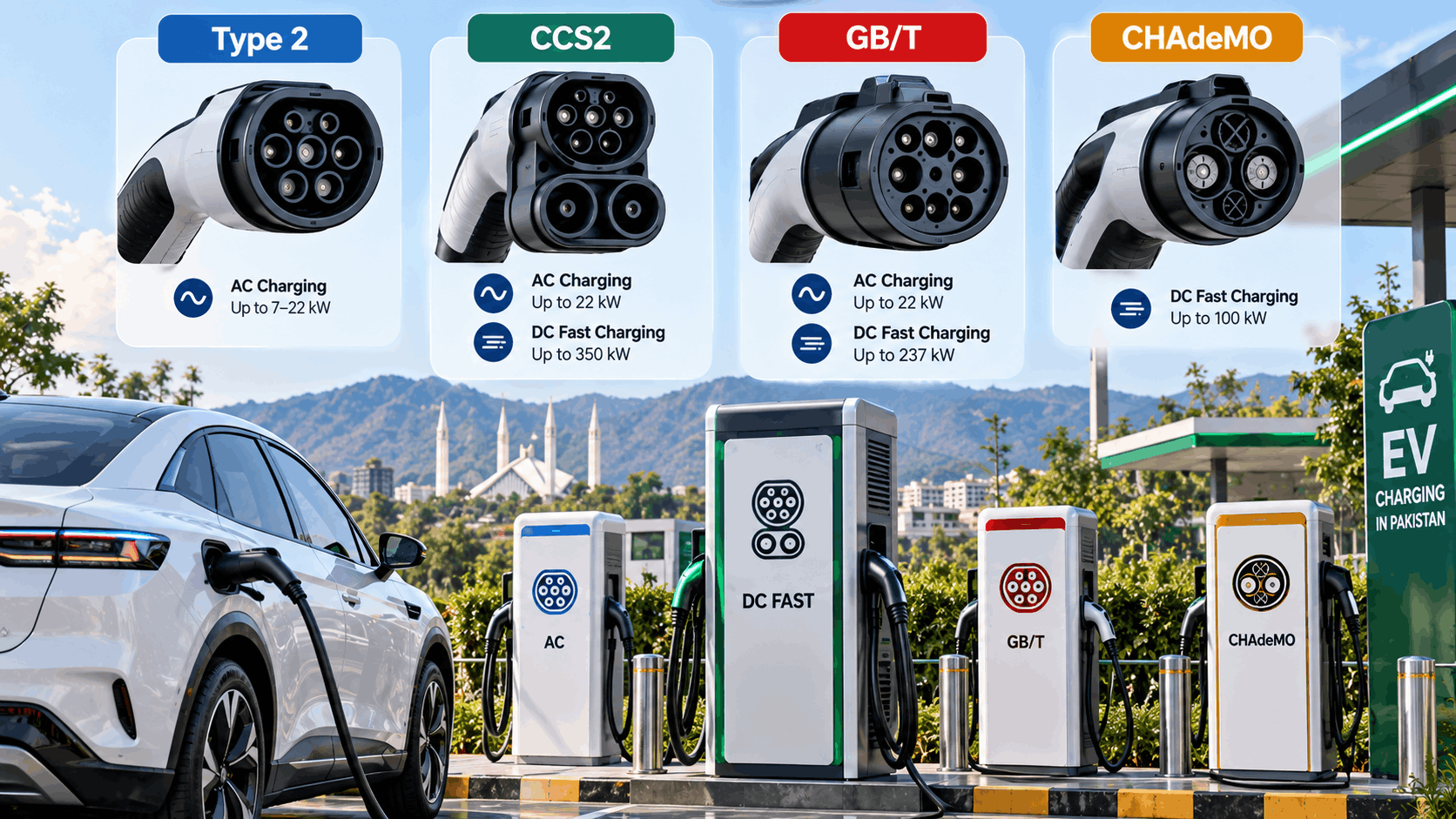
Buying an electric vehicle in Pakistan involves more than comparing battery capacity and driving range. You also need to know which charging connector the vehicle uses. Unlike petrol cars, where almost every vehicle can use the same fuel nozzle, EVs can have different AC and DC charging ports depending on the manufacturer and the market for which the vehicle was originally produced.
This is particularly important in Pakistan because the market includes officially launched EVs alongside imported vehicles from China, Japan, Europe and other regions. CCS2, Type 2, GB/T and CHAdeMO can therefore all appear on vehicles in Pakistan. Understanding these standards can help you choose the correct home charger, determine whether a public fast charger will work with your car, and avoid buying an EV that is difficult to charge on longer journeys.
AC Charging vs. DC Fast Charging
Before comparing connectors, it is important to understand the difference between AC and DC charging. Electricity supplied to homes and businesses is alternating current, or AC. EV batteries store direct current, or DC. When you connect an EV to an AC charger, the vehicle’s onboard charger converts AC electricity into DC before sending it to the battery.
Because the conversion happens inside the vehicle, AC charging speed is limited by both the charging equipment and the car’s onboard charger. A wallbox may support 11 kW, for example, but a vehicle with a 7 kW onboard charger will not suddenly charge at 11 kW.
DC fast chargers work differently. They convert electricity to DC inside the charging station and deliver DC power more directly to the battery. This allows much higher charging power and is why DC chargers are normally used at motorway stops and public fast-charging locations.
What Is a Type 2 EV Charger?
Type 2, also known as the Mennekes connector, is one of the most widely used AC charging connectors. It is common on European-market EVs and is also used by many vehicles officially sold in international markets.
Type 2 is primarily associated with AC charging. Depending on the vehicle, electrical supply and onboard charger, it can support single-phase or three-phase charging.
For a typical EV owner in Pakistan, Type 2 is most relevant when charging at home, an office, hotel, shopping centre or destination charger.
A home wallbox might provide around 7 kW, while some three-phase installations can provide 11 kW or 22 kW. However, the actual charging speed depends on what the vehicle itself can accept.
This distinction matters: installing a more powerful AC charger does not guarantee that your car will charge at that full power.
What Is CCS2?
CCS2, or Combined Charging System Type 2, expands the Type 2 design to support DC fast charging.
A CCS2 vehicle inlet essentially combines the Type 2 AC connection with two additional large DC contacts underneath it. This allows one vehicle charging inlet to support both normal AC charging and high-power DC fast charging.
In practice, a CCS2-equipped EV may use the Type 2 portion when connected to a home AC wallbox and the complete CCS2 connection when plugged into a DC fast charger.
This makes CCS2 convenient because the manufacturer does not need completely separate AC and DC charging locations on the vehicle.
CCS2 has become particularly important for newer EVs because it can support high DC charging power, although the maximum charging speed depends on the vehicle’s battery architecture and charging system rather than the connector alone.
Type 2 vs. CCS2: Are They the Same?
They are related but not exactly the same.
Type 2 = primarily AC charging
CCS2 = Type 2 connection plus additional DC pins for fast charging
If an EV specification says AC Type 2 and DC CCS2, it means the car can normally use a Type 2 connection for slower AC charging and CCS2 for DC fast charging.
For consumers, this is one of the easiest combinations to understand because the same vehicle inlet area can handle both charging methods.
What Is GB/T Charging?
GB/T refers to Chinese national charging standards. Because Pakistan has a growing number of Chinese vehicles and privately imported Chinese-market EVs, buyers may encounter GB/T charging ports.
GB/T should not be confused with CCS2. The physical connectors and communication systems are different, meaning a GB/T vehicle cannot simply plug directly into a CCS2 charger.
There are also separate GB/T connections for AC and DC charging. A vehicle imported from the Chinese domestic market may therefore have charging hardware different from an export version of the same model.
This is particularly important when buying a used or privately imported EV. Two vehicles that look almost identical can potentially have different charging ports because they were originally produced for different markets.
Before buying an imported EV, physically inspect the charging port and confirm both its AC and DC charging standards.
When buying a used EV, also check its battery State of Health.
CCS2 vs. GB/T
The biggest practical difference for Pakistani consumers is compatibility.
A CCS2 charger requires a CCS2-compatible vehicle, while a GB/T DC vehicle normally requires GB/T-compatible charging equipment or an appropriate conversion solution.
The connectors are not interchangeable simply because both provide DC fast charging.
Adapters and converter systems do exist for some combinations, but buyers should not assume that every charger can safely be converted to every vehicle. DC fast charging involves high voltage, communication between the charger and vehicle, safety checks and battery-management coordination.
For that reason, native compatibility with the charging network you expect to use is preferable to depending entirely on adapters.
What About CHAdeMO?
Another connector you may encounter is CHAdeMO, particularly on some Japanese EVs and older imported electric vehicles.
CHAdeMO is a DC fast-charging standard developed in Japan. It uses a separate DC connector rather than the combined Type 2/CCS2 design.
While CHAdeMO played an important role during the early expansion of electric vehicles, many newer global EV platforms have shifted toward CCS-based charging. However, buyers considering used Japanese imports should still check for CHAdeMO compatibility.
A vehicle can also have one port for AC charging and a separate CHAdeMO port for DC fast charging.
Which EV Charging Standards Are Recognized in Pakistan?
Pakistan does not exist within a single-connector EV ecosystem. The country’s charging framework recognizes multiple technologies because different vehicles can require different connections.
The National Energy Efficiency and Conservation Authority’s EV charging infrastructure regulations reference compatibility with standards and connector systems including CCS2, CHAdeMO, GB/T, Mennekes (Type 2), Tesla and relevant IEC standards. The regulations also cover safety, registration and technical requirements for EV charging infrastructure in Pakistan. Neeca
This multi-standard environment is one reason Pakistani EV buyers should check connector compatibility rather than assuming every public charger will work with every electric car.
What Does 7 kW, 22 kW or 120 kW Mean?
The connector type tells you how the vehicle connects, while the kW rating tells you approximately how much charging power can be delivered.
For example, a home AC charger might be rated at 7 kW. Public AC equipment may support higher power such as 11 kW or 22 kW where the electrical supply and vehicle support it. DC fast chargers can operate at much higher levels such as 30 kW, 60 kW, 120 kW, 150 kW, 350 kW or beyond.
However, the charger’s maximum rating is not the same as the charging speed your EV will always receive.
If your vehicle can accept a maximum of 70 kW DC, connecting it to a 120 kW charger will not make it charge at 120 kW. The vehicle requests the amount of power that its battery-management system considers appropriate.
Battery temperature and state of charge also affect the actual speed.
Why Charging Speed Falls as the Battery Fills
Even when the charger and vehicle support the same maximum power, charging speed normally changes throughout the session.
An EV may reach high charging power when the battery has a relatively low state of charge and then gradually reduce power as the battery fills. This behaviour is known as the charging curve.
Battery temperature also matters. A battery that is too cold or too hot may accept less power. EVs with battery preconditioning can heat or cool the battery before reaching a fast charger to improve charging performance.
This is why a charger labelled 120 kW or 350 kW does not mean your car will receive that power continuously.
Which Charger Should You Install at Home in Pakistan?
For most EV owners, home charging is likely to be the most convenient option. A vehicle parked overnight usually does not require extremely fast charging.
The first step is checking your vehicle’s AC charging port and maximum AC input. If the car supports Type 2 at 7 kW, installing a compatible 7 kW wallbox may make more sense than paying for significantly more powerful equipment the vehicle cannot use.
You also need to consider the electrical connection available at your property. Higher-power chargers may require electrical upgrades or three-phase power.
Installation should be carried out with appropriate circuit protection, grounding, cable sizing and safety equipment. EV charging involves sustained high electrical loads, so a charger should not simply be connected through unsuitable household wiring.
What to Check Before Buying an EV in Pakistan
Before buying either a new or used EV, check four charging specifications: AC connector type, maximum AC charging power, DC connector type and maximum DC charging power.
For an imported vehicle, also determine which regional version you are buying. Do not assume that because an international version uses CCS2, a Chinese domestic-market version of the same vehicle uses the same connector.
You should also check whether compatible public fast chargers exist along the routes you regularly travel. Someone who charges entirely at home in Lahore may have different requirements from someone who frequently travels between Lahore, Islamabad, Peshawar or other cities.
Charging compatibility should therefore be treated as part of the vehicle-buying decision rather than something to investigate after purchasing the car.
The Future of EV Charging in Pakistan
Pakistan’s charging ecosystem is likely to evolve as more officially supported EVs enter the market and public charging networks expand. Greater standardization would make EV ownership easier, but multiple connector types are likely to remain relevant for some time because the country’s vehicle fleet includes both officially distributed and imported models.
For consumers, the important distinction is simple: Type 2 is mainly associated with AC charging, CCS2 combines Type 2 with DC fast charging, GB/T is a separate Chinese charging standard, and CHAdeMO can still appear on Japanese EVs.
Knowing the connector is only the first step. Charging speed also depends on charger power, the vehicle’s onboard charger, maximum DC acceptance rate, battery temperature, state of charge and charging curve.
Understanding these differences before buying an electric vehicle can make home charging easier and prevent unpleasant surprises when trying to use a public fast charger in Pakistan.