

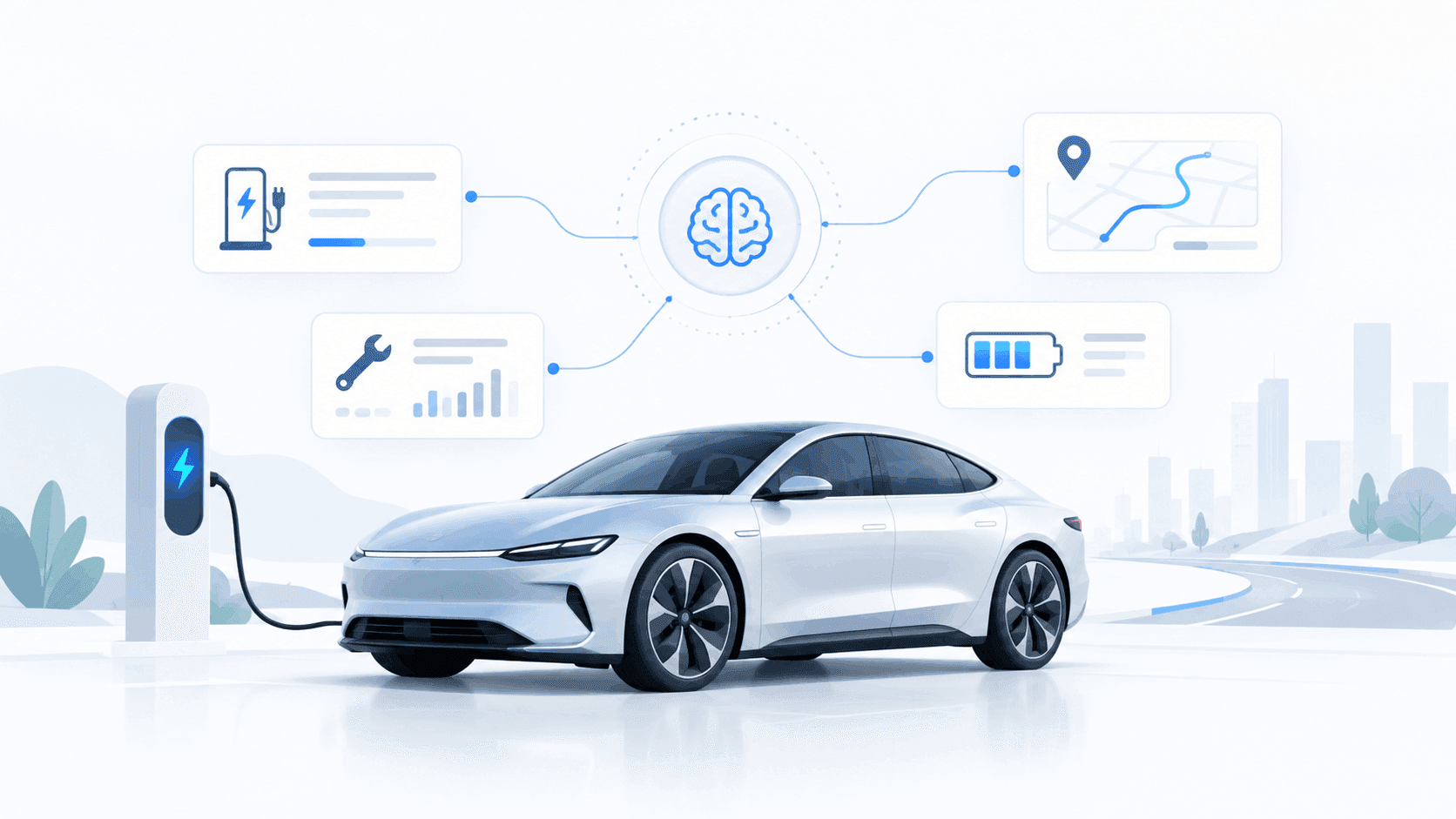
Artificial intelligence is already transforming the automotive industry. Modern vehicles use AI for driver assistance, navigation, battery management, predictive maintenance, and personalized infotainment. But the next major step goes beyond AI systems that simply analyze information or respond to commands. That next step is agentic AI in automotive.
Agentic AI introduces autonomous AI agents that can understand goals, make decisions, use different tools and systems, and perform multi-step tasks with limited human intervention. Instead of simply telling a driver that a battery is running low, an AI agent could find suitable charging stations, compare availability, adjust the route, and help prepare the vehicle for charging. This shift could change how cars operate, how electric vehicles charge, how maintenance is performed, and even how drivers interact with automotive services.
What Is Agentic AI in Automotive?
Agentic AI refers to artificial intelligence systems designed to work toward a goal rather than simply produce an answer. Traditional AI usually performs a specific task: a navigation system calculates a route, while a diagnostic system detects a potential mechanical problem. An AI agent, however, can connect several tasks together and decide what actions are needed to achieve a broader objective.
For example, imagine that a vehicle detects unusual battery temperatures. Instead of only displaying a warning, an automotive AI agent could analyze sensor data, determine the seriousness of the issue, check nearby service centers, suggest an appointment, and provide diagnostic information to the service provider. The important difference is that the AI is not simply generating information; it is coordinating actions.
This is one reason the automotive industry is gradually moving from the software-defined vehicle (SDV) toward what some technology companies describe as an AI-defined vehicle. In this model, artificial intelligence becomes a more active layer that can coordinate vehicle functions, understand context, and personalize the driving experience.
How Agentic AI Could Change Cars
Cars are becoming increasingly connected digital platforms equipped with cameras, radar, vehicle sensors, powerful processors, cloud connectivity, and software-controlled components. AI agents could act as an intelligent layer connecting these systems, allowing the vehicle to understand a driver’s objective and coordinate multiple functions without requiring the driver to manually navigate different menus and applications.
For example, a driver could say, “Find somewhere to charge near my destination and make sure I still arrive before 6 PM.” An AI agent could evaluate the vehicle’s battery level, expected energy consumption, traffic conditions, available charging stations, charging speeds, and estimated charging time before recommending the most suitable route.
More advanced vehicles could use multiple specialized AI agents responsible for navigation, energy management, infotainment, maintenance, and external services. These agents could communicate with one another to complete tasks that currently require several separate apps or manual decisions.
Smarter In-Car AI Assistants
Voice assistants have existed in vehicles for years, but most remain relatively limited. They can usually perform basic tasks such as changing music, adjusting climate controls, making calls, or entering navigation destinations. Agentic AI could make these assistants considerably more capable by allowing them to understand broader objectives rather than processing individual commands one at a time.
For example, a driver might say, “I’m going to Islamabad tomorrow morning. Prepare the car for the trip.” An advanced automotive AI agent could check the expected route, estimate the required battery range, identify charging opportunities, review relevant weather conditions, and suggest an appropriate departure time.
Some of these capabilities are already starting to appear in the automotive industry. Google has introduced automotive AI technologies designed to support more natural, multi-turn conversations inside vehicles, while other technology companies are developing AI platforms capable of connecting vehicle data with navigation, cloud services, and driver preferences.
Agentic AI and EV Charging
Electric vehicle charging is another area where AI agents could have a significant impact. Finding the right charger involves several variables, including distance, charger compatibility, charging speed, availability, battery level, electricity price, and expected waiting time. An AI charging agent could continuously evaluate these factors and recommend the best option based on the driver’s journey.
For example, the system might determine that the closest charging station is busy and instead recommend another charger several kilometers away because it would reduce the total journey time. The agent could also take battery temperature, remaining range, traffic conditions, and charging speed into account before selecting a station.
AI agents could also help charging network operators manage infrastructure. AWS has documented how charging technology company Autel developed an AI-agent system for charging station management that uses specialized agents to support equipment monitoring, operations, revenue analysis, and smart charging.
For more technical information, see the external source: AWS – How Autel Transformed Charging Station Management with AI Agents.
As EV networks grow, similar technologies could help operators detect charger failures, predict demand, balance energy loads, and prioritize maintenance before problems significantly affect customers.
Predictive Maintenance Could Become More Autonomous
Predictive maintenance already uses vehicle data to identify components that may fail before they actually break. Agentic AI could take this concept further by moving from simply identifying problems to helping coordinate the entire maintenance process.
Consider a vehicle that detects abnormal brake wear. Instead of only displaying a dashboard warning, an automotive maintenance agent could analyze sensor readings and maintenance history, estimate remaining component life, identify suitable repair centers, check parts availability, recommend appointment times, and prepare diagnostic information for the technician.
This could make vehicle maintenance more proactive and convenient. Drivers may receive fewer unexpected breakdowns, while service centers could receive better diagnostic information before the vehicle even arrives.
AI Agents and Electric Vehicle Battery Management
Battery performance is one of the most important factors affecting electric vehicles. EVs constantly generate information about battery temperature, voltage, charging behavior, energy consumption, and state of charge. AI agents could continuously analyze this information and coordinate different vehicle systems to improve efficiency and battery performance.
For example, an agent could combine navigation data with climate control, charging strategy, driving conditions, and battery conditioning during a long journey. Instead of treating these systems separately, the AI could optimize them together based on the driver’s destination and current battery condition.
Over time, increasingly capable agents could help manage more of the battery lifecycle, from everyday charging optimization to battery degradation monitoring and maintenance recommendations. This could become particularly valuable as EV batteries age and their performance becomes more dependent on charging behavior, temperature, and usage patterns.
Edge AI and Cloud AI Will Work Together
Automotive agentic AI is unlikely to operate entirely in the cloud. Vehicles contain systems that must respond quickly and continue functioning even when internet connectivity is unavailable. For this reason, future automotive AI platforms will likely use a combination of edge AI and cloud AI.
Edge AI runs directly inside the vehicle and can handle time-sensitive functions, privacy-sensitive information, basic vehicle controls, and immediate driver interactions. Cloud AI, on the other hand, can provide more computationally intensive reasoning, access external services, process larger datasets, and coordinate information across multiple platforms.
The challenge for automakers will be determining which tasks should remain inside the vehicle and which can safely use cloud infrastructure. Safety-critical operations will generally require highly reliable local systems, while services such as trip planning, external searches, and complex information processing may benefit from cloud-based AI.
Challenges of Agentic AI in Automotive
Giving AI systems greater autonomy also creates significant challenges. Automotive AI agents need strong cybersecurity protections because they may interact with vehicle systems, cloud services, charging infrastructure, payment platforms, navigation systems, and personal information.
Reliability is equally important. An incorrect answer from a general chatbot may be inconvenient, but an incorrect action involving a vehicle can have much more serious consequences. Manufacturers will therefore need strict boundaries around what an AI agent can control and when human approval is required.
Privacy, regulatory compliance, explainability, connectivity, computing costs, and integration with older vehicle platforms will also influence adoption. Safety-critical vehicle functions will still require specialized automotive software, extensive testing, and strict safety engineering even as AI becomes more capable.
The Future of Agentic AI in Automotive
The automotive industry has already moved from mechanically controlled vehicles toward increasingly software-defined vehicles. Agentic AI could represent another major stage in that evolution, with cars gradually becoming intelligent platforms capable of coordinating navigation, charging, maintenance, infotainment, energy consumption, and digital services on behalf of drivers.
The biggest change may not be a single new feature. Instead, it could be the ability of different AI systems to work together toward a driver’s goal. A vehicle may eventually recognize that maintenance is needed before the driver notices a problem, plan charging before the battery becomes low, adjust routes based on energy requirements, and coordinate services without forcing the driver to manage every individual step.
Agentic AI will not make vehicles completely autonomous overnight. Safety, regulation, cybersecurity, reliability, and driver trust remain major requirements. However, as vehicles become increasingly connected and software-driven, AI agents are likely to become an important part of the automotive ecosystem.
The future car may not simply respond to commands. It could increasingly understand objectives, determine the steps required to achieve them, and coordinate multiple vehicle and external systems to help the driver complete a journey more efficiently.