

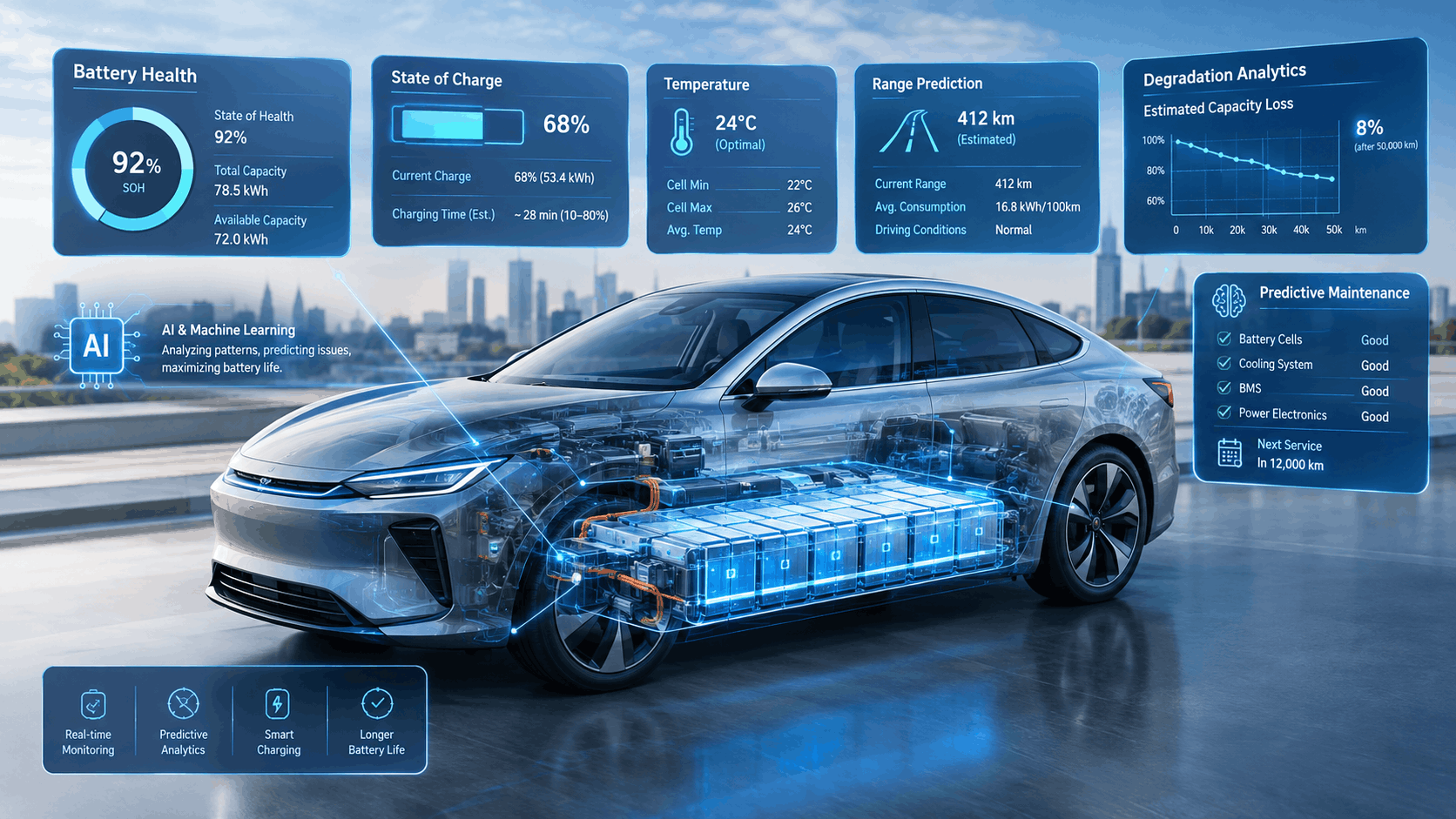
Electric vehicles are becoming more advanced every year, but battery performance remains one of the biggest concerns for drivers, manufacturers, and fleet operators. An EV battery directly affects driving range, charging speed, reliability, resale value, and overall vehicle performance. As batteries age, their ability to store and deliver energy gradually changes, making accurate battery health monitoring increasingly important. This is where artificial intelligence and machine learning are playing a major role.
AI can analyze large amounts of battery data, identify patterns, estimate remaining range, predict degradation, and detect warning signs that may indicate a future battery problem. Instead of simply reacting when battery performance drops, modern EV systems are moving toward predictive battery management, where software can estimate what may happen before a failure actually occurs.
What Is EV Battery Health?
EV battery health refers to the overall condition and performance of an electric vehicle battery compared with when it was new. One of the most widely used measurements is State of Health, commonly known as SOH. A new battery generally starts close to its maximum usable capacity, but this capacity slowly decreases over time because of charging cycles, temperature exposure, driving habits, storage conditions, fast charging, and natural chemical aging. A reduction in battery health can affect driving range, charging performance, acceleration, efficiency, and the long-term value of the vehicle. For this reason, manufacturers increasingly use advanced battery management systems to monitor battery behavior throughout the vehicle’s life. Battery chemistry and pack design are also improving rapidly, and many of these developments are covered in our guide to EV Battery Technology: The Next Leap in Range and the Breakthroughs Powering Next-Generation Electric Vehicles.
How AI Is Used in EV Battery Management
Modern electric vehicles generate enormous amounts of battery data, and a Battery Management System, or BMS, continuously monitors information such as voltage, current, temperature, charging and discharging patterns, energy consumption, state of charge, and individual cell performance.
Machine learning models can analyze this information to identify relationships between operating conditions and battery behavior that may be difficult to detect using fixed rules alone. Instead of relying only on predefined limits, an AI-powered battery management system can learn from historical and real-time data to improve estimates of battery condition and future performance.
This allows AI systems to support more accurate predictions of remaining driving range, State of Charge, State of Health, battery degradation, Remaining Useful Life, temperature-related risks, abnormal cell behavior, and potential battery failures. This growing reliance on software is part of the wider shift toward software-defined vehicles, where software increasingly controls performance, diagnostics, energy management, and many core vehicle functions. You can learn more in our article, The New Engine Is Code: Why the Software-Defined Vehicle Is the Biggest Threat to Traditional Automakers.
How Machine Learning Improves EV Range Prediction
Range anxiety remains one of the most common concerns among EV drivers. Traditional range estimation may rely mainly on current battery charge and average energy consumption, but actual driving range depends on many different variables. These can include driving speed, acceleration, traffic, road gradient, outside temperature, cabin heating or cooling, battery temperature, vehicle weight, driving style, and the age of the battery. Machine learning can improve EV range prediction by analyzing many of these factors at the same time.
An AI model can learn how a particular vehicle consumes energy under different conditions and then adjust the estimated range accordingly. For example, highway driving in cold weather with the cabin heater running may use considerably more energy than city driving in mild temperatures. A machine learning system can identify these patterns and provide a more realistic estimate of how far the vehicle can travel.
AI for Predicting EV Battery Aging
Battery aging is unavoidable, but the rate of degradation can vary significantly depending on how the battery is used. Frequent fast charging, prolonged exposure to high temperatures, deep charging and discharging cycles, and keeping a battery at very high charge levels for long periods can all contribute to battery wear. Machine learning can analyze large amounts of historical battery data to identify patterns that are associated with capacity loss.
Instead of waiting years to observe the full aging process of a battery, researchers can use data-driven models to estimate future degradation from earlier performance measurements. This can help automakers improve battery pack design, thermal management systems, charging strategies, and warranty planning. The National Renewable Energy Laboratory has also conducted research into battery lifetime and degradation modeling, including the use of data-driven approaches to better understand long-term battery performance. Learn more about battery lifetime research from NREL.
Predicting Remaining Useful Life of an EV Battery
Another important use of machine learning is estimating Remaining Useful Life, or RUL. Remaining Useful Life describes how much useful service a battery may have before its performance falls below a defined level. This information can be useful for EV owners, manufacturers, dealerships, and fleet operators. For example, a fleet company managing hundreds of electric vehicles could use predictive models to identify which batteries are degrading faster and which vehicles may need maintenance first.
Rather than replacing batteries according to a fixed schedule, operators can make decisions based on the actual condition of each battery. AI-based RUL models may consider battery age, charge cycles, temperature history, charging habits, voltage behavior, internal resistance, and capacity loss to estimate how long the battery is likely to remain useful.
AI for Early Battery Failure Detection
Battery degradation usually happens gradually, but some abnormal battery behaviors may indicate a developing fault. Detecting these problems early is important because battery faults can affect performance, reliability, and safety. AI-powered systems can compare real-time battery behavior with previously learned patterns and flag unusual activity.
For example, an abnormal increase in temperature in one area of the battery pack, unusual voltage changes, or unexpected charging behavior may indicate that a cell is operating differently from the rest of the pack. Machine learning-based anomaly detection can help identify these issues earlier so the battery can be inspected before the problem becomes more serious.
How Edge AI Can Improve Battery Monitoring
Many EV battery decisions need to happen quickly, especially when the system detects abnormal temperature, voltage, or charging behavior. This is where Edge AI can be particularly useful. Instead of sending every piece of vehicle data to a remote cloud server, Edge AI allows some machine learning models to run directly inside the vehicle or on nearby computing hardware. This can reduce response time and allow the system to react immediately to changing battery conditions. It can also reduce the amount of data that needs to be transmitted externally. For a deeper explanation of how local AI processing works, see our guide to Edge AI: Benefits, Applications, and the Future of Real-Time Intelligence.
AI and Predictive Maintenance for Electric Vehicles
AI-based battery monitoring is also making predictive maintenance more practical. Traditional vehicle maintenance often follows fixed service schedules, but predictive maintenance uses sensor data and real-time vehicle information to estimate when a component actually needs attention. In EV battery systems, AI can help identify unexpected capacity loss, voltage imbalance, cooling system problems, charging irregularities, abnormal temperature patterns, or declining cell performance.
This allows manufacturers and fleet operators to investigate potential problems before they lead to reduced performance or unexpected vehicle downtime. For commercial fleets, this can be especially valuable because unplanned downtime can increase operating costs and affect vehicle availability.
Machine Learning Techniques Used for EV Battery Health
Different machine learning techniques can be used to monitor and predict EV battery health. Regression models can estimate battery capacity, State of Health, or Remaining Useful Life. Neural networks can identify complex relationships between battery measurements and degradation. Time-series models can analyze how battery behavior changes over weeks, months, or years, while anomaly detection algorithms can identify unusual temperature, voltage, or current patterns. Deep learning models may also be used when very large datasets are available. Researchers are increasingly exploring hybrid systems that combine machine learning with physics-based battery models. This approach can be useful because it combines established knowledge of battery chemistry with the ability of AI to learn from real-world vehicle data.
Can AI Help Prevent EV Battery Failure?
AI cannot guarantee that every battery failure will be prevented, but it can improve the ability to identify risk earlier. A battery may show subtle warning signs before a major fault occurs, including abnormal temperature changes, inconsistent voltage readings, unusual charging patterns, or performance differences between individual cells.
Machine learning systems can continuously monitor these signals and detect patterns that would be difficult for a person to identify manually. The U.S. Department of Energy has highlighted technologies designed to improve lithium-ion battery health monitoring and detect developing battery problems earlier, showing how advanced monitoring can contribute to safer battery systems. Read more about Battery Health Sentry from the U.S. Department of Energy.
Benefits of AI for EV Battery Health
Using AI for EV battery health monitoring offers several important benefits. More accurate State of Health estimates can give drivers a clearer picture of battery condition. Better range prediction can reduce uncertainty during long journeys, while early fault detection may improve reliability and safety.
Battery aging predictions can help manufacturers improve warranties and charging strategies, and predictive maintenance can help fleet operators reduce unexpected downtime. AI may also become increasingly important in the used EV market, where buyers want to know how much useful battery capacity remains before purchasing a second-hand electric vehicle.
Challenges of AI-Based Battery Prediction
Despite its advantages, AI-based battery prediction still has limitations. Machine learning models need large amounts of reliable and representative data, and battery behavior can vary depending on battery chemistry, vehicle design, climate, charging infrastructure, and driving conditions. A model trained using one battery type may not perform equally well with another chemistry or vehicle platform.
AI predictions must also be accurate, explainable, and fast enough for use in real-world vehicles. Data privacy and cybersecurity are additional concerns because connected EVs can collect and transmit large amounts of operating information. For these reasons, machine learning usually works best when combined with traditional battery engineering, physical models, sensor data, and established safety systems.
The Future of AI in EV Battery Technology
The role of AI in electric vehicle battery management is likely to grow as EV adoption increases. Future battery management systems may continuously learn from both individual vehicles and large fleets, allowing manufacturers to improve range estimation, charging strategies, degradation prediction, and fault detection. AI could also support smarter fast charging by adjusting charging speed according to battery temperature, age, chemistry, and current health. Another important application is battery second life. Accurate State of Health estimates could help determine whether an older EV battery still has enough usable capacity for stationary energy storage or whether it should be sent for recycling.
Conclusion
Artificial intelligence and machine learning are changing how electric vehicle batteries are monitored, managed, and maintained. By analyzing information such as voltage, current, temperature, charging behavior, driving patterns, and historical battery performance, AI can help estimate driving range, predict battery aging, calculate State of Health, estimate Remaining Useful Life, and detect potential battery failures.
This can lead to more reliable range estimates and a better understanding of battery condition. For manufacturers, AI can support better battery design, charging strategies, safety systems, and warranty planning. For fleet operators, predictive maintenance can reduce unexpected downtime and improve vehicle availability. As EV technology continues to develop, AI-powered battery management is likely to become an increasingly important part of making electric vehicles safer, smarter, more efficient, and longer lasting.