

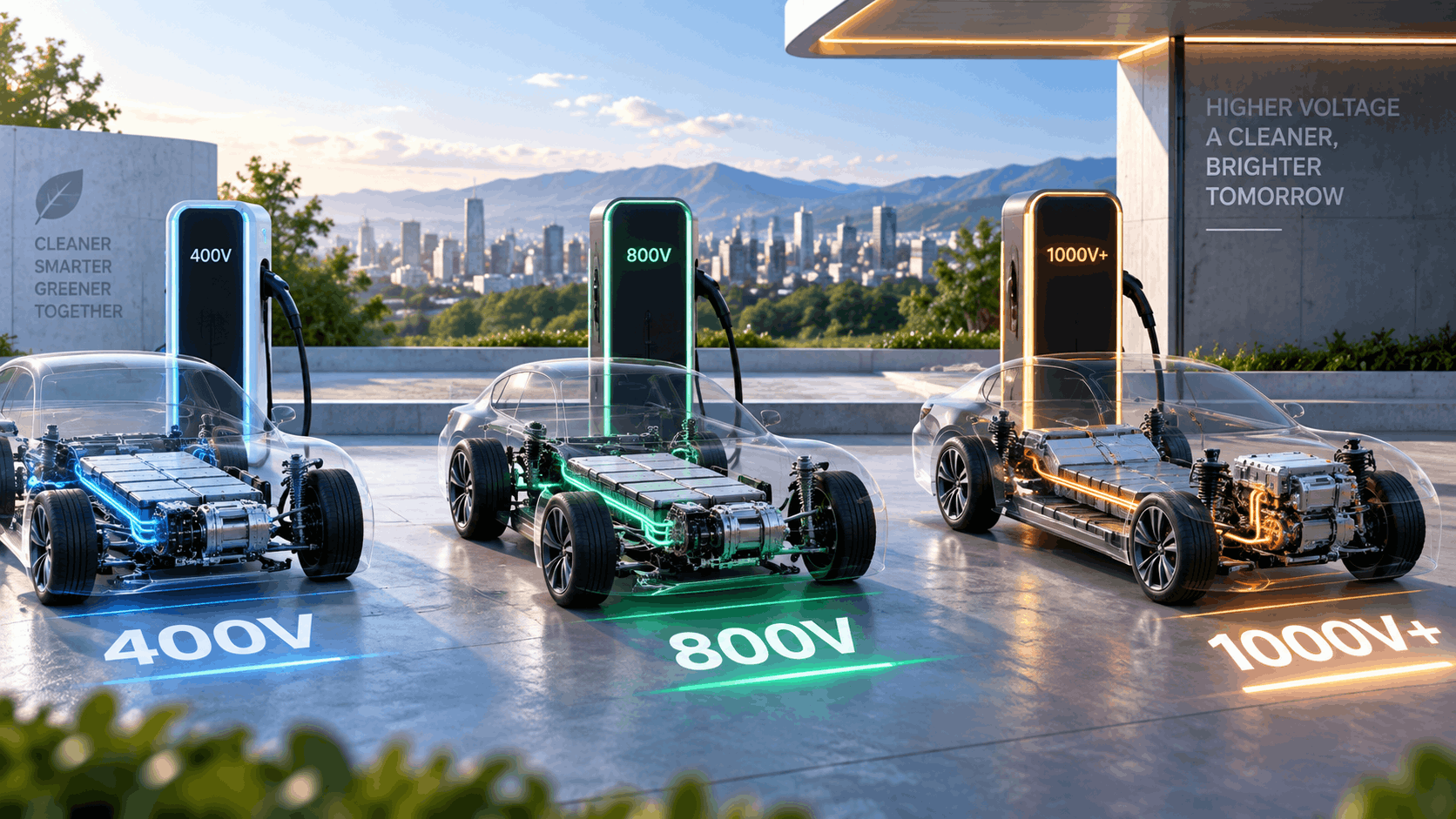
Electric vehicles are often described as having a 400V or 800V architecture, but those numbers represent much more than the voltage of the battery. An EV’s voltage architecture affects charging power, electrical current, cable size, heat generation, power electronics, efficiency, and even how manufacturers design the drivetrain.
For years, roughly 400V systems were the standard for mainstream electric vehicles. More manufacturers are now moving toward 800V architectures, while some newer platforms operate above 900V and emerging systems are pushing toward 1,000V. Higher voltage can provide important advantages, particularly for ultra-fast charging and high-performance EVs, but it also adds cost and engineering complexity. Understanding EV voltage architecture helps explain why two electric cars with similar battery sizes can have very different charging and performance characteristics.
What Is EV Voltage Architecture?
EV voltage architecture describes the approximate operating voltage of the vehicle’s high-voltage electrical system. This system connects the traction battery with components such as the inverter, electric motors, DC fast-charging system, DC/DC converter, climate-control equipment, and other high-power electronics.
A vehicle described as a 400V EV does not necessarily operate at exactly 400 volts at all times. Battery voltage changes depending on the battery chemistry, number of cells connected in series, state of charge, temperature, and operating conditions. The same applies to 800V vehicles. These numbers are better understood as voltage classes rather than fixed voltages.
Most modern battery-electric vehicles use high-voltage systems because moving large amounts of electrical power at low voltage would require extremely high current. Increasing voltage allows engineers to transmit the same amount of power with less current.
Why Does Higher Voltage Matter?
Electrical power can be expressed using a simple relationship:
Power = Voltage × Current
Imagine an EV needs approximately 200 kW of electrical power. A 400V system would theoretically require around 500 amps, while an 800V system could deliver the same power at roughly 250 amps.
Reducing current is valuable because electrical resistance generates heat. Resistive losses increase approximately with the square of current, represented by I²R. Higher-voltage systems can therefore reduce electrical losses or allow manufacturers to use smaller conductors while still delivering large amounts of power.
This is one reason high-voltage architectures are attractive for powerful motors and very fast DC charging.
What Is a 400V EV Architecture?
The 400V architecture became the conventional design for many early and current mass-market electric vehicles. Depending on battery configuration and state of charge, the actual pack voltage may operate substantially above or below the nominal 400V figure.
A major advantage of 400V technology is maturity. Components such as inverters, chargers, contactors, connectors, compressors, and DC/DC converters are widely available, and manufacturers have years of experience designing vehicles around this voltage range.
A 400V EV can still charge very quickly. Battery chemistry, thermal management, charging curves, cell design, charger capability, and software all influence charging speed. Voltage alone does not determine how quickly an EV charges.
For mainstream vehicles where extreme charging speeds or very high continuous power are not required, a well-designed 400V system can remain practical and cost-effective.
What Is an 800V EV Architecture?
An 800V architecture approximately doubles the voltage available in a traditional 400V system. The main goal is not simply to advertise a bigger number; it is to reduce the current required for high-power operation.
Porsche helped bring 800V technology into mainstream attention with the Taycan. Porsche says the higher system voltage enables faster charging while reducing cable weight and installation space compared with conventional 400V technology.
For a deeper technical explanation, see Porsche’s overview of the Taycan’s 800-volt electrical architecture.
Other EV platforms have since adopted similar architectures. Hyundai Motor Group’s E-GMP, for example, supports 800V charging while also allowing charging from 400V infrastructure through its power electronics.
400V vs. 800V EV Charging
Charging is where the advantages of higher voltage are easiest to understand. A DC fast charger must transfer a large amount of electrical power through the charging cable and vehicle connection.
At 400V, reaching extremely high charging power requires very high current. At 800V, similar power can be transferred using significantly less current. Alternatively, manufacturers can combine high voltage with substantial current to achieve even greater charging power.
Modern examples show the difference. Porsche’s current Taycan 800V architecture can accept up to 320 kW under suitable conditions, while the same vehicle is limited to lower charging power when connected to 400V infrastructure.
However, an 800V label does not automatically mean an EV will charge twice as fast as a 400V model. Maximum charger output, battery temperature, state of charge, cell chemistry, battery size, thermal management, and the vehicle’s charging curve all determine real-world charging time.
Does 800V Improve EV Efficiency?
Higher voltage can improve electrical efficiency in some parts of the drivetrain because lower current can reduce resistive losses. Manufacturers may also reduce the cross-sectional area of high-voltage cables, helping lower weight.
The benefits become particularly useful in high-performance vehicles where large amounts of power move between the battery, inverter, and motors. Porsche states that its 800V system allows smaller cable cross-sections and reduces electrical losses.
However, switching from 400V to 800V does not suddenly double vehicle efficiency or driving range. Aerodynamics, vehicle mass, tire resistance, motor efficiency, inverter technology, battery chemistry, climate conditions, and driving speed have a much greater combined influence on real-world range.
Why Doesn’t Every EV Use 800V?
If higher voltage has advantages, it may seem logical for every manufacturer to immediately switch to 800V. The problem is cost and complexity.
Higher-voltage systems require components designed and validated for those voltage levels, including semiconductors, capacitors, insulation, connectors, charging hardware, electric motors, safety systems, and thermal-management equipment.
Manufacturers also need to ensure compatibility with existing charging infrastructure. Some charging stations operate at voltages below what a high-voltage battery requires, meaning the vehicle may need additional power-conversion hardware.
A 400V architecture may therefore remain more economical for affordable city cars and other EVs where moderate charging and performance levels are sufficient.
How Do 800V EVs Use 400V Chargers?
Charging compatibility is an important part of high-voltage EV design. An 800V battery cannot always directly take full advantage of a lower-voltage charger.
Different manufacturers solve this in different ways. Hyundai’s E-GMP architecture can use the vehicle’s motor and inverter to boost incoming 400V power to the voltage required by its 800V battery.
Other manufacturers use dedicated DC/DC boost converters or integrated charging electronics.
This means an 800V vehicle can still use many 400V chargers, but charging speed may be lower depending on the vehicle’s conversion system and the charger’s capabilities.
Beyond 800V: 900V+ EV Systems
The industry is already moving beyond the simple 400V-versus-800V discussion. Some electric vehicles use architectures exceeding 900V.
Lucid describes the Air as using a 900V+ architecture, allowing the vehicle to operate at very high voltage for efficient power delivery and fast charging. Lucid also notes that lower-voltage charging stations require its onboard boost system to manage the voltage difference.
These architectures show that 800V is not an upper limit. Voltage levels can continue increasing where manufacturers believe the improvements in charging, performance, and electrical efficiency justify the additional engineering requirements.
The Move Toward 1,000V EV Architecture
The next major step is already emerging: 1,000V passenger EV platforms.
In 2025, BYD announced its Super e-Platform using a 1,000V high-voltage architecture across major systems including the battery, motor, power supply, and climate-control system. BYD says the platform combines 1,000V operation with very high charging current to target charging power of up to 1,000 kW under compatible conditions.
This demonstrates where high-voltage EV engineering may be heading. Instead of treating 800V as the final architecture, manufacturers can continue raising system voltage to support increasingly powerful drivetrains and charging systems.
Infrastructure will be critical, though. A vehicle capable of extremely high charging power cannot achieve those speeds unless the charger and local electricity connection can provide the required voltage and power.
Does Higher Voltage Mean More Driving Range?
Not directly. Battery voltage and battery energy capacity are different measurements.
Voltage is measured in volts (V), while battery capacity is normally discussed in kilowatt-hours (kWh). A 100 kWh 400V battery and a 100 kWh 800V battery contain roughly the same amount of usable energy if all other factors are equal.
An 800V architecture may reduce certain electrical losses and vehicle weight, which can contribute to efficiency, but it does not automatically give the vehicle twice the range.
Driving range still depends mainly on battery capacity and how efficiently the vehicle uses that energy.
400V, 800V or 1,000V: Which Is Better?
There is no single voltage architecture that is best for every electric vehicle. A 400V system can be cost-effective, mature, and perfectly suitable for mainstream EVs. An 800V system becomes attractive when manufacturers want higher charging power, lower current, reduced cable requirements, or sustained high-performance operation.
Systems above 900V and approaching 1,000V push those advantages further but demand more advanced components and compatible charging infrastructure.
The correct architecture therefore depends on the vehicle. An affordable urban EV and a high-performance long-distance electric car have very different engineering requirements.
The Future of EV Voltage Architecture
EV voltage architecture is evolving alongside battery cells, charging infrastructure, power electronics, and semiconductor technology. The industry has moved from predominantly 400V vehicles toward a growing number of 800V platforms, while 900V+ and 1,000V systems show that higher-voltage designs are continuing to develop.
Future EVs are unlikely to converge on one voltage. Instead, manufacturers will choose architectures based on charging targets, vehicle price, performance, battery chemistry, available infrastructure, and overall system efficiency.
For consumers, this means voltage should not be considered in isolation. An 800V or 1,000V badge can indicate advanced electrical engineering, but real-world charging speed ultimately depends on the complete system — the battery, charging curve, thermal management, power electronics, and charger working together.
As ultra-fast charging expands, EV voltage architecture will become an increasingly important part of how electric vehicles are designed, marketed, and compared.