

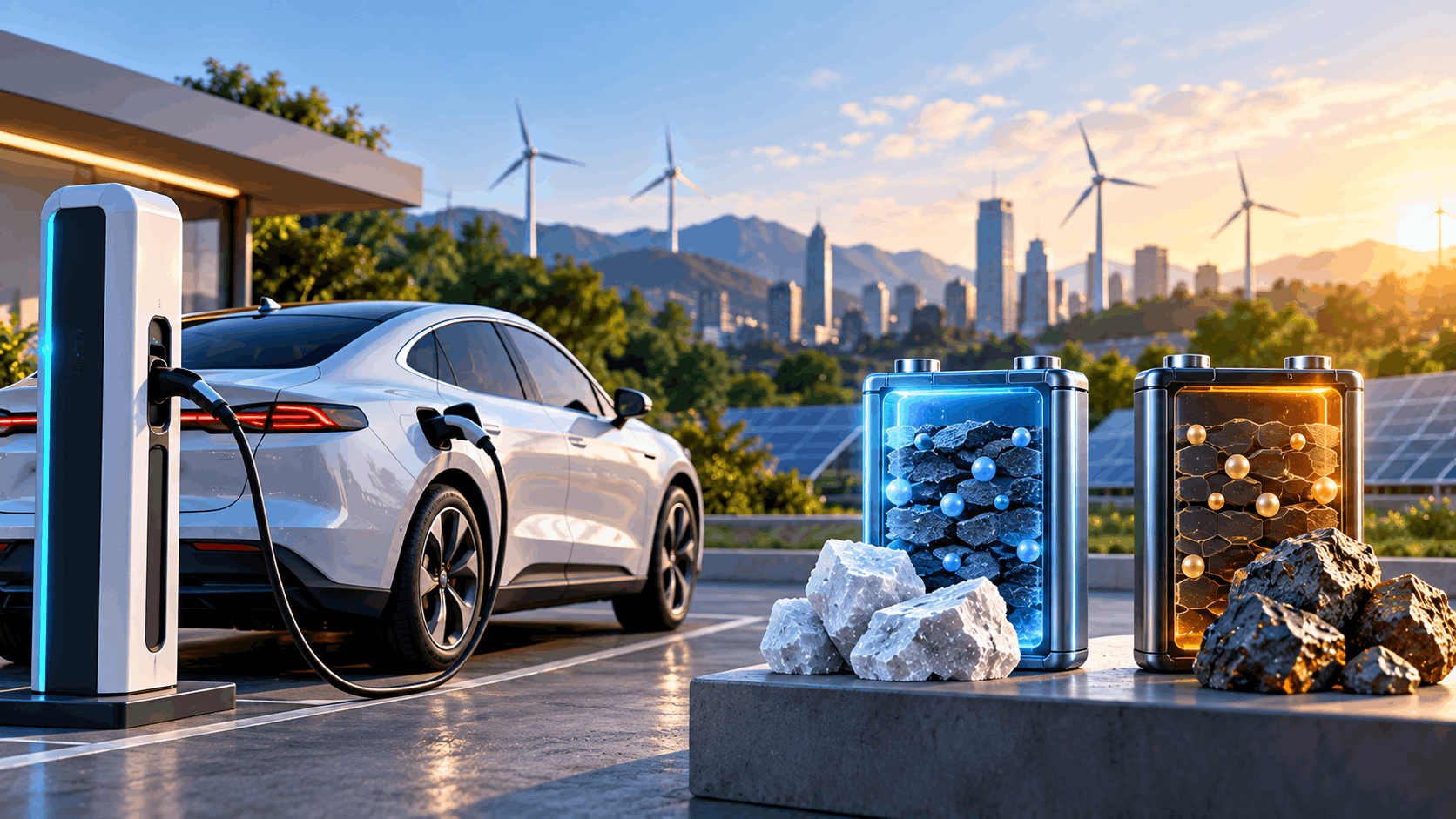
Lithium-ion batteries have powered the rapid growth of electric vehicles, but lithium is not the only element that can store energy inside a rechargeable battery. A competing technology based on sodium is moving from laboratories into commercial vehicles and large-scale production. The sodium-ion EV battery could provide automakers with another option for building affordable electric cars, particularly where extreme driving range is less important than cost, safety, cold-weather performance, and supply-chain stability.
Sodium is abundant, widely available, and does not require lithium, nickel, or cobalt in many battery designs. However, sodium-ion batteries also have an important disadvantage: they generally store less energy for the same weight than modern lithium-ion batteries. That trade-off means sodium-ion technology is unlikely to replace lithium everywhere, but it could become an important alternative for entry-level EVs, city cars, commercial vehicles, hybrid battery packs, and stationary energy storage.
What Is a Sodium-Ion EV Battery?
A sodium-ion battery is a rechargeable battery that uses sodium ions to carry electrical charge between the positive and negative electrodes. Its basic operating principle is similar to a lithium-ion battery. During charging and discharging, ions move between the cathode and anode through an electrolyte while electrons travel through the external electrical circuit.
The major difference is the material carrying the charge. Lithium-ion batteries use lithium ions, while sodium-ion batteries use sodium ions. Sodium atoms are larger and heavier than lithium atoms, which contributes to the lower energy density of current sodium-ion cells. However, sodium is far more abundant and can potentially support a more geographically diversified battery supply chain.
Many sodium-ion batteries use hard carbon for the anode and materials such as layered oxides or Prussian blue analogues for the cathode. The chemistry continues to evolve as manufacturers attempt to increase energy density, cycle life, charging performance, and manufacturing efficiency.
Why Are Automakers Interested in Sodium-Ion Batteries?
The automotive industry’s interest in sodium-ion batteries is largely driven by cost, resource availability, cold-weather performance, and the desire to avoid relying on a single battery chemistry.
Lithium prices have experienced significant fluctuations in recent years. Although lithium-ion manufacturing is now highly optimized, dependence on lithium and other battery materials can expose manufacturers to commodity price changes and geopolitical supply risks. Sodium is much more widely available, giving battery manufacturers another potential raw-material pathway.
The International Energy Agency reported in 2026 that sodium-ion technology is entering a scale-up phase as leading battery manufacturers expand production. The IEA also notes that sodium-ion batteries could help manufacturers reduce exposure to lithium price volatility, although today’s low-cost LFP batteries remain difficult for sodium-ion technology to beat in many applications.
For a detailed industry overview, see the International Energy Agency’s analysis of sodium-ion battery momentum.
Sodium-Ion vs. Lithium-Ion EV Batteries
The biggest difference between sodium-ion and lithium-ion batteries today is energy density. Energy density determines how much energy a battery can store relative to its weight or volume, which directly affects how large and heavy an EV battery must be to achieve a particular driving range.
According to the IEA, the latest sodium-ion cells can reach around 175 Wh/kg, compared with approximately 205 Wh/kg for advanced LFP cells and around 265 Wh/kg for NMC cells. This gap matters because an EV using sodium-ion batteries may need a larger or heavier battery pack to achieve the same range as a lithium-ion vehicle.
However, energy density is only one battery metric. Cost, safety, temperature performance, charging capability, cycle life, raw-material availability, and manufacturing complexity also matter. Sodium-ion batteries may therefore make sense in applications where maximum range is not the highest priority.
Could Sodium-Ion Batteries Make EVs Cheaper?
Lower cost is one of the biggest promises surrounding sodium-ion batteries, but it is important not to assume that every sodium battery is already cheaper than lithium-ion.
Sodium itself is abundant and inexpensive, and some sodium-ion designs can avoid expensive materials such as lithium, nickel, and cobalt. Aluminum can also potentially be used more extensively in sodium-ion cells, creating additional manufacturing opportunities.
However, raw-material prices are only part of battery cost. Lithium-ion batteries benefit from decades of research, enormous factories, established suppliers, optimized production lines, and massive economies of scale. Sodium-ion manufacturing is still much smaller.
The IEA says sodium-ion technology does not currently undercut LFP batteries in most applications at today’s lithium prices. The long-term cost advantage will therefore depend on manufacturing scale, energy density improvements, material supply chains, and future lithium prices.
The better way to describe sodium-ion batteries is potentially lower-cost, rather than automatically cheaper.
Sodium-Ion Batteries Perform Well in Cold Weather
One of sodium-ion technology’s most interesting advantages is low-temperature performance. EV batteries typically lose usable capacity and charging performance when temperatures fall, and LFP batteries can be particularly affected by extreme cold.
Modern sodium-ion cells have demonstrated considerably stronger cold-weather behavior. CATL says its Naxtra sodium-ion passenger EV battery can retain more than 90% usable capacity at -40°C and operate across temperatures from approximately -40°C to 70°C.
This could make sodium-ion batteries especially attractive in regions with harsh winters. Better cold-weather performance could reduce range loss and improve vehicle reliability without requiring as much energy for battery heating.
It also creates an interesting possibility: combining sodium-ion and lithium-ion cells inside the same battery system.
Hybrid Sodium-Ion and Lithium Battery Packs
The future may not require automakers to choose between sodium-ion and lithium-ion chemistry. Battery packs could use both.
A hybrid battery could use lithium-ion cells where high energy density is required while sodium-ion cells provide better cold-temperature performance, lower dependence on lithium, or additional power characteristics.
CATL has already presented a sodium-LFP dual-power architecture that combines its Naxtra sodium-ion battery technology with LFP cells. The idea is to use the strengths of different chemistries within one vehicle rather than forcing one chemistry to handle every requirement.
This type of multi-chemistry architecture could become increasingly important as EV manufacturers optimize batteries for different markets, climates, vehicle sizes, and prices.
How Far Can a Sodium-Ion EV Travel?
Range remains one of the main limitations of sodium-ion EV batteries. Lower energy density means fitting enough energy into a passenger vehicle is more difficult than with high-energy lithium chemistries.
The IEA estimates that current sodium-ion technology could support approximately 350 km of range in an average SUV, while lithium-ion alternatives can typically support roughly 400–600 km depending on chemistry and conditions.
However, the technology is improving quickly. CATL announced that its 175 Wh/kg Naxtra battery can support more than 400 km of pure-electric range in its initial passenger-vehicle application, with higher ranges expected as the technology and supply chain improve.
That range may already be sufficient for urban vehicles and everyday commuting. Not every EV needs a 700 km battery, particularly if reducing the vehicle’s purchase price is the priority.
Are Sodium-Ion Batteries Safer?
Battery safety depends on cell chemistry, manufacturing quality, pack design, thermal management, battery management software, and how the battery is used. It would therefore be misleading to claim that every sodium-ion battery is automatically safer than every lithium-ion battery. AI for EV battery health uses machine learning to predict range, aging, and potential battery failures.
However, sodium-ion chemistry has characteristics that manufacturers are using to pursue improved thermal stability. CATL has emphasized safety as one of the key benefits of its Naxtra technology, and in September 2025 the battery passed China’s GB 38031-2025 electric-vehicle traction battery safety certification.
Safety improvements could become especially important for affordable EVs, commercial vehicles, battery swapping, and stationary energy storage, where batteries experience frequent charge and discharge cycles.
What Are the Main Disadvantages?
Energy density remains the largest disadvantage. A heavier or larger battery can reduce vehicle efficiency, passenger space, or driving range. This makes sodium-ion chemistry less attractive for premium EVs where consumers expect very long ranges without increasing battery size.
The supply chain is another challenge. Lithium-ion production already operates at enormous scale, whereas sodium-ion cell production remains relatively small. The IEA estimates current sodium-ion manufacturing capacity at only a small fraction of lithium-ion capacity, and specialized materials such as battery-grade hard carbon still need a much larger supply chain.
Sodium-ion technology also has to compete with LFP batteries, which have become significantly cheaper while continuing to improve in energy density, charging speed, durability, and manufacturing efficiency.
Where Will Sodium-Ion EV Batteries Make the Most Sense?
The strongest early applications may be vehicles where affordability matters more than extreme driving range. Small electric cars, urban delivery vehicles, commercial fleets, two- and three-wheelers, and vehicles operating in cold climates are particularly promising.
Stationary energy storage could become an even larger market because weight and size matter much less when the battery stays in one location. The same manufacturing growth driven by grid storage could eventually help reduce sodium-ion costs for electric vehicles.
Sodium-ion cells could also appear inside hybrid battery packs instead of completely replacing lithium-ion technology. This would allow automakers to optimize different parts of the battery for range, power, temperature performance, cost, and safety.
The Future of Sodium-Ion EV Batteries
Sodium-ion technology has moved well beyond being only a laboratory experiment. Commercial batteries are entering vehicles, manufacturers are building production capacity, and major companies are investing in next-generation sodium-ion chemistry.
However, lithium-ion batteries still have major advantages. Their energy density is higher, production infrastructure is enormous, and LFP chemistry has become extremely competitive on cost. Sodium-ion batteries will need continued improvements in energy density, manufacturing scale, and material supply chains to compete across more EV segments.
The most realistic future is therefore not sodium replacing lithium completely. Instead, EV manufacturers are likely to use multiple battery chemistries depending on what each vehicle needs. Long-range premium EVs may continue using high-energy lithium batteries, while affordable city EVs, cold-climate vehicles, commercial fleets, and energy storage systems could increasingly use sodium-ion technology.
For the sodium-ion EV battery, the key advantage may ultimately be choice. A second scalable battery chemistry could reduce dependence on lithium, expand material supply options, improve cold-weather performance, and give manufacturers another path toward affordable electric vehicles.