

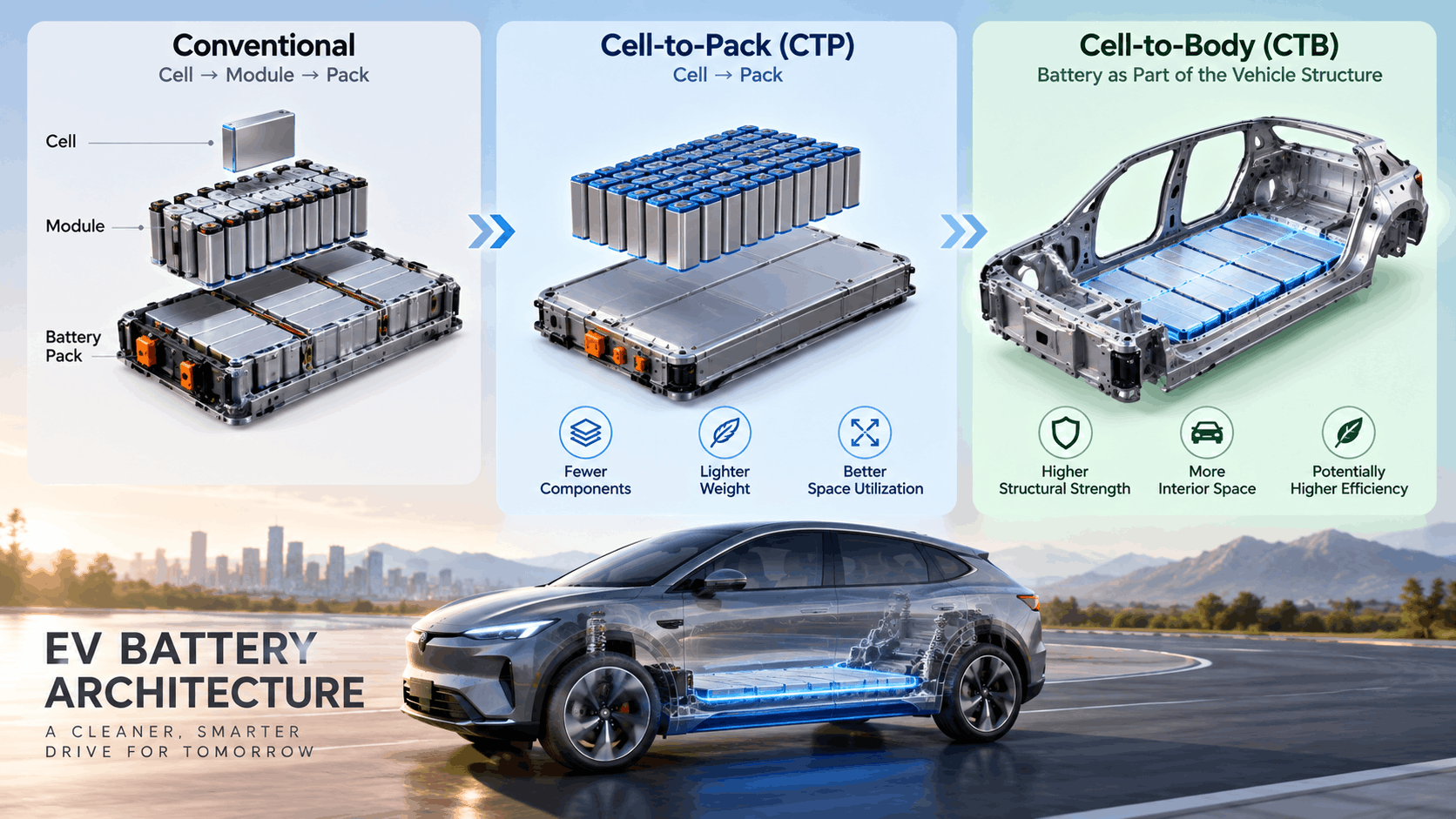
Electric vehicle battery technology is evolving beyond chemistry. While much of the discussion focuses on LFP, NMC, sodium-ion, and solid-state batteries, manufacturers are also changing how individual battery cells are physically integrated into an electric vehicle. Two increasingly important approaches are Cell-to-Pack (CTP) and Cell-to-Body (CTB) battery architecture.
Traditional EV batteries group individual cells into modules before assembling those modules into a complete battery pack. Cell-to-Pack removes the module layer, allowing cells to be integrated more directly into the pack. Cell-to-Body goes further by integrating the battery more closely with the vehicle’s body structure. Both approaches aim to reduce unnecessary components, improve space utilization, lower weight, and potentially increase the amount of usable battery capacity that can fit inside a vehicle.
How Traditional EV Battery Packs Work
A conventional electric vehicle battery generally follows a cell-to-module-to-pack structure. Individual battery cells are grouped into modules, several modules are installed inside a protective battery enclosure, and the complete pack is mounted to the vehicle.
Modules provide structural support and make it easier to organize cells, electrical connections, cooling systems, sensors, and safety components. However, module housings, brackets, connectors, fasteners, and other structural parts take up space and add weight without storing energy.
As automakers try to increase range while reducing battery size, weight, and manufacturing complexity, eliminating some of these intermediate structures has become increasingly attractive.
What Is Cell-to-Pack Battery Technology?
Cell-to-Pack, or CTP, removes the traditional battery module layer. Instead of following a cell-to-module-to-pack structure, individual cells or larger groups of cells are integrated more directly into the battery pack.
The simplified structure can increase the proportion of the battery pack occupied by energy-storing cells. Fewer module housings and connectors may also reduce component count, weight, manufacturing steps, and unused space.
The basic architecture becomes:
Traditional battery: Cell → Module → Pack → Vehicle
Cell-to-Pack: Cell → Pack → Vehicle
CTP does not mean that battery cells are simply placed loosely inside an enclosure. The pack still needs sophisticated structural protection, cooling, electrical connections, sensors, insulation, crash protection, and a battery management system.
CATL is one of the major manufacturers developing CTP technology and says its newer CTP designs improve battery-pack volume utilization through highly integrated structures. For an official technical overview, see CATL’s battery technology overview.
What Is Cell-to-Body Battery Technology?
Cell-to-Body, commonly abbreviated as CTB, takes battery integration another step. Instead of treating the battery pack as a mostly separate component mounted underneath the vehicle, CTB integrates the battery system more closely with the vehicle body.
In a traditional EV, the vehicle floor and battery enclosure are largely separate structures. In a CTB design, some of these structural functions can be combined. The battery enclosure or its structural components can contribute to the rigidity of the vehicle itself.
A simplified progression looks like this:
Traditional: Cell → Module → Pack → Vehicle
CTP: Cell → Pack → Vehicle
CTB: Cell/Battery Structure → Vehicle Body
This tighter integration can improve packaging efficiency, but it also means the battery and vehicle body must be designed together from the beginning.
Cell-to-Pack vs. Cell-to-Body: What Is the Main Difference?
The biggest difference is the level of integration. Cell-to-Pack primarily removes unnecessary structures inside the battery pack. The finished battery pack still remains a recognizable component that is installed into the vehicle.
Cell-to-Body moves beyond pack optimization by integrating the battery system with the vehicle’s structural design. Parts that previously belonged separately to the battery pack and vehicle body may perform shared functions.
CTP can therefore be viewed as improving the battery pack itself, while CTB attempts to improve the complete battery-and-vehicle system.
Why Removing Battery Modules Matters
Battery modules provide important structural and organizational functions, but they do not store electricity themselves. Every module housing uses space and contributes weight.
By removing conventional modules, manufacturers can potentially fit more cells into a battery pack of similar dimensions. Alternatively, they can provide the same battery capacity using a smaller or lighter pack.
This concept is sometimes described as improving pack-level energy density or packaging efficiency. The chemistry of the individual cells may remain unchanged, but more of the available volume can be dedicated to active battery components instead of supporting structures.
This is important because improving the efficiency of the complete battery pack can increase vehicle performance even when individual battery cells do not significantly improve.
Can CTB Provide More Interior Space?
Cell-to-Body architecture may allow manufacturers to use the floor area of an EV more efficiently because the battery and body are designed as a coordinated structure.
Traditional battery packs require their own enclosure, while the vehicle requires a separate floor and supporting structure. Greater integration may reduce some of this duplication.
Depending on the vehicle design, manufacturers could use the saved space to create a thinner floor, increase cabin room, improve seating position, or package more battery capacity underneath passengers.
However, CTB does not automatically guarantee more passenger space. The actual benefit depends on how the manufacturer designs the complete platform.
Structural Strength Is Another Major Difference
One of the most interesting advantages of Cell-to-Body technology is the possibility of using the battery enclosure as part of the vehicle’s structural system.
The battery occupies a large area beneath an electric car, making it potentially useful for improving chassis stiffness. A more rigid structure can help engineers optimize handling, suspension behavior, noise and vibration, and crash performance.
CTP packs can also be extremely strong, but CTB makes structural integration a more fundamental part of the vehicle architecture.
Battery architecture alone, however, does not determine vehicle safety. Cell chemistry, crash structures, thermal management, manufacturing quality, software, battery protection, and thermal-propagation control remain equally important.
How CTP and CTB Affect EV Range
Neither Cell-to-Pack nor Cell-to-Body directly creates additional energy. Instead, the potential range benefit comes from reducing inactive material and using available space more efficiently.
If a CTP battery allows more cells to fit inside the same enclosure, the manufacturer may increase battery capacity without substantially increasing pack dimensions. Alternatively, maintaining the same capacity with a lighter pack could improve vehicle efficiency.
CTB can extend the idea further by removing duplication between the battery pack and vehicle structure.
However, EV range still depends heavily on battery chemistry, battery capacity, aerodynamics, vehicle weight, tires, motors, power electronics, temperature, and driving conditions. CTP or CTB should therefore be considered one part of the overall efficiency equation.
What About Battery Cooling?
More integrated batteries require carefully designed thermal-management systems. Individual cells generate heat during driving and particularly during DC fast charging, so manufacturers must maintain relatively consistent temperatures throughout the battery.
Removing modules gives engineers opportunities to redesign cooling systems and place thermal-management components closer to the cells. This can potentially improve heat transfer while reducing unnecessary components.
However, higher levels of integration also make thermal engineering more complicated because cooling, structural support, electrical isolation, and crash protection must all work within the same compact architecture.
Are Cell-to-Pack Batteries Easier to Repair?
Repairability is one of the potential trade-offs of increasingly integrated battery designs.
Traditional modular battery packs can theoretically allow technicians to replace an individual module rather than replacing the entire battery. Whether manufacturers actually support this type of repair varies significantly between vehicles.
Removing modules can make individual sections of a CTP battery harder to access. CTB may increase the challenge because the battery structure can be more closely connected with the vehicle body.
That does not mean every integrated battery is impossible to repair. Manufacturers can design service procedures into CTP and CTB systems, but repairability depends heavily on the individual vehicle architecture.
What Is Cell-to-Chassis?
Another term you may encounter is Cell-to-Chassis (CTC). Like Cell-to-Body, CTC represents a move toward deeper integration between battery cells and the vehicle structure.
There is no perfectly universal definition separating CTB and CTC because different manufacturers use the terms differently. Generally, both describe architectures that move beyond a traditional standalone battery pack.
The long-term direction is clear: EV manufacturers are gradually integrating cells, battery structures, chassis components, thermal management, power electronics, and vehicle systems more closely together.
Cell-to-Pack vs. Cell-to-Body: Which Is Better?
Neither technology is automatically better for every electric vehicle. Cell-to-Pack provides many packaging benefits while maintaining a relatively distinct battery pack. It can reduce components, improve space utilization, and simplify parts of battery manufacturing.
Cell-to-Body takes integration further. It can potentially improve vehicle packaging and structural rigidity by designing the battery and body as a combined system. The downside is greater engineering complexity and potentially more difficult repairs after significant battery or structural damage.
The right solution depends on the manufacturer’s vehicle platform, production strategy, battery chemistry, safety requirements, cost targets, and repair philosophy.
The Future of EV Battery Architecture
Battery development is moving from cell-to-module, through cell-to-pack, toward cell-to-body and cell-to-chassis architectures. This evolution reflects a broader shift in electric vehicle engineering: manufacturers are no longer treating the battery as simply a large component installed underneath a car.
Instead, the battery is becoming one of the core structures around which an EV is designed.
The debate around Cell-to-Pack vs. Cell-to-Body EV batteries is therefore about more than packaging. It represents two stages in the industry’s move toward lighter, simpler, more integrated electric vehicles. CTP removes unnecessary layers inside the battery pack, while CTB pushes integration into the vehicle itself.
As EV platforms continue to evolve, the boundary between the battery, chassis, and body could become increasingly difficult to separate.