

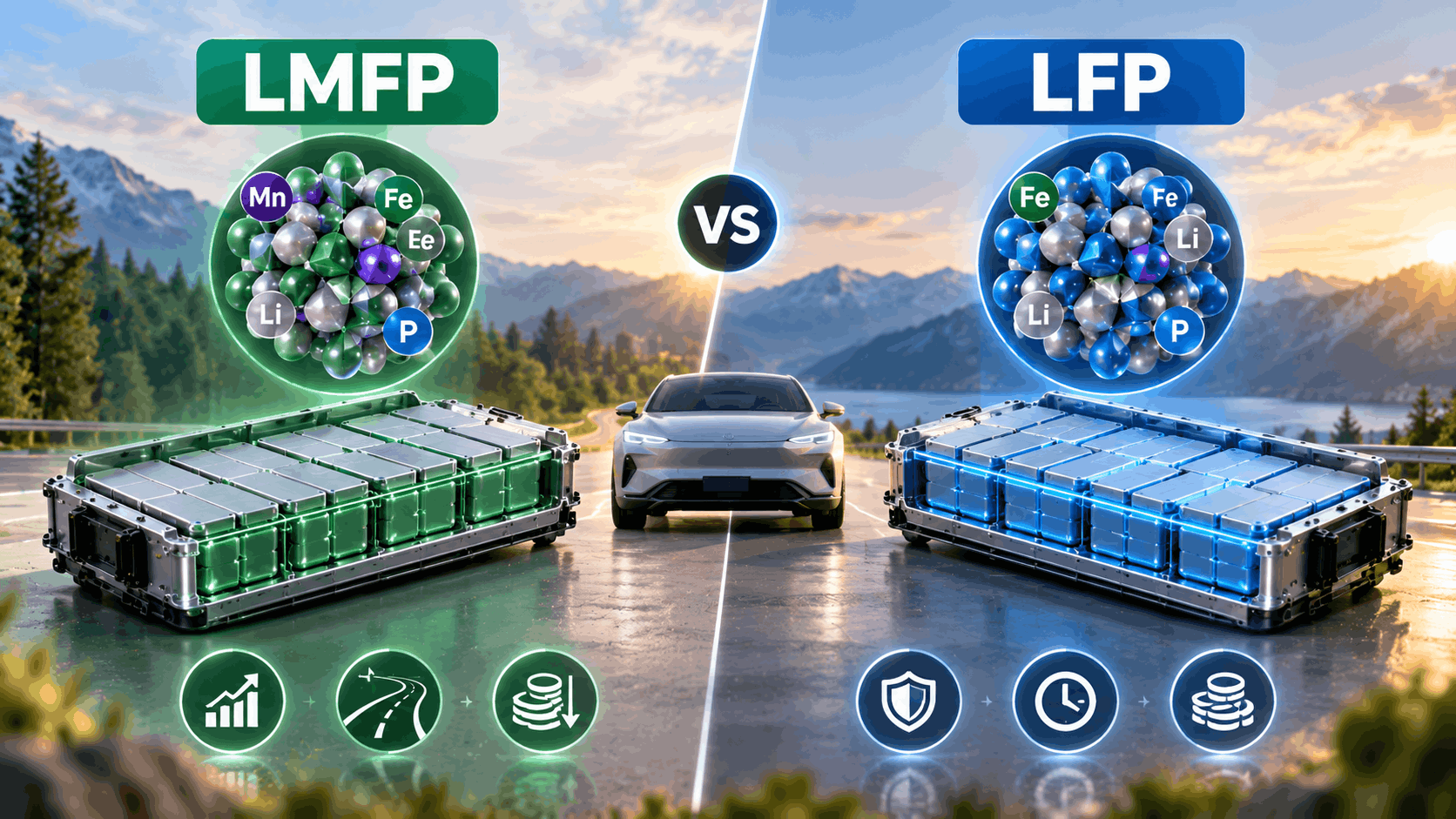
Lithium iron phosphate batteries have become one of the most important battery technologies in electric vehicles. LFP batteries are popular because they combine relatively low cost, long cycle life, good thermal stability, and freedom from nickel and cobalt. Their main limitation is energy density: compared with some nickel-based chemistries, an LFP battery generally needs more space and weight to store the same amount of energy.
A newer chemistry called LMFP, or lithium manganese iron phosphate, attempts to improve this weakness without abandoning the basic phosphate chemistry that makes LFP attractive. By replacing some of the iron in LFP with manganese, manufacturers can increase the operating voltage of the cathode and potentially store more energy in a battery of similar size. This makes the LMFP vs. LFP battery comparison particularly interesting for affordable electric vehicles that need more driving range without moving to expensive nickel-rich batteries.
What Is an LFP Battery?
LFP stands for lithium iron phosphate, with the chemical formula LiFePO₄. It is a lithium-ion battery cathode chemistry built around lithium, iron, phosphorus, and oxygen.
One of LFP’s biggest advantages is its use of relatively abundant materials. It does not require nickel or cobalt in the cathode, which can simplify material sourcing and help control costs. Its phosphate structure is also known for strong thermal stability and long cycle life, making LFP suitable for electric cars, buses, commercial vehicles, and stationary energy storage.
The trade-off is energy density. LFP operates at a lower voltage than several competing lithium-ion chemistries, limiting the amount of energy that can be stored for a given battery weight. Battery manufacturers have improved this significantly through better cells, Cell-to-Pack designs, and more efficient battery packaging, but chemistry still places limits on how far conventional LFP can go.
What Is an LMFP Battery?
LMFP stands for lithium manganese iron phosphate. It belongs to the same general olivine phosphate family as LFP, but part of the iron is replaced with manganese.
This relatively small chemical change has an important effect. Manganese operates at a higher electrochemical potential than iron, allowing LMFP to achieve a higher average operating voltage while maintaining a similar theoretical capacity.
In simple terms, LFP provides a strong foundation for safety, durability, and affordability, while manganese is added to increase voltage and therefore energy density.
LMFP can be represented broadly as:
LiMnₓFe₁₋ₓPO₄
The exact ratio of manganese to iron varies between designs. Manufacturers must carefully balance the two because increasing manganese can improve voltage while also creating challenges involving conductivity, cycling stability, and material behavior.
LMFP vs. LFP: What Is the Main Difference?
The fundamental difference is the cathode composition. LFP uses iron as its primary transition metal, while LMFP uses a mixture of manganese and iron.
That additional manganese raises the battery’s operating voltage. Since battery energy depends on both capacity and voltage, a higher voltage allows LMFP to potentially provide more energy without requiring a proportional increase in battery size.
This is why LMFP is often described as an evolutionary improvement rather than a completely new battery chemistry. Manufacturers can retain many of the advantages associated with phosphate batteries while attempting to improve range.
Can LMFP Provide Higher Energy Density?
This is LMFP’s main attraction.
LFP’s cathode operates around a relatively low voltage compared with high-energy nickel-based materials. Introducing manganese creates a higher-voltage contribution, allowing LMFP cells to increase specific energy even when their fundamental lithium storage capacity remains relatively similar.
A recent scientific review describes LMFP as combining LFP’s thermal stability and cost characteristics with higher voltage, while noting that practical development still faces conductivity, lithium-ion diffusion, manganese dissolution, and density challenges.
In current commercial development, manufacturers are also reporting meaningful gains. Gotion, for example, says its second-generation LMFP technology increases energy density relative to its LFP baseline while raising operating voltage. You can see the manufacturer’s current LMFP technology information on Gotion’s official LMFP page.
The exact improvement in a production EV depends on the cell design, battery pack, thermal management, vehicle efficiency, and how much of the theoretical chemistry advantage is achieved in real cells.
Could LMFP Give Affordable EVs More Range?
Potentially, and this may be one of its most important applications.
Suppose an affordable electric car already uses an LFP battery that fills most of the available space underneath the vehicle. Increasing battery capacity by simply adding more cells could make the pack larger, heavier, and more expensive.
If LMFP provides greater energy density within approximately the same package, manufacturers could instead increase stored energy without dramatically increasing battery size.
That extra energy could be used for additional driving range. Alternatively, an automaker could maintain approximately the same range while installing a smaller battery, reducing weight or freeing space elsewhere in the vehicle.
This makes LMFP particularly attractive for mainstream EVs, where manufacturers must carefully balance range, battery cost, vehicle weight, and selling price.
LMFP vs. LFP Battery Cost
LMFP does not automatically mean cheaper batteries.
LFP has an enormous advantage in manufacturing maturity. Battery companies have spent years optimizing LFP production, and very large factories already manufacture the chemistry at scale.
LMFP introduces manganese, which is relatively abundant and considerably less costly than materials such as cobalt. It can therefore potentially improve energy density without moving toward expensive nickel-rich cathodes.
However, LMFP materials require additional manufacturing optimization, coatings, particle engineering, and other techniques to address their electrochemical limitations. Until LMFP reaches much larger production volumes, mature LFP manufacturing may remain cheaper in many applications.
The economic argument for LMFP may therefore be less about producing the absolute cheapest cell and more about delivering more energy per battery pack while retaining relatively affordable materials.
Does LMFP Keep the Safety Advantages of LFP?
LFP is widely valued for the thermal stability of its phosphate-based cathode structure. LMFP retains a related olivine phosphate structure, which makes it attractive compared with chemistries that prioritize very high energy density at the expense of other characteristics.
However, it would be misleading to say that every LMFP battery is automatically as safe as every LFP battery. Battery safety depends on much more than cathode chemistry, including cell design, electrolyte, manufacturing quality, battery management software, cooling, pack structure, electrical protection, and crash engineering.
LMFP’s connection to the phosphate chemistry family is encouraging, but safety must ultimately be evaluated at the complete cell and battery-pack level.
What Are the Problems With LMFP?
Adding manganese also creates technical challenges.
One major issue is electrical conductivity. Like LFP, LMFP has relatively poor intrinsic electronic conductivity, meaning manufacturers often rely on carbon coatings, particle optimization, and other techniques to achieve strong power and charging performance.
Manganese can also introduce problems involving manganese dissolution and structural distortion, which may contribute to capacity loss over repeated charging cycles. Researchers are investigating coatings, doping, particle engineering, and optimized manganese-to-iron ratios to reduce these effects.
LMFP must therefore do more than demonstrate high theoretical energy density. Manufacturers need to achieve long cycle life, fast charging, stable performance, low manufacturing costs, and large-scale consistency before it can challenge mature LFP across the mass market.
LMFP vs. LFP for Fast Charging
Battery chemistry affects fast charging, but it is only one part of the system. Charging speed also depends on anode design, electrolyte, cell structure, battery temperature, thermal management, state of charge, charging voltage, and battery-management software.
LMFP’s conductivity and lithium-ion diffusion challenges can make high-rate performance more difficult, which is one reason manufacturers use coatings and material modifications.
However, commercial developers are already targeting fast-charging LMFP batteries. The important point for consumers is that the letters LMFP alone will not tell you how quickly an EV charges. Two LMFP vehicles could have very different charging curves depending on their complete battery systems.
LMFP vs. NMC: Could It Fill the Gap?
LMFP could occupy an interesting position between LFP and higher-energy nickel-based chemistries such as NMC.
LFP offers affordability, durability, and good thermal stability but comparatively lower energy density. Nickel-rich NMC can provide higher energy density but typically relies on more expensive materials and requires careful thermal management.
LMFP attempts to increase energy density while staying within the iron-and-manganese phosphate family.
This could make it attractive for vehicles that need more range than conventional LFP can conveniently provide but do not require the highest possible energy density of premium battery chemistries.
Some battery manufacturers are also investigating LMFP blended with other cathode materials, which could allow engineers to balance cost, energy density, power, and longevity rather than relying on a single chemistry.
Will LMFP Replace LFP?
A complete replacement is unlikely.
LFP already works extremely well for many applications. Affordable urban EVs, commercial vehicles, buses, and stationary storage systems may not need LMFP’s additional energy density if conventional LFP already provides sufficient range.
LMFP becomes more attractive when battery space is limited and manufacturers want additional range without moving to a significantly more expensive chemistry.
The two could therefore coexist. LFP may remain the cost-focused option, while LMFP expands the capabilities of phosphate batteries into vehicles requiring somewhat higher energy density.
The Future of LMFP Batteries in Electric Vehicles
The development of LMFP demonstrates that EV battery innovation does not always require completely replacing existing chemistry. Sometimes modifying an established battery can create a better balance of cost, safety, durability, and energy density.
By adding manganese to the LFP chemistry, manufacturers can raise battery voltage and potentially store more energy within a similar amount of space. That could help affordable electric cars achieve longer ranges without relying heavily on nickel or cobalt.
LMFP still has important technical challenges involving conductivity, manganese stability, density, fast charging, and manufacturing scale. LFP also has a significant advantage from its mature global supply chain and years of mass production.
For this reason, the LMFP vs. LFP battery competition is unlikely to produce a single winner. LFP can continue serving applications where cost and longevity matter most, while LMFP could become an increasingly important option when manufacturers want the economics of phosphate batteries with additional driving range.