

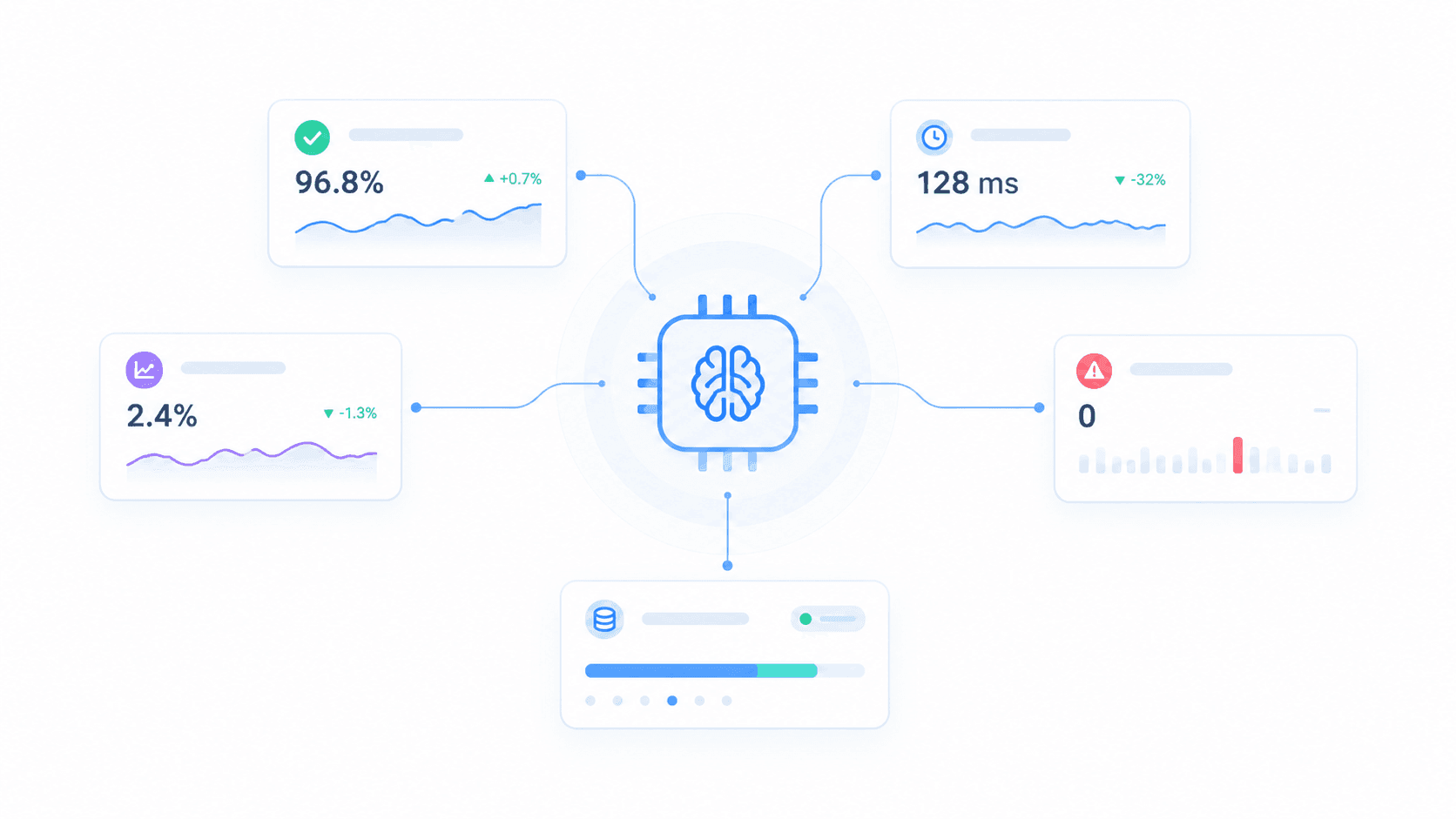
Artificial intelligence does not stop needing attention once a model is deployed. In fact, deployment is often where the real challenge begins. An AI model may perform extremely well during development and testing but behave differently when exposed to real users, changing data, unusual requests, infrastructure problems, or new business conditions. Generative AI systems introduce additional complications, including hallucinations, unpredictable outputs, prompt attacks, rising inference costs, and inconsistent responses.
This is why AI observability has become an important part of operating artificial intelligence in production. AI observability gives organizations visibility into how AI systems behave after deployment. Instead of simply checking whether an application is online, teams monitor model performance, inputs, outputs, latency, costs, data quality, safety issues, user behavior, and other signals that can reveal problems.
This article explains what AI observability is, how companies monitor AI models after deployment, which metrics matter, and why observability is becoming essential for production AI systems.
What Is AI Observability?
AI observability is the practice of collecting, analyzing, and interpreting information about an AI system to understand how it behaves in production. It helps engineering, machine learning, security, and product teams answer questions such as whether the model is still producing accurate results, whether production data has changed, whether users are sending unexpected inputs, whether the system is generating unsafe responses, and whether latency or costs are increasing.
Traditional application monitoring focuses heavily on infrastructure metrics such as CPU usage, memory consumption, server errors, and response times. AI observability goes further because an AI application can be technically healthy while its model produces poor results. A chatbot, for example, might have 99.99% infrastructure uptime while confidently giving customers incorrect information. From an infrastructure perspective, the system is working, but from an AI quality perspective, it is failing. That distinction is one of the reasons AI requires specialized observability.
Why AI Models Need Monitoring After Deployment
Before deployment, machine-learning teams usually evaluate models using test datasets, benchmarks, simulations, or human evaluations. However, laboratory testing cannot perfectly reproduce real-world conditions. Once deployed, the model encounters new users, changing environments, unexpected questions, evolving language, new products, unusual data patterns, and sometimes deliberately malicious inputs.
The U.S. National Institute of Standards and Technology (NIST) emphasizes the importance of monitoring AI systems throughout their lifecycle because post-deployment monitoring can help organizations identify performance degradation, unexpected behavior, attacks, and emerging risks. Organizations can refer to the NIST AI Risk Management Framework for guidance on managing AI-related risks:
As AI moves beyond software applications and into robots, vehicles, and other physical systems, continuous monitoring becomes even more important. Read our guide to Physical AI and how artificial intelligence is moving from screens into robots and vehicles.
The Main Components of AI Observability
A mature AI observability strategy usually monitors several layers of an AI application rather than treating the model as an isolated component.
1. Model Performance Monitoring
The first question is simple: Is the model still doing its job correctly? For predictive machine-learning systems, companies may track metrics such as accuracy, precision, recall, F1 score, false-positive rate, false-negative rate, and prediction confidence.
Consider a bank using an AI model to detect fraudulent transactions. During testing, the model might detect 94% of fraud cases. However, several months later, criminals may begin using new transaction patterns that were not present in the original training data. If detection performance falls to 82%, observability systems should identify the deterioration before it creates significant financial losses.
Generative AI applications require different evaluation techniques because there may not always be a single correct answer. Instead, companies may monitor relevance, factual accuracy, instruction following, answer completeness, toxicity, hallucination rates, and human feedback to understand whether the system is performing reliably.
AI observability is particularly important in predictive applications such as machine learning for EV battery health, where model accuracy can change as batteries age and operating conditions evolve.
2. Data Drift Monitoring
One of the biggest challenges for deployed machine-learning systems is data drift. Data drift occurs when the statistical characteristics of production data change compared with the data used during model development.
Suppose an e-commerce company trains a recommendation model using customer behavior from 2024 and 2025. Customer preferences may later change because of new trends, products, economic conditions, or demographic shifts. The model itself has not changed, but the world around the model has. Observability platforms can compare production data distributions against historical baselines and alert teams when significant changes appear.
3. Concept Drift Monitoring
Concept drift is related to data drift but represents a different problem. It occurs when the relationship between inputs and expected outcomes changes.
Imagine an AI system predicting whether customers are likely to cancel a subscription. Historically, low product usage might have been the strongest indicator of cancellation. After the company changes its pricing model, cost could become the primary reason customers leave. The previous relationship between customer behavior and churn has changed. Detecting concept drift can signal that the model needs to be retrained, recalibrated, or redesigned.
4. Generative AI Output Monitoring
Large language models create additional observability challenges because their outputs are open-ended and often non-deterministic. Companies deploying generative AI therefore monitor the conversations and responses produced by their applications.
Common areas include hallucinations, where models generate unsupported or fabricated information; relevance, which measures whether responses actually answer the user’s question; toxicity, which checks for offensive or inappropriate content; groundedness, which measures whether answers are supported by trusted documents; instruction adherence, which evaluates whether the model followed system rules; and sensitive information exposure, which helps detect accidental disclosure of confidential or personal data.
For high-volume applications, companies cannot manually review every interaction. Automated evaluators are therefore frequently combined with sampling and human review.
5. Prompt and Response Tracing
Modern generative-AI applications often involve far more than a single prompt sent to a model. A request might move through several stages, such as user request → prompt template → retrieval system → database → LLM → tool call → second LLM request → final response.
When something goes wrong, developers need to understand exactly where the failure occurred. This is where AI tracing becomes valuable. Tracing records the individual steps involved in producing an AI response, including the user’s input, system prompt, retrieved documents, selected model, tokens consumed, tool calls, model responses, processing time, final output, and evaluation score.
Developers can then inspect problematic interactions instead of attempting to reproduce failures blindly.
6. Latency and Reliability Monitoring
AI models can also experience traditional operational problems. Companies commonly track model response time, time to first token, requests per minute, API failures, timeout rates, GPU utilization, queue length, and service availability.
Latency is particularly important for customer-facing AI products. A support assistant that takes 20 seconds to answer every question may produce excellent responses but still deliver a poor user experience. Observability allows teams to determine whether the slowdown originates from the model, retrieval system, database, external API, or another part of the application.
7. AI Cost Monitoring
Generative AI introduces a metric that traditional software teams did not always monitor closely at the request level: inference cost. Large language model providers commonly charge according to token usage or computational resources.
Companies therefore monitor input tokens, output tokens, cost per request, cost per user, cost per feature, cost per model, and overall daily or monthly AI spending. This information can reveal expensive workflows. For example, developers might discover that an application sends a 15,000-token context window even when only 3,000 tokens are relevant. Reducing unnecessary context can lower costs while potentially improving response quality.
8. AI Security Monitoring
Production AI systems can become targets for new categories of attacks. One well-known example is prompt injection, where a malicious user attempts to manipulate an AI application into ignoring its original instructions.
Companies may monitor for suspicious prompts, abnormal tool calls, unusual data access, repeated jailbreak attempts, excessive request volumes, or attempts to retrieve restricted information. Observability logs can also help security teams investigate AI incidents after they occur.
AI Observability vs. Traditional Monitoring
Traditional monitoring asks, “Is the application working?” AI observability asks a broader question: “Is the application working, and is the AI behaving correctly?”
For example, conventional software monitoring might show that the server is healthy, the API is available, the database is connected, and response time is 500 milliseconds. AI observability might additionally reveal that the hallucination rate increased by 12%, customer satisfaction declined, retrieval relevance dropped, or token usage doubled.
Both forms of monitoring are necessary. AI observability does not replace traditional infrastructure monitoring. Instead, it adds the model, data, quality, and behavioral layers needed to understand AI-powered applications.
How Companies Build an AI Observability Pipeline
A typical observability workflow can be represented as AI Application → Telemetry → Observability Platform → Evaluation → Alerts → Investigation → Improvement.
When users interact with an AI application, the system records relevant telemetry. That information may include prompts, model outputs, metadata, latency, token usage, retrieval results, model versions, feedback, and evaluation scores. Observability systems then analyze the information using dashboards, statistical monitoring, automated evaluations, anomaly detection, and alerts.
For example, if the hallucination rate exceeds 5%, an alert may be generated. Engineers can then inspect affected traces, identify that irrelevant documents are being retrieved, modify the retrieval pipeline, and monitor production metrics to confirm whether the fix improved results. Observability therefore creates a continuous feedback loop between production behavior and AI development.
Key AI Observability Metrics Companies Should Track
The correct metrics depend on the application, but production AI teams commonly monitor several categories. Quality metrics may include accuracy, relevance, groundedness, hallucination rate, task completion, and user ratings. Operational metrics may include latency, throughput, availability, error rate, and timeouts. Data metrics may include drift, missing values, unusual distributions, and schema changes.
For generative AI, teams may also track prompt length, response length, token consumption, retrieval quality, tool success rates, and model-evaluation scores. On the business side, organizations can measure conversion rate, customer satisfaction, automation rate, escalation rate, and revenue impact.
The most effective observability programs connect technical model metrics with real business outcomes. A higher model score means little if customer satisfaction continues falling.
Best Practices for AI Observability
Organizations implementing AI observability should establish clear production baselines before problems occur. Teams should define what acceptable AI behavior looks like and decide which quality, latency, safety, and cost thresholds matter.
Versioning is equally important. Model versions, prompts, retrieval configurations, datasets, and application changes should be traceable. Without versioning, determining what caused a performance change becomes difficult.
Companies should also combine automated evaluation with human review. Automated evaluators provide scale, while human experts can identify subtle failures that automated metrics may miss. Teams should monitor long-term trends rather than focusing only on isolated numbers, because a gradual decline in answer quality over several weeks can be more significant than a temporary spike.
Finally, observability should connect alerts to action. Teams need processes for investigating incidents, rolling back changes, modifying prompts, retraining models, improving retrieval systems, or escalating serious problems.
The Future of AI Observability
AI observability will likely become increasingly important as companies move from experimental AI projects to systems that perform meaningful business functions. Future applications may involve multiple models, autonomous AI agents, databases, external tools, APIs, memory systems, and human approval processes.
Monitoring a single model will no longer be enough. Organizations will need visibility across the entire AI system lifecycle, including what information models receive, what decisions they make, which tools they use, how much they cost, and what consequences their actions produce.
Observability may eventually become for AI what application-performance monitoring became for cloud software: a standard operational requirement rather than an optional feature.
Final Thoughts
Deploying an AI model is not the end of the machine-learning lifecycle. It is the beginning of its interaction with the real world. Production environments continuously change, and AI systems can experience data drift, declining performance, hallucinations, unexpected inputs, security threats, infrastructure failures, and rising costs.
AI observability gives companies the visibility required to detect these problems and understand why they happen. By monitoring models, data, prompts, outputs, infrastructure, costs, security signals, and business outcomes, organizations can operate AI systems more reliably and improve them based on real production behavior.
As businesses give AI systems greater responsibility, the ability to observe those systems will become just as important as the ability to build them.
Frequently Asked Questions About AI Observability
What is AI observability in simple terms?model performance monitoring
AI observability is the process of monitoring an artificial-intelligence system after deployment to understand its performance, behavior, reliability, cost, data quality, and potential problems.
Why is AI observability important?
AI systems can behave differently in production because of changing data, unexpected user behavior, model drift, security attacks, or application changes. Observability helps companies identify these problems before they significantly affect users or business operations.
What is the difference between AI monitoring and AI observability?
AI monitoring typically tracks predefined metrics and alerts. AI observability goes further by collecting detailed information such as traces, model inputs, outputs, evaluations, and system context so teams can investigate why a problem happened.
What should companies monitor for large language models?
Companies commonly monitor hallucinations, groundedness, relevance, toxicity, latency, token consumption, inference cost, prompt behavior, retrieval quality, tool calls, user feedback, and security events.
Does AI observability prevent model hallucinations?
Observability does not automatically eliminate hallucinations. However, it helps companies detect, measure, investigate, and reduce them by identifying problematic queries, prompts, models, retrieval results, or application configurations.
What is model drift?
Model drift refers to declining or changing model performance after deployment, often because production data or the relationship between inputs and expected outcomes has changed over time.
Is AI observability only necessary for generative AI?
No. AI observability applies to traditional machine-learning models, recommendation engines, fraud-detection systems, computer-vision applications, predictive analytics, generative AI, AI agents, and many other production AI systems.