

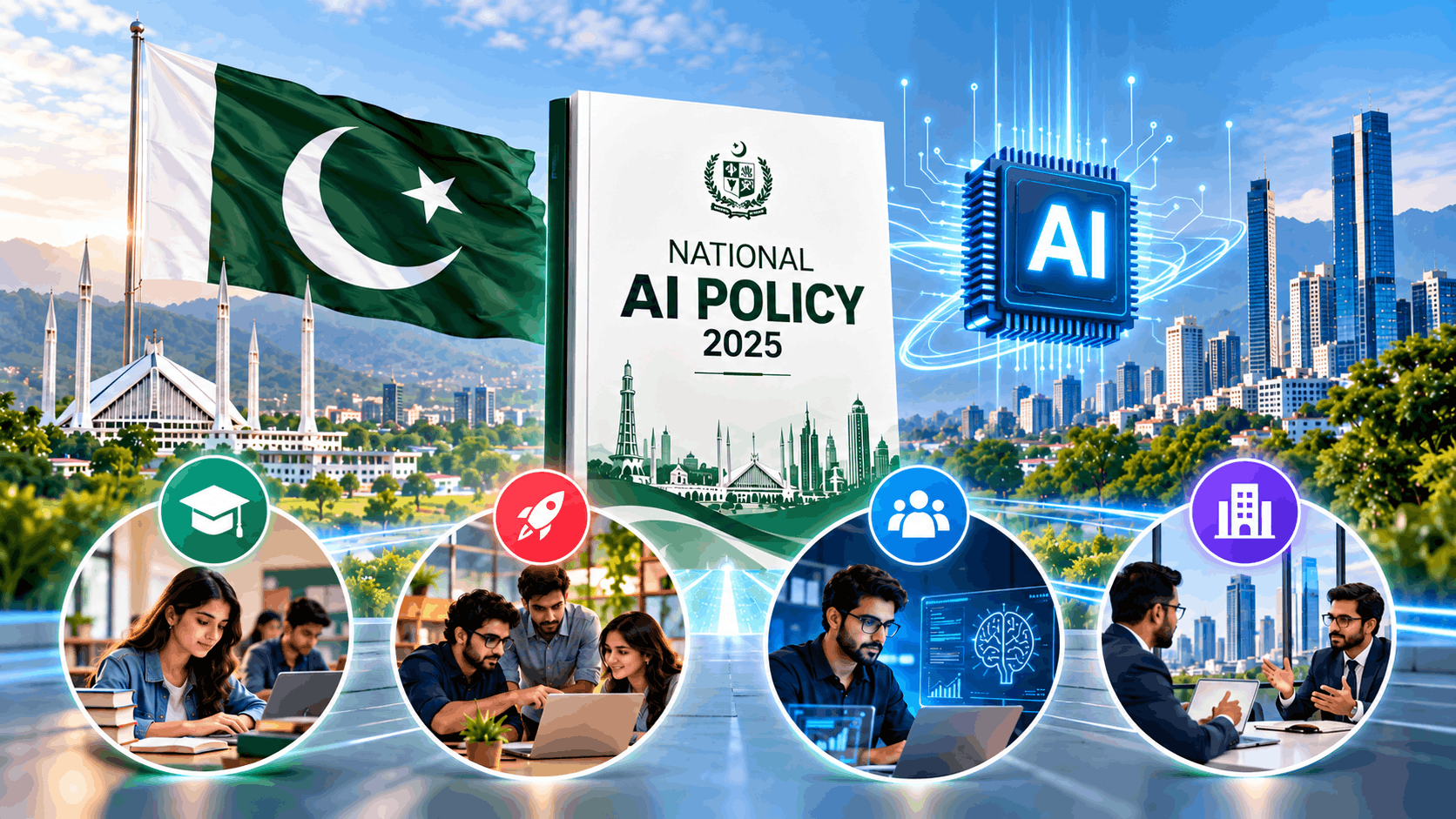
Artificial intelligence is already changing how Pakistanis study, work, build software, run businesses and compete in the global digital economy. In July 2025, Pakistan formally approved its National Artificial Intelligence Policy 2025, creating a national framework for developing AI skills, supporting research and startups, building computing infrastructure and encouraging responsible AI adoption.
The policy is much broader than simply encouraging people to use tools such as ChatGPT. It covers AI education, workforce training, startup funding, research, data and computing infrastructure, responsible AI, cybersecurity, public-sector adoption and international collaboration.
For students and developers, it could create new training and research opportunities. For startups, it proposes funding and incubation mechanisms. For businesses, it encourages AI adoption while also introducing greater emphasis on security, privacy and responsible use.
What Is Pakistan’s National AI Policy 2025?
Pakistan’s National AI Policy is a government roadmap for developing an AI ecosystem rather than a standalone law regulating every AI application.
The Ministry of IT & Telecommunication lists the National Artificial Intelligence Policy as approved on July 31, 2025. The policy is structured around six major areas: AI innovation, awareness and readiness, secure and trustworthy AI, sectoral transformation, AI infrastructure and international partnerships. It also sets targets for training, research, funding and responsible adoption. Ministry of IT and Telecommunication
The important distinction is that a policy sets direction and implementation goals. Individual programs, regulations, funding mechanisms and technical standards still need to be implemented through the relevant institutions.
The Six Main Areas of Pakistan’s AI Policy
The policy can be understood through six broad pillars.
| Pillar | Main Focus |
|---|---|
| AI Innovation Ecosystem | Research, startups, funding and commercialization |
| Awareness & Readiness | AI education, skills and public awareness |
| Secure & Trustworthy AI | Privacy, cybersecurity, ethics and responsible AI |
| Transformation & Evolution | Using AI across important economic and public sectors |
| AI Infrastructure | Computing resources, datasets and AI facilities |
| International Partnerships | Research partnerships, investment and global cooperation |
Together, these areas attempt to address both sides of AI development: creating economic opportunities while establishing safeguards around how the technology is used.
What Does the AI Policy Mean for Students?
Students are one of the groups most directly affected by the policy’s skills agenda.
The framework calls for AI-focused programs in schools, colleges and universities, alongside broader national training initiatives. It also emphasizes moving education beyond rote learning toward analytical and technology-oriented skills.
A major target is training 200,000 people annually in AI and related technologies through national skill-development programs.
That training is intended to include areas beyond basic AI-tool usage. Depending on the programs eventually offered, relevant skills could include machine learning, data science, generative AI, computer vision, natural language processing, AI ethics and related technologies.
For computer science and software engineering students, this could mean AI becoming a more important part of university education rather than remaining an optional specialization.
Scholarships and AI Research
The policy also places significant emphasis on advanced education and research.
It proposes scholarship programs, research support, internships and collaboration between universities and industry.
This matters because using an existing AI model and developing AI technology require very different skill levels.
Pakistan needs software developers who can integrate existing AI APIs, but research-intensive areas also require people who understand mathematics, machine learning, model training, data engineering and computing infrastructure.
The policy therefore attempts to build both practical AI skills and a longer-term research pipeline.
What Does It Mean for Pakistani Developers?
For software developers, AI is increasingly becoming another layer of the technology stack.
A web developer may use an LLM API to build an AI assistant. A Python developer might build a RAG system around company documents. A mobile developer could integrate computer vision, translation or speech recognition into an application.
The policy’s emphasis on training and AI infrastructure could make these skills more accessible.
Developers should therefore consider learning practical technologies such as Python, machine learning fundamentals, LLM APIs, RAG, vector databases, AI agents, model evaluation and responsible AI development alongside conventional software engineering.
The policy does not mean traditional programming becomes unnecessary. AI applications still require databases, APIs, authentication, cloud infrastructure, security, frontend interfaces and reliable software engineering.
What Does the Policy Mean for AI Startups?
The startup side of the policy is particularly significant.
Pakistan’s AI strategy proposes a National AI Fund, along with innovation and venture-support mechanisms intended to encourage research, product development and commercialization.
Centres of Excellence in AI are also envisioned as places where academia, industry, researchers and startups can access expertise, training and infrastructure.
Potential startup opportunities extend well beyond building another general-purpose chatbot.
Pakistani companies could develop AI products for agriculture, healthcare, education, financial services, manufacturing, logistics, cybersecurity, e-commerce, government services and local-language applications.
Local AI Products Could Become More Important
Pakistan currently consumes a large amount of technology developed outside the country.
The AI policy aims to encourage more locally developed AI products.
This does not necessarily mean Pakistan needs to build a competitor to every large global AI model. There are many smaller problems where local companies have an advantage because they understand Pakistani users, businesses, languages and workflows.
For example, a startup could build AI for Urdu document processing, agricultural advisory systems, local customer support, Pakistani legal-document search, manufacturing quality inspection or business automation.
A successful AI ecosystem can therefore include both companies building models and companies building specialized products on top of existing models.
What Does the Policy Mean for Jobs?
AI will create demand for some skills while changing the tasks performed in many existing jobs.
Potential AI-related roles include machine-learning engineers, AI engineers, data scientists, data engineers, MLOps engineers, AI product managers, cybersecurity specialists, AI researchers, automation developers and AI governance professionals.
But the impact is not limited to technology workers.
Accountants, marketers, designers, teachers, engineers, customer-support teams, analysts and managers may increasingly use AI within their existing professions.
This is why the policy’s training agenda includes broader AI literacy rather than focusing exclusively on computer science graduates.
For workers, the practical implication is that learning how to work effectively with AI may become increasingly valuable even when their job title does not contain the word “AI.”
Will AI Replace Jobs in Pakistan?
The policy does not provide a simple prediction that AI will either eliminate jobs or create more jobs overall.
AI can automate individual tasks without necessarily eliminating an entire occupation. At the same time, some roles can face greater disruption when a large percentage of their routine work becomes automatable.
Jobs involving repetitive digital tasks may change more quickly, while roles requiring domain knowledge, accountability, physical interaction, judgment and human relationships can evolve differently.
The policy’s response is primarily focused on reskilling and upskilling, with the aim of preparing workers to use AI rather than assuming existing skills will remain sufficient indefinitely.
What Does the AI Policy Mean for Businesses?
For Pakistani businesses, AI adoption can range from simple productivity tools to deeply integrated automation.
A small company might use AI for customer support, marketing or document processing. A larger organization might deploy AI for fraud detection, demand forecasting, predictive maintenance, cybersecurity or supply-chain optimization.
The policy encourages wider AI adoption across sectors such as education, healthcare, agriculture, manufacturing, energy and public services.
However, businesses also need to consider the risks associated with AI.
Uploading confidential customer information into an external AI service, for example, creates different privacy and security concerns from using AI to generate public marketing copy.
Edge AI runs models directly at the data source rather than relying entirely on cloud processing.
Responsible AI and Data Privacy
The policy does not focus only on innovation. It also emphasizes responsible and trustworthy AI.
Important areas include privacy, cybersecurity, transparency, accountability, fairness and protection against harmful AI use.
The framework envisages governance mechanisms and regulatory sandboxes that can allow AI systems to be tested in controlled environments.
This becomes especially important when AI affects sensitive decisions involving healthcare, finance, employment, government services or personal information.
Businesses adopting AI should therefore start thinking about where their data goes, which models process it, how outputs are verified and whether important decisions retain appropriate human oversight.
AI observability focuses on monitoring AI models after deployment.
Pakistan Needs AI Computing Infrastructure
Modern AI development requires more than skilled programmers.
Training and operating advanced models can require GPUs, high-performance computing, cloud platforms, large datasets and significant electricity.
The policy therefore includes AI infrastructure as a separate pillar, with plans around computing resources, AI hubs, datasets and research access.
This infrastructure could be particularly important for universities and startups that cannot independently afford expensive GPU clusters.
However, the existence of a policy objective does not mean every proposed facility or resource is already available. Actual access will depend on implementation, budgets and individual programs.
What Happens Next?
The National AI Policy provides Pakistan with an official framework, but its practical impact depends on implementation.
Training targets need actual courses and qualified instructors. Startup funds require transparent application and selection processes. Research programs need financing. AI hubs need computing infrastructure. Responsible-AI principles need practical standards that organizations can follow.
Students, developers and businesses should therefore distinguish between policy targets and programs that are already operational.
The policy tells us where Pakistan intends to go with AI; implementation will determine how much of that roadmap becomes available to ordinary students, researchers, startups and companies.
For Pakistan’s technology sector, the immediate practical message is clear: AI skills, AI-enabled products and responsible deployment are becoming part of the country’s formal digital strategy. Students can prepare by developing AI and software skills, startups can look for problems where local knowledge provides an advantage, and businesses can explore AI automation while paying closer attention to security, privacy and reliability.