

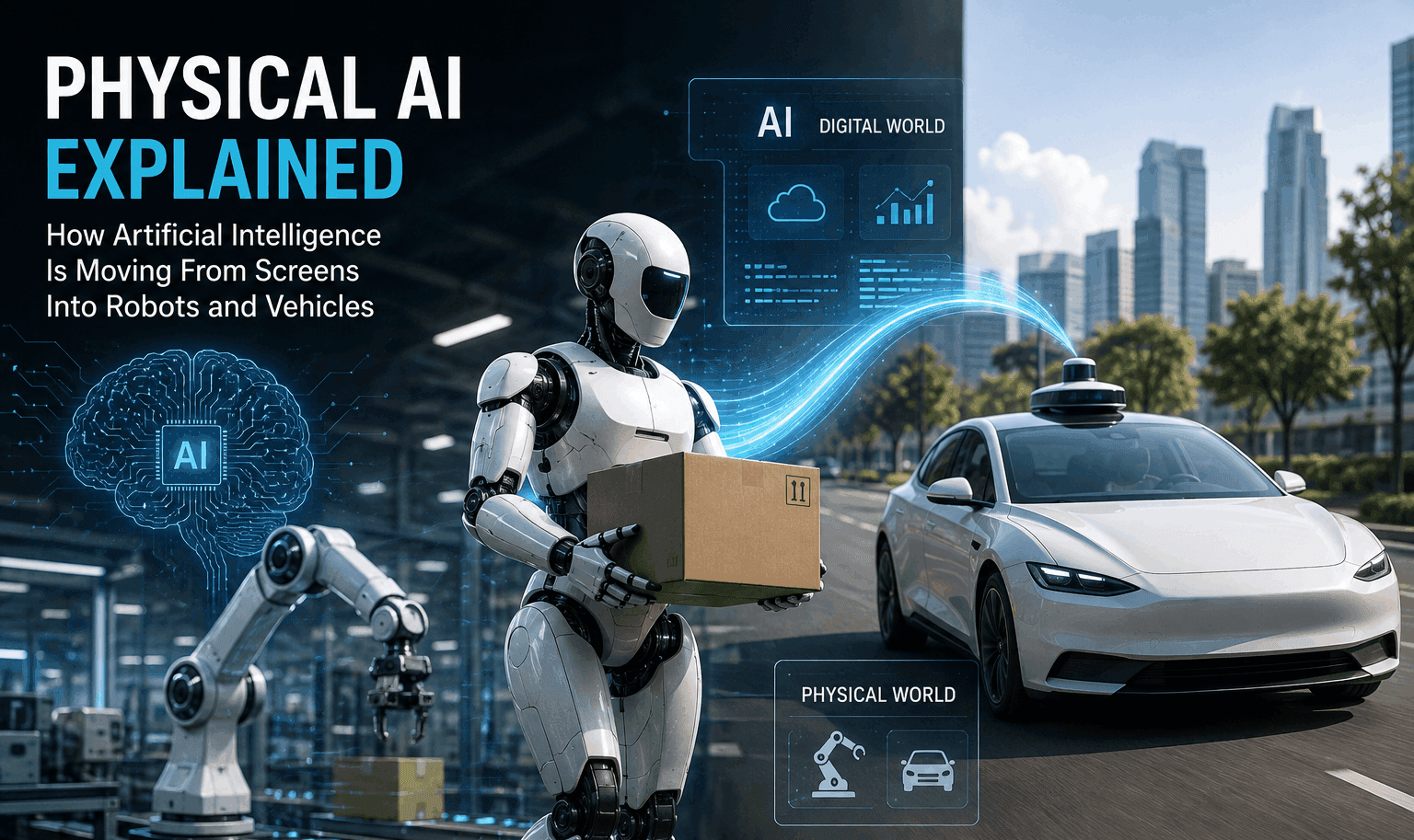
Physical AI Explained: How Artificial Intelligence Is Moving From Screens Into Robots and Vehicles
Artificial intelligence has spent most of its modern history inside computers. It answers questions, analyzes data, generates images, recommends products, writes code, and helps businesses process information. But AI is now moving beyond screens and into machines that can interact directly with the physical world.
This emerging field is known as physical AI. It combines artificial intelligence with robotics, sensors, computer vision, autonomous systems, and real-world decision-making. From warehouse robots and humanoid machines to self-driving vehicles, physical AI is changing how intelligent systems operate.
In this guide, we will explain physical AI in simple terms, including how it works, how it differs from traditional AI, its main applications, the technologies behind it, its benefits, challenges, and future potential.
What Is Physical AI?
Physical AI refers to artificial intelligence systems that can perceive, understand, reason about, and act within the physical world. Unlike traditional AI, which usually produces digital outputs such as text, images, or predictions, physical AI can control machines and influence real-world environments. Examples include warehouse robots that move products, autonomous vehicles that navigate roads, robotic arms that assemble parts, drones that inspect infrastructure, agricultural robots that identify crops, and humanoid robots that interact with objects. NVIDIA describes physical AI as technology that enables autonomous systems such as robots and self-driving vehicles to perceive, understand, reason, and perform complex actions in the physical world. NVIDIA The key difference is simple: traditional AI mainly processes information, while physical AI turns intelligence into physical action.
Physical AI Explained in Simple Terms
Imagine an AI system looking at a photo and answering the question, “Is there a red box on the table?” A normal AI model might recognize the object and reply, “Yes.” A physical AI system could go much further. A robot could look at the table through cameras, identify the red box, estimate its location and orientation, understand an instruction to pick it up, plan how to move its arm, grip the box safely, place it somewhere else, and check whether the task was completed. This ability to move from perception to real-world action is the foundation of physical AI.
Physical AI vs Traditional AI
Traditional artificial intelligence mainly operates in digital environments. It can generate text, classify images, detect fraud, recommend products, translate languages, analyze documents, or predict business outcomes. Physical AI works differently because its decisions can affect real objects. A robot can move, a vehicle can brake, a drone can change direction, and a robotic arm can pick up or place an item. That makes physical AI more complex and more safety-critical. A chatbot producing an incorrect sentence is usually inconvenient. A robot making the wrong movement near a person or machine could create a real physical risk. For this reason, physical AI systems require strong perception, control, testing, reliability, and safety mechanisms.
Physical AI vs Generative AI
Generative AI and physical AI are related, but they are not the same. Generative AI creates digital content such as text, images, audio, video, code, and 3D assets. Physical AI uses artificial intelligence to understand an environment and control a machine within it. The two fields are increasingly being combined. A robot may use a multimodal AI model to understand a spoken instruction, recognize objects visually, and then translate that understanding into physical movement. This means generative AI may become an important intelligence layer inside future robots and autonomous systems.
Physical AI vs Embodied AI
Physical AI is also closely related to embodied AI. Embodied AI generally refers to artificial intelligence that operates through a physical body or agent. That body could be a humanoid robot, robotic arm, warehouse robot, drone, or autonomous vehicle. In practice, physical AI and embodied AI often overlap because both focus on intelligent systems that can understand and interact with the real world.
Why Physical AI Is Growing Now
Robotics has existed for decades, but physical AI is receiving more attention because several technologies are advancing at the same time. These include powerful AI foundation models, computer vision, multimodal AI, improved sensors, faster processors, robotic hardware, reinforcement learning, simulation, synthetic data, digital twins, and edge computing. Traditional industrial robots often perform fixed tasks in highly controlled environments. A robotic arm might repeat the same movement thousands of times with very little variation. Physical AI aims to make machines more adaptable. Instead of following only predefined instructions, robots can increasingly interpret changing conditions and adjust their actions.
How Does Physical AI Work?
Many physical AI systems follow a basic cycle:
Sense → Perceive → Understand → Reason → Plan → Act → Learn
The machine continuously collects information, interprets what is happening, decides what to do, performs an action, and then observes the result.
1. Sensors Collect Information
A physical AI system first needs information about its surroundings. Different machines use different types of sensors. Cameras provide visual information about objects, roads, people, machinery, signs, and obstacles. LiDAR can measure distances and create three-dimensional maps of the environment. Radar can detect objects and estimate their distance and speed. Ultrasonic sensors can identify nearby obstacles. Robotic systems may also use force sensors, touch sensors, GPS, gyroscopes, accelerometers, and other devices to understand position, movement, pressure, and orientation.
2. AI Perceives the Environment
Once sensor data is collected, the AI must interpret it. This is where technologies such as computer vision and machine learning become important. A robot or vehicle may need to recognize humans, cars, tools, boxes, traffic lights, road markings, machinery, pallets, or free space. It must often understand more than just what an object is. It may also need to know where the object is, how far away it is, whether it is moving, how fast it is moving, and how it relates to other objects. This is known as scene understanding.
3. The System Reasons About What to Do
After understanding the environment, the system must make a decision. A warehouse robot may ask which route is safest. A robotic arm may decide how to grasp an irregular object. An autonomous vehicle may decide whether to slow down, stop, or change lanes. The AI evaluates its goal, surroundings, possible risks, and available options before deciding on the next action.
4. The Machine Plans and Acts
The system then converts its decision into a physical movement. A robotic arm may calculate joint positions, movement speed, gripper angle, and gripping force. An autonomous vehicle may calculate its steering angle, braking, acceleration, and path. Motors and actuators then perform the action. At the same time, sensors continue monitoring the environment, creating a continuous feedback loop.
The Physical AI Feedback Loop
The feedback loop is one of the most important parts of physical AI. Imagine a robot trying to pick up a bottle. It identifies the bottle, moves its hand, detects contact, measures gripping force, lifts the bottle, checks whether it is slipping, and adjusts its grip if necessary. This constant process of sensing, acting, and correcting allows physical AI systems to operate in unpredictable environments.
Physical AI in Robotics
Robotics is one of the biggest applications of physical AI. Traditional robots are often designed for highly structured tasks. They may work in fixed positions and follow predefined movements. Physical AI can make robots more flexible and capable of adapting to changing environments. In manufacturing, AI-powered robots may handle assembly, welding, inspection, packaging, and material movement. This is closely connected to the broader use of industrial AI, which combines AI, robotics, sensors, and industrial data to improve manufacturing and engineering operations. In warehouses, autonomous robots may move products, shelves, tools, and workstations are designed around human size and movement, which means humanoid robots could potentially operate in existing environments without major redesigns.
Google DeepMind and Physical AI
Major AI companies are also developing models specifically for robotics. Google DeepMind introduced Gemini Robotics models designed to help robots understand, act, and react in the physical world. The company has highlighted embodied reasoning as an important capability for machines that need to understand environments and take actions safely. Google DeepMind This shows how AI foundation models are beginning to move beyond understanding text and images toward controlling physical machines.
Physical AI in Autonomous Vehicles
Autonomous vehicles are another major example of physical AI. Driving requires a vehicle to understand many things at once. It must detect lanes, pedestrians, vehicles, cyclists, road signs, traffic lights, and obstacles. It must also estimate movement, predict what other road users may do, and make safe decisions. A simplified autonomous driving process looks like this: sensors observe the environment, AI recognizes important objects, the system predicts movement, a safe path is planned, and the vehicle adjusts steering, acceleration, and braking. The entire process repeats continuously as road conditions change. This growing intelligence is also closely connected to the rise of software-defined vehicles, where software increasingly controls and upgrades core vehicle functions.
Why Simulation Is Important
Training physical AI systems entirely in the real world would be expensive, slow, and sometimes dangerous. Simulation allows developers to create virtual environments where robots and vehicles can practice tasks safely. These environments may include factories, warehouses, roads, homes, weather conditions, people, machines, and obstacles. AI systems can perform thousands or millions of virtual training attempts before being deployed in the real world.
What Is Sim-to-Real Learning?
Sim-to-real learning involves training a system in simulation and then transferring what it has learned to a real machine. For example, a robot could practice grasping thousands of virtual objects before attempting similar tasks with physical objects. Because simulations are never exactly the same as reality, developers often vary lighting, textures, object positions, friction, camera angles, and environmental conditions. This helps the AI become more adaptable when it moves into the real world.
Digital Twins and Physical AI
A digital twin is a virtual representation of a physical object, machine, building, factory, or environment. A company could create a digital version of a warehouse containing shelves, machinery, robots, conveyor systems, and workstations. Engineers could test how robots behave in the virtual environment before deploying them physically. Digital twins can help improve safety, efficiency, planning, and system design.
Reinforcement Learning
Reinforcement learning is also important for physical AI. Instead of learning only from examples, an AI agent can improve by taking actions and receiving feedback. A simulated robot learning to walk may receive positive feedback when it moves forward and stays balanced, while receiving negative feedback when it falls or collides with an object.
Vision-Language-Action Models
One of the most important developments in robotics is the rise of vision-language-action models, often called VLA models. These models combine visual understanding, language comprehension, and physical action. A person might tell a robot, “Pick up the green cup beside the laptop.” The robot must understand the instruction, identify the cup, locate it, calculate how to grasp it, and then perform the movement. This could make robots easier to control because people may increasingly use natural language instead of programming every movement manually.
Major Physical AI Applications
Physical AI has potential across many industries. In manufacturing, it can support assembly, quality control, welding, packaging, and material handling. In warehouses, robots can move inventory, sort packages, and transport goods. In agriculture, physical AI could help with crop monitoring, weed detection, fruit picking, precision spraying, and autonomous harvesting. In healthcare, possible applications include surgical robots, rehabilitation systems, hospital delivery robots, and laboratory automation. Construction companies may use autonomous machinery, inspection robots, and robotic surveying systems. Infrastructure operators may use drones and robots to inspect bridges, pipelines, railways, power lines, and industrial equipment. Physical AI may also play a growing role in retail, transportation, logistics, and home robotics.
What Makes Physical AI Difficult?
Physical AI is challenging because the real world is unpredictable. A robot may encounter unfamiliar objects, changing lighting, people, clutter, unexpected movement, or unusual conditions. It must also understand three-dimensional space, distance, balance, motion, and physical forces. Physics matters as well. Objects can slip, break, roll, spill, bend, or fall. A machine interacting with the real world must account for these possibilities. Another challenge is that mistakes can have physical consequences. A robot cannot always undo a bad movement, so safety is critical. Real-world training data is also expensive because it requires hardware, sensors, engineers, maintenance, and time.
The Importance of Edge AI
Physical AI systems often need to make decisions very quickly. A robot detecting a person in its path should not always depend on a distant cloud server before deciding to stop. For this reason, much of the processing may happen directly on the machine. This is known as edge AI. Edge computing can provide lower latency, faster responses, greater reliability, and less dependence on internet connections. Cloud systems may still be used for training models, fleet management, and large-scale data analysis.
Is Physical AI the Same as Robotics?
No. Robotics is the broader field of designing, building, and operating robots. Not every robot uses advanced AI. Some robots simply follow fixed instructions. Physical AI adds capabilities such as perception, learning, reasoning, adaptation, environmental understanding, and autonomous decision-making. In this sense, physical AI can be viewed as an intelligent layer within modern robotics.
Physical AI Safety and Security
Safety is one of the most important issues in physical AI. Systems operating near people may use collision detection, emergency stop systems, restricted zones, speed limits, redundant sensors, fail-safe behavior, continuous diagnostics, and human supervision. Cybersecurity is also important. If a connected robot or autonomous machine is compromised, an attacker could potentially affect real-world behavior. Companies must therefore protect robot control systems, sensor data, software updates, networks, authentication systems, and cloud infrastructure. Privacy also matters because many physical AI systems rely on cameras and sensors that may capture information about people or environments.
Will Physical AI Replace Human Workers?
Physical AI will likely automate some physical tasks, especially work that is repetitive, dangerous, physically demanding, or highly structured. However, many jobs require judgment, communication, creativity, dexterity, social interaction, responsibility, and the ability to handle unusual situations. In many workplaces, physical AI may work alongside people rather than completely replacing them. Robots could handle heavy lifting or repetitive movement, while humans focus on supervision, maintenance, problem-solving, planning, and quality control. Physical AI may also create new jobs in robotics engineering, AI engineering, simulation, maintenance, cybersecurity, safety, fleet management, and human-robot interaction.
The Future of Physical AI
Physical AI is still developing, but several trends are likely to shape its future. Robots may become more general-purpose instead of being designed for only one task. Natural language control could make robots easier to use. Simulation and digital twins may allow machines to train more efficiently. Vision-language-action models could improve how robots understand instructions and environments. Autonomous vehicles may continue improving perception, prediction, planning, and safety. Robotic hands may become better at manipulating unfamiliar objects. Edge AI may also make machines faster and more independent. The biggest long-term change may be the movement of AI from software into the physical economy.