

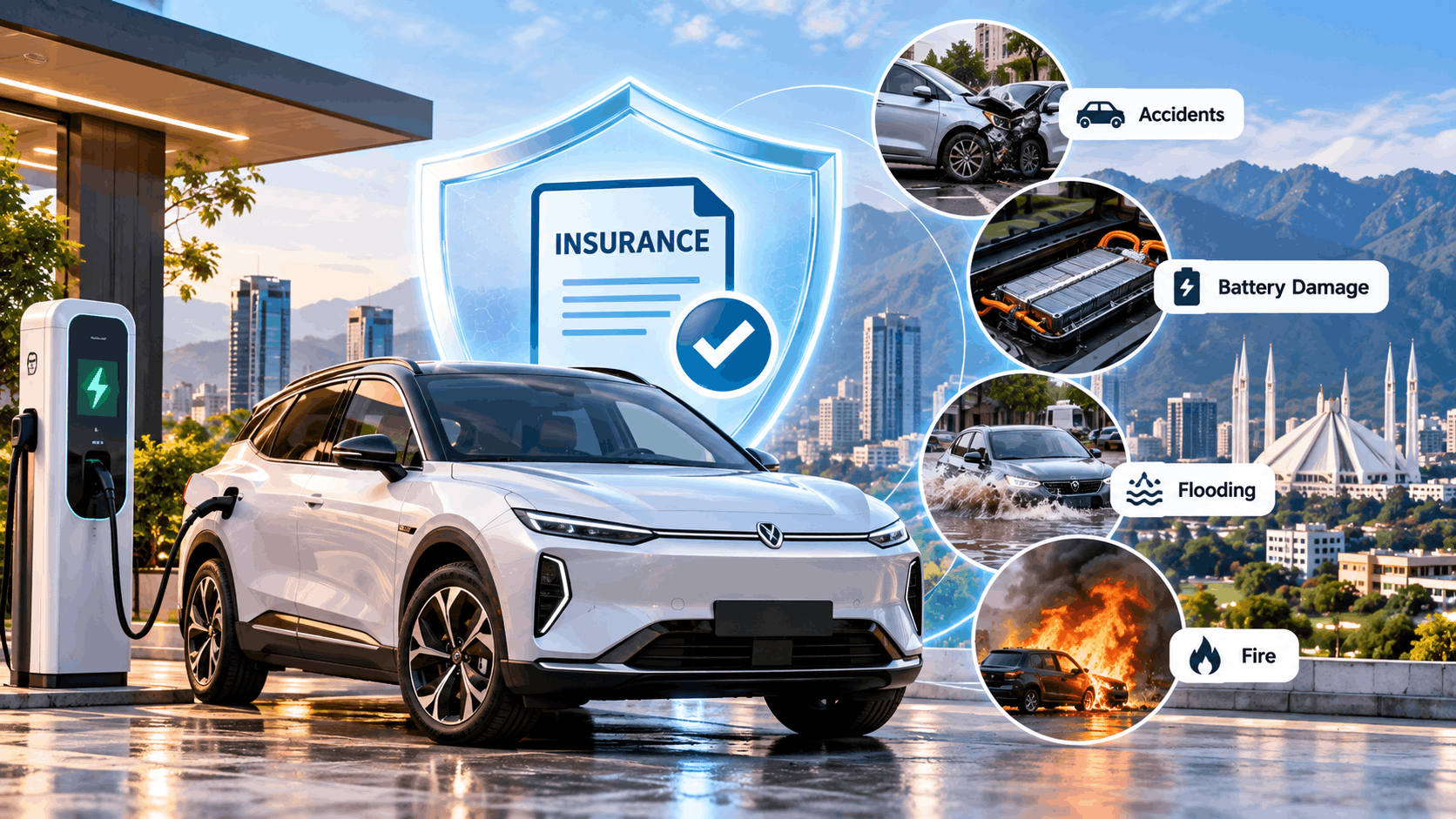
Electric vehicles are becoming more common in Pakistan, but insuring an EV is slightly different from insuring a conventional petrol or diesel car. The basic risks—accidents, theft, fire and natural disasters—are familiar, but an EV introduces expensive components such as the traction battery, electric motors, power electronics and charging system.
For EV owners, the most important question is therefore not simply, “Is my car insured?” It is exactly what happens if the battery is damaged in an accident, exposed to floodwater or develops an electrical problem.
A comprehensive motor policy may provide substantial protection, but battery coverage should never be assumed. Policy wording, exclusions, depreciation, deductibles and the cause of damage can determine whether a claim is accepted and how much the insurer pays.
Is EV Insurance Available in Pakistan?
Yes. Electric cars can be insured in Pakistan, although insurers may assess the vehicle differently depending on its make, model, value, availability of parts and repair network.
EV insurance does not necessarily require an entirely separate type of motor policy. Comprehensive motor insurance can cover many of the same risks as it does for conventional cars, including accidental damage, theft, fire and certain natural events.
The difference is that EV owners need to pay particular attention to how expensive electrical components are treated.
TPL Insurance’s current guidance for electric-car owners similarly advises customers to check how a policy treats the battery and other major EV components instead of assuming they are automatically covered. TPL Insurance’s EV insurance guide
Why the EV Battery Matters So Much
The traction battery is usually the most expensive individual component in an electric vehicle.
Unlike the small 12V battery found in conventional cars, an EV traction battery can contain hundreds or thousands of individual cells combined into modules and a large battery pack underneath the vehicle.
A serious accident can damage the battery enclosure, modules, cooling system, high-voltage connectors or battery-management electronics.
This creates a potentially expensive insurance claim even when the visible body damage does not initially appear severe.
The important distinction is between battery damage caused by an insured event and a battery that simply deteriorates or fails.
Is EV Battery Damage Covered by Insurance?
This is where EV owners should read the policy carefully.
Suppose another vehicle hits your EV and the collision physically damages the battery pack. If accidental damage to the vehicle is covered, the battery may potentially form part of that accident claim, subject to the policy’s conditions.
Now consider a different situation: after several years, the battery gradually loses capacity and its driving range decreases.
That is normally an ageing, degradation or warranty issue rather than accidental insurance damage.
A third scenario is an internal electrical or mechanical failure without an accident. Standard motor insurance can contain exclusions for mechanical or electrical breakdown, meaning the insurer may treat this differently from collision damage.
Before purchasing EV insurance, get a clear answer to this question:
“If the high-voltage traction battery is damaged by an accident, flood or fire, how will my policy settle the claim?”
Ideally, obtain the answer in the policy wording or written endorsement rather than relying only on a verbal explanation.
What About Battery Degradation?
Battery degradation should not be confused with battery damage.
All lithium-ion batteries gradually lose usable capacity. An EV that originally provided 400 km of range might provide somewhat less after years of driving and charging.
Insurance generally exists to protect against defined unexpected losses rather than normal ageing.
Therefore, normal capacity degradation, wear and tear or reduced State of Health should generally be considered a manufacturer warranty and maintenance issue, not something owners should automatically expect comprehensive motor insurance to pay for.
Battery warranties are consequently important even when the vehicle itself is insured.
EV Accidents Can Be More Complicated
The body of an EV can often be repaired similarly to a conventional vehicle, but damage near the battery requires additional inspection.
Many modern EV batteries are mounted underneath the passenger compartment. A collision with another vehicle, a large object or a severe impact underneath the car can potentially affect the battery enclosure.
Even if the car continues driving normally, a damaged enclosure or high-voltage component should be professionally inspected.
This is especially important with modern EVs using structural or highly integrated battery packs, where battery and vehicle-body repairs can become closely connected.
For insurance purposes, owners should confirm whether repairs can be performed at an authorized EV workshop and whether the insurer will approve manufacturer-recommended battery diagnostics after an accident.
Does EV Insurance Cover Flood Damage?
Flood coverage is particularly important in Pakistan because vehicles can be exposed to urban flooding and standing water during heavy rainfall.
Comprehensive motor policies can include flood and other natural-event coverage, but EV owners need to check how that protection applies specifically to the high-voltage battery and electrical system.
There is also a major difference between a vehicle being damaged by a covered flood event and damage occurring because the owner knowingly drove through unsafe water or continued operating an already damaged vehicle.
If an EV has been deeply submerged or you suspect water has reached the high-voltage system, do not attempt to charge or restart it merely to see whether it still works. Contact the insurer and the manufacturer’s authorized service network and arrange appropriate recovery.
The insurer may need evidence showing what happened before repairs begin.
What About Rain and Normal Water Exposure?
EVs are designed for ordinary rain, wet roads and routine washing. A properly functioning EV does not require an insurance claim simply because it was driven in rain.
Flooding is different.
Deep water, prolonged submersion, damaged seals or impact damage can expose electrical systems to conditions far beyond ordinary road use.
For an insurance claim, the cause of the damage can therefore be as important as the damaged component itself.
Comprehensive vs Third-Party Insurance for an EV
The difference becomes particularly important with an expensive electric car.
| Cover | Third-Party | Comprehensive |
|---|---|---|
| Damage to another person’s vehicle/property | Usually covered | Usually covered |
| Damage to your own EV after an accident | No | Subject to policy |
| Theft of your EV | No | Can be covered |
| Fire | No | Can be covered |
| Flood/natural events | No | Can be covered |
| Battery damage from covered accident | No | Check policy wording |
| Battery degradation | No | Generally not insurance damage |
| Mechanical/electrical failure | No | Often subject to exclusions |
The exact coverage always depends on the insurer and policy wording, so this table should be treated as a general guide rather than a guarantee of claim acceptance.
Imported EVs Need Extra Attention
Pakistan’s EV market contains both officially supported vehicles and imported models.
Insurance can become more complicated for an imported EV if replacement body panels, battery modules, electronic control units or other components are difficult to source locally.
Before insuring a grey-import EV, ask whether the insurer is willing to cover the declared value and where repairs would be performed.
Also check how the insurer determines replacement-part prices if components have to be imported.
A cheaper premium is not particularly useful if a major claim becomes difficult to repair because the required parts or approved technical expertise are unavailable.
What About the Home EV Charger?
Do not automatically assume that insurance on the car also covers your wall-mounted home charger.
The charger is normally installed at a property rather than forming a permanent part of the vehicle. Damage caused by an electrical surge, fire, flooding or another event may therefore fall under different insurance arrangements.
If you have an expensive 7 kW, 11 kW or higher-power home charging installation, ask whether it needs separate property or equipment coverage.
The same principle applies to charging cables and portable EV chargers: confirm whether they are considered insured vehicle accessories.
Depreciation Can Affect an EV Claim
Another issue is depreciation.
Suppose an older EV’s damaged component costs significantly more to replace than its depreciated value. Depending on the policy, the insurer may apply depreciation or other settlement conditions instead of automatically paying the complete cost of a brand-new replacement.
This becomes particularly important with expensive battery packs.
Ask whether depreciation applies to the traction battery, electronic components and replacement parts, and whether different depreciation rules apply based on the vehicle’s age.
What Happens if the EV Is a Total Loss?
A severe accident or flood can create a situation where repairing the vehicle is economically unreasonable compared with its insured value.
For EVs, a heavily damaged battery can contribute significantly to repair costs.
Owners should therefore understand the insured declared value, total-loss threshold and settlement method before purchasing the policy.
This is particularly important when EV prices are changing quickly. A vehicle’s market value can move significantly after price reductions, new models or changes in the used-EV market.
What EV Owners Should Check Before Buying Insurance
Before paying the premium, compare more than the headline price. Check traction-battery accident coverage, flood and water damage, fire, theft, electrical/mechanical breakdown exclusions, depreciation, deductible/excess, total-loss calculation, authorized EV workshops, replacement-part rules, charging equipment, roadside recovery and claim procedures.
Also tell the insurer the exact make, model, variant and value of the vehicle.
If the EV is imported, make that clear as well.
Most importantly, ask for clarification in writing whenever battery coverage is unclear. A slightly cheaper policy can become considerably more expensive for the owner if the most valuable component of the vehicle is inadequately protected.
Is EV Insurance Worth Considering in Pakistan?
For a high-value EV, comprehensive insurance can protect against financial risks that could otherwise be expensive to absorb personally.
The key is not simply finding “EV insurance.” It is finding a policy whose wording makes sense for an electric vehicle.
Two policies with similar premiums can potentially treat battery damage, depreciation, flooding, replacement parts and deductibles differently.
For Pakistani EV owners, battery coverage should be one of the first questions asked rather than something discovered after an accident.
As Pakistan’s EV market grows, insurers and repair networks are likely to gain more experience with high-voltage batteries and EV-specific claims. Until then, owners should carefully review the policy, understand its exclusions and confirm how the insurer would handle the scenarios that are most expensive for an electric vehicle.